Keyword cannibalization: why fewer WordPress pages often rank better
Two of your pages compete for the same search, and both lose. Here is how to spot page dilution on your WordPress site and fix it by consolidating.
A few months ago I ran a search for one of my own topics and found two of my own pages sitting next to each other in the results, both a little lower than either of them deserved. They were fighting each other. Google could not tell which one was the real answer, so it hedged, and I lost ranking on both. I built that problem myself, one well-meaning page at a time.
This is page dilution, and its close cousin is keyword cannibalization. If your WordPress site has been running for a few years and you've added content the way a growing site does, by writing something new whenever a topic comes up, you may have some of this. The good news is that the fix is a smaller site, and smaller is easier to run.
The short version:
- When several of your own pages chase the same topic, they split the ranking signal and no single one gets strong enough to rank.
- Keyword cannibalization is the sharp version: two pages fight over the one slot Google gives your domain, so you compete against yourself.
- Tags and categories quietly make it worse, because every one of them spins up its own thin archive page.
- The fix is subtraction: fold the cluster into one strong page, redirect the rest to it, and repoint your internal links.
Two of your own pages, quietly costing you ranking
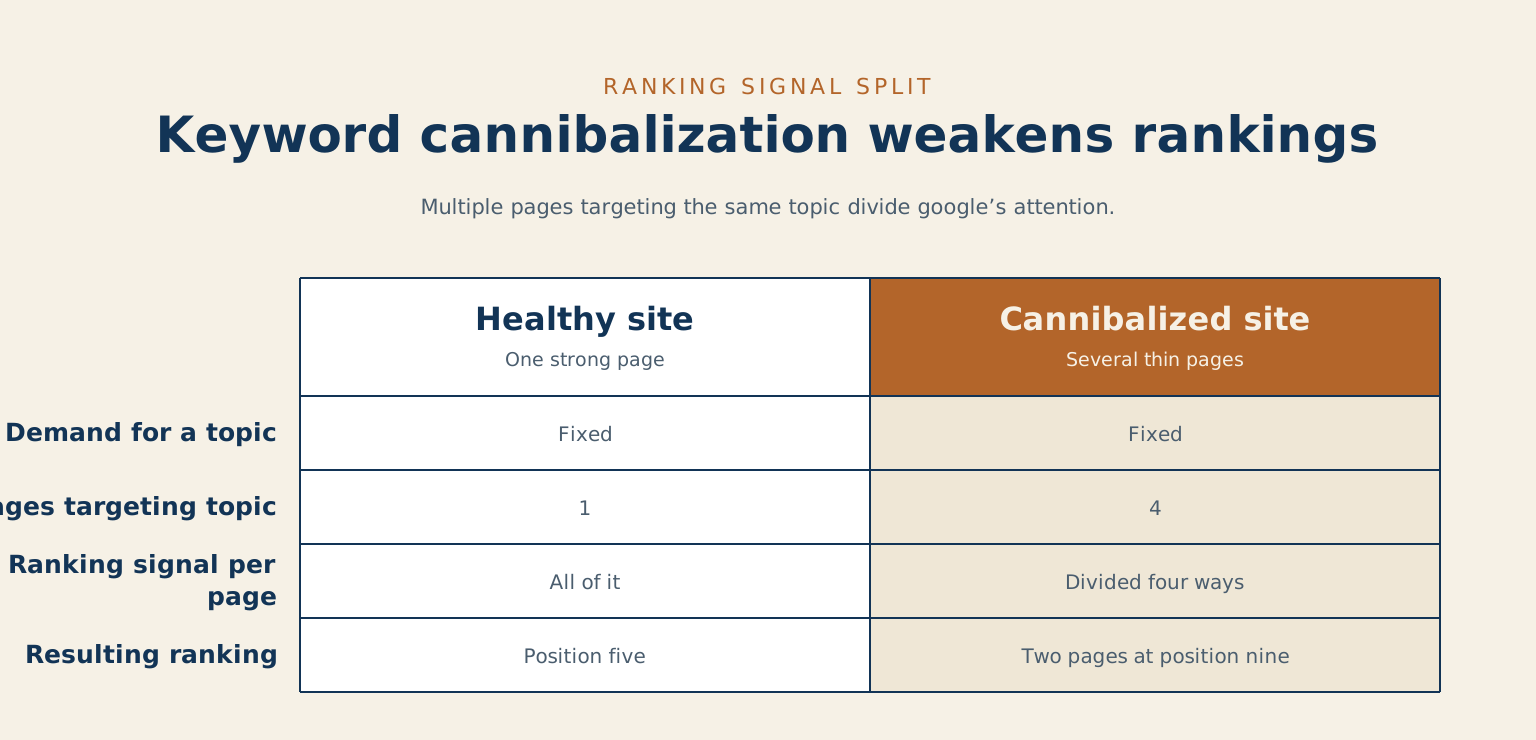
That fight costs you real ranking, and the mechanism is simple. The demand for a topic is fixed, and Google will only hand your domain so much room for it. When you spread that topic across several thin pages, no single page is strong enough to rank, because the signal that would make one page authoritative gets divided among all of them.
Every page that targets a topic collects signals, such as the links pointing at it and the other pages on your own site that link to it. Those signals are what tell a search engine "this page is the authority on this thing." When you have one strong page, all of that pools in one place. When you have four near-duplicate pages, the pool splits four ways. None of them gets deep enough.
Google's own guidance on duplicate URLs says it helps to consolidate the signals for the individual URLs, such as links to them, into a single preferred URL.
Bidding against yourself
Keyword cannibalization is the sharper version of the same problem. Two of your pages target the same search phrase, so they compete against each other for the one slot Google is willing to give your domain. Instead of one page at position five, you get two pages taking turns at position nine. You are bidding against yourself.
Instead of one page at position five, you get two pages taking turns at position nine.
- Page dilution: What is happening: Several of your pages chase the same topic and split the ranking signal between them; What you see in the results: A cluster of thin pages, none of them ranking as well as one strong page would
- Keyword cannibalization: What is happening: Two pages target the same search phrase and compete for the room Google gives your domain; What you see in the results: Two pages taking turns at position nine instead of one page at position five
- Duplicate content: What is happening: The same text sits on two URLs; What you see in the results: The same words showing up at two of your own addresses
Three problems people lump together. The two on top are about competing pages; only the last one is about copied text.
Where the competition comes from
The cause surprises people. It is good intentions, where you might expect bad writing. You wrote a helpful post, then six months later you wrote another helpful post on almost the same thing, and you never went back to reconcile them. Multiply that across a few years and you have a site that quietly competes with itself.
How I found it on my own site
I audited thisismyurl.com for exactly this, and the tags were where the damage showed up first. WordPress makes it very easy to add a new tag, and I had taken it up on the offer. I was sitting on 129 post tags, and a lot of them were near-duplicates: one tag for a topic, plus a second tag for almost the same topic sitting right beside it.
The problem is that every tag generates its own archive page, and every one of those archive pages is a URL that Google can index. WordPress's template hierarchy includes a template for tag archives. So a handful of near-duplicate tags becomes a handful of near-duplicate archive pages, all of them thin and all of them splitting the ranking signal for the same subject. My tags were not organizing my content. They were shredding it into pieces too small to rank.
I cut the tags from 129 down to 18. Before deleting anything, I moved each duplicate onto the one term I was keeping, so no post lost its classification and no useful grouping disappeared. The site got simpler, the archive pages that survived got stronger, and I stopped competing with myself in the one place I had the most control.
How to spot dilution on your own site
Finding the worst of it takes no fancy tool. You need to look at your site the way a search engine does, which means counting the URLs that actually exist and judging each one on its own. This is the same trap I wrote about in website over-optimization: adding more feels like progress, and on an established site it can be the thing quietly working against you.
Search your own domain first. In Google, type site:yourdomain.com your topic and see how many of your own pages come back for a phrase you care about. If three or four of them look like they are all trying to answer the same question, that is your cluster, and that is the fight you have been losing.
Read the report that already exists. If you have Google Search Console connected, open the performance report and look at one query. If several different pages on your site are picking up impressions for the same query, none of them clearly, you are watching cannibalization happen in real time. This is the most honest evidence there is, because it is Google telling you it cannot decide.
Audit your archive pages as well as your posts. This is the one that's easy to miss, and it is the one that got me. Your tags, categories, and other groupings each spin up their own pages. Count them. If you have more archive pages than you have real topics, you have a dilution machine running in the background.
The fix: fold the cluster into one page
My operating rule now is simple. When demand exists for a topic, my goal is a single strong page that owns it outright. When I catch myself about to write a fifth near-duplicate, I go strengthen the page that already exists instead.
The pattern I use when I come across a cluster of competing URLs looks like this.
- Identify the cluster. Group every page and archive that is targeting the same search intent. Be honest about it. "Almost the same" belongs in the cluster.
- Pick the survivor. Choose the single strongest page to be canonical. Look first at the page with the most links. This page is the one everything else will fold into.
- Merge the useful content. Pull anything genuinely worth keeping from the weaker pages into the survivor, so the reader who lands there gets the complete answer and nothing valuable is lost.
- Redirect the rest. Set up a 301 redirect from each retired URL to the survivor. This is the step that actually pools the signal. The links and authority that pointed at the old pages now flow to the one page you kept.
- Fix your internal links. Go through your own site and point every internal link that used to reference a retired page at the survivor instead. Your internal links are a vote, and you want every vote landing on the same page.
Your internal links are a vote, and you want every vote landing on the same page.
Redirect and links, or neither
The 301 and the internal-link cleanup are the steps people skip, and they are the two that matter most. A redirect without the internal-link fix leaves your own site pointing at ghosts. The internal-link fix without the redirect strands the authority you already earned. Do both, or you have moved the mess rather than cleared it. Google's link guidance says anchor text "tells people and Google something about the page you're linking to," so write the new internal links with the survivor's topic in the words. That redirect-and-consolidation work is the core of what I do in a technical SEO engagement, if you would rather hand it off.
Why fewer pages is the stronger play
The instinct, when a topic sits low in the results, is to write another page about it. I understand the instinct, because I had it for years. But a new page may not help a topic you are already diluting. It just gives the same fixed demand one more thin page to spread itself across.
So the next time you sit down to write about something your site already covers, open the existing page first, before you start a new one. Ask yourself one question: am I about to strengthen this page or split it? If the page you already have covers the topic, it is the one worth your afternoon. Make that page stronger and let it own the topic.
What is the oldest topic on your site that you have written about more than once?
Common questions about keyword cannibalization
Is this the same as duplicate content? They are cousins, and the difference matters. Duplicate content is the same text sitting on two URLs. Cannibalization is two different pages chasing the same search phrase, so they compete for that one slot even when the writing is completely different.
Will deleting the extra pages cost me traffic? Redirect them and it should not. A 301 from each retired URL to the survivor carries the links and authority along, so the traffic pools on the page you kept instead of disappearing.
How do I decide which page to keep? Pick the one with the most links pointing at it and the strongest content, then fold the useful parts of the others into it. If you would rather not make that call yourself, sorting out which pages compete is part of what a site audit is for, and you can always tell me what you are seeing first.
References
Checked against Consolidate duplicate URLs, Redirects and Google Search, Link best practices and the Performance report, on 2026-10-11.