Process
How I work
I start every engagement with a written audit and end it with a written handoff. Between them: a fixed scope, a fixed price paid in phases, and me, named, accountable, doing the work end to end. No re-assignment to juniors after the contract signs, no open-ended retainer that quietly grows. A clear problem, a defined fix, a date the work is done.
This page describes the cadence, the deliverables, the trade-offs, and who is accountable. It is shorter than a typical agency proposal because the practice is small on purpose.
What the method is for
All of it serves one goal: a system you can understand, audit, and maintain, one that will outlast whoever built it, including me. You should be able to read how it works and prove what it does and what it costs, so you can keep it running without heroics long after the build is done. Every phase below answers to one of those four words. So when another page here points back to “the method,” that is the method it means.
Discovery (week 1–2)
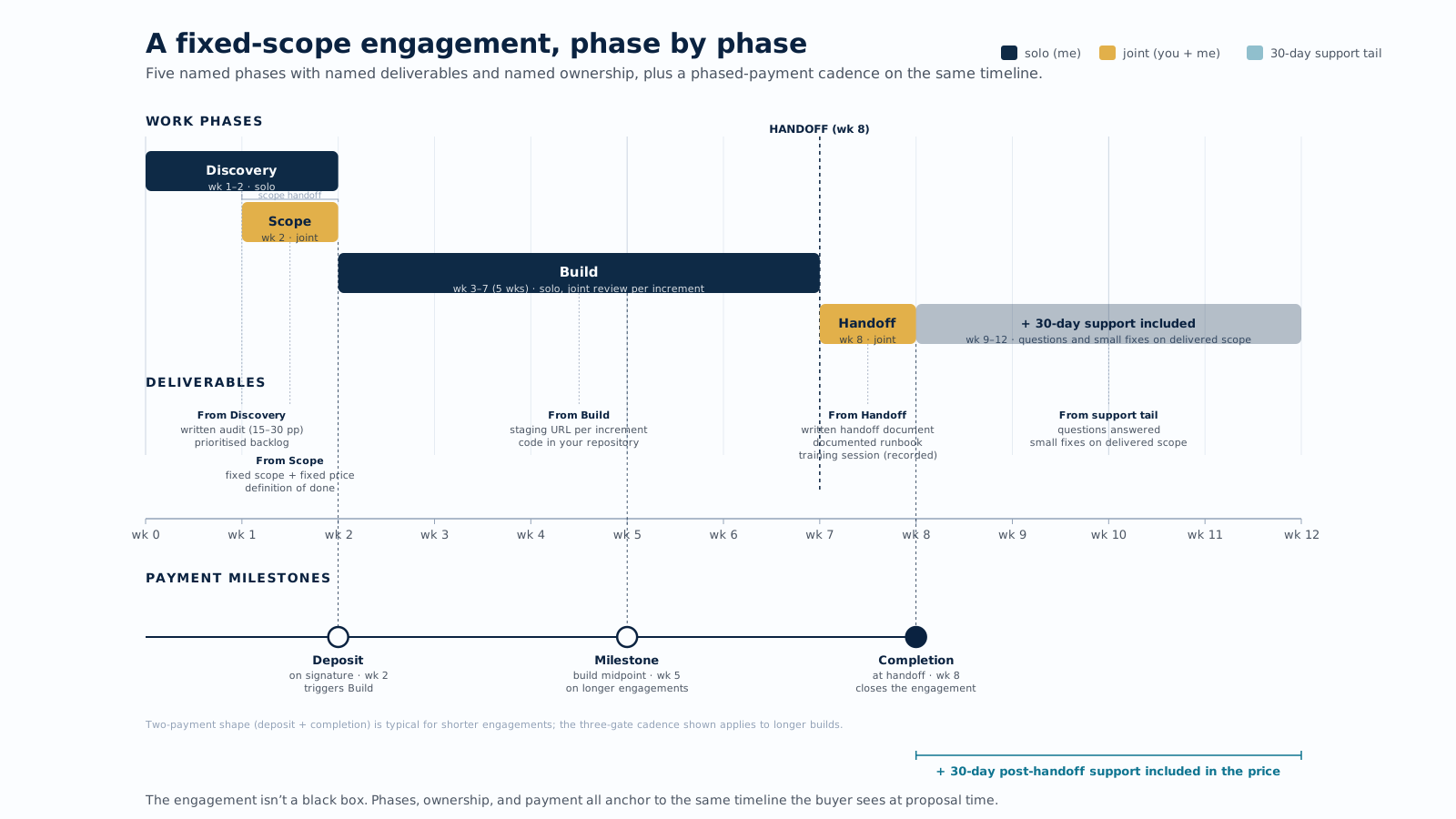 Two synchronised tracks on a shared week-by-week timeline from week zero through week twelve. The top track shows five named work phases stacked top to bottom: Discovery at weeks one to two (solo, navy); Scope at week two (joint, gold) overlapping Discovery; Build at weeks three to seven (solo, navy); Handoff at week eight (joint, gold); and a translucent thirty-day support tail at weeks nine to twelve. Below each bar, named deliverables drop as labelled callouts. The bottom track is a payment-milestone axis with three circular markers aligned to the same weeks: Deposit on signature at week two, Milestone at build midpoint at week five, Completion at handoff at week eight. Vertical hairlines connect each payment marker to its triggering phase. Ownership is encoded by colour: navy for solo, gold for joint.
The existing site, traffic, search visibility, and conversion path are reviewed in detail. The output is a written audit: what is blocking results, what is working, and which fixes would compound the most, not a dashboard screenshot. The audit is yours to keep regardless of whether you continue.
Scope (week 2)
From the audit, a fixed scope, fixed price, and a clear definition of done are agreed in writing. Work is delivered in fixed-fee phases rather than open-ended retainers, so the cost is predictable and the work has a finish line. Out-of-scope requests are tracked separately and quoted on their own merits.
Why fixed scope, not retainer
This is one of the positions I've taken on how I work: fixed price exists because buyers deserve to know what the work costs before they commit.
Open-ended retainers reward agencies for staying busy, not for finishing. Fixed-scope phases reward the opposite: a clear problem, a defined fix, a price that does not creep, and a date the work is done. That model is harder to sell, because there is no comfortable monthly number, but it is the right model for a senior practitioner doing the work directly.
When the work is genuinely ongoing
Some work really is continuous, and pretending otherwise would be its own kind of dishonesty. The philosophy still holds (rewards finishing, not staying busy) but the shape changes. There are two recurring vehicles, and both keep the bill predictable rather than open-ended.
Reserved capacity blocks
Committed monthly hours, reserved against the calendar rather than pooled and prayed. Blocks come in 10, 20, or 40 hours per month, at a 10–15% discount off the headline rate, with the discount scaling to block size. Unused hours expire at the end of the month: no rollover, no bank-it-for-later that quietly becomes a year of unbilled work. Sixty days notice on either side to terminate. Suited to teams that need a senior on tap for code review, architecture calls, or production support without waiting for a fresh statement of work each time.
Care plans for sites I built
A flat monthly fee covering uptime monitoring, security patching, plugin and core updates, a monthly performance check, and a defined quarterly review of the site against current best practice. The maintenance budget calculator gives you a number to hold any quote against, mine included. Available only on builds I delivered, and only within twenty-four months of launch. Outside that window the site has drifted enough that an audit is the honest starting point. Anything outside the care-plan surface (new features, content sprints, redesigns) bills separately at the headline rate.
Build (week 3 onward)
Implementation happens in short, reviewable increments. You see progress as it ships. Code goes through a staging environment before production. Performance, accessibility, and SEO are checked before each release using the same standards documented in the accessibility statement and the editorial standards, not as an afterthought when something breaks.
Three positions govern what gets built: accessibility is a precondition, not a phase; every plugin is a roommate I pick carefully; and if AI touches your project, I disclose every use of it before it ships.
Handoff and capability (final week)
Every engagement ends with a written handoff: what was changed, what to monitor, and what to do next. If your team will maintain the work, training is included so they can. The work is built to be left: boring, durable, and maintainable on purpose, with reasoning visible in the documentation rather than locked in someone's head. The aim is to leave you more capable than you started, not more dependent on a vendor.
Two more positions sit in this phase: teaching you how I built it is part of the build, not a line item, and the next developer who opens the code is in a teaching moment too, so it is written to be read.
What you receive
Concrete deliverables, not just hours billed. Every engagement produces some or all of the following, depending on scope:
- A written audit, typically 15 to 30 pages, with findings, evidence, and a prioritized backlog with effort estimates. Yours to keep regardless of whether the engagement continues.
- A staging URL for every reviewable increment, with a short note describing what changed and what to look at.
- Code in your repository, not on a vendor's private server. You own the code, the credentials, the hosting, and the deploy pipeline at the end of the engagement.
- A documented runbook covering the architecture, the deploy process, the third-party services, and the gotchas, written for someone who has never met me.
- A training session for your in-house team where capability transfer is in scope, recorded for future reference.
- A 30-day post-handoff support window for questions and small fixes related to the delivered scope, included at no additional cost.
How pricing works
- Fixed fee per phase. Each phase has a written scope, a fixed price, and a defined deliverable. No time-and-materials. No hourly meter running in the background.
- Phased payment. Typically a deposit on signature and the balance on completion, or split across phase milestones for longer engagements.
- No surprise invoices. Out-of-scope requests are flagged, scoped, and quoted before any work begins. You decide whether they get added.
- Plain Canadian dollars. Quotes are in CAD, GST/HST is shown separately, and a written contract precedes every engagement.
- One rate for everyone. The hourly figure behind every quote is the same for a national newsroom and a Main Street shop.
Continuity and risk
A small practice has one obvious risk: what happens when the practitioner is unavailable. The site is built so that risk does not become your problem.
- I push code to a repository you own and control, typically GitHub, GitLab, or a private Git host. No proprietary builders. No vendor lock-in.
- I hand over every credential before the final invoice, with a written list of every account and key in use.
- I write the documentation for a stranger: any competent WordPress developer should be able to pick up the work cold.
- I maintain a referral network of senior Canadian developers and trainers, available if a longer-term continuity arrangement is needed.
What is in scope
- WordPress site builds, rebuilds, and migrations on managed hosting.
- Technical SEO audits and remediation: site architecture, crawlability, structured data, Core Web Vitals.
- Editorial systems: content models, taxonomies, internal linking, glossary and reference structures.
- Accessibility reviews of primary flows, contrast and focus audits, plain-language passes.
- Training for in-house teams, delivered instructor-led, lab-based, or written.
- Speaking, conferences, and paid talks on WordPress, accessibility, technical SEO, and editorial systems. Booked separately from delivery work; details on the speaking page.
What is out of scope
Open-ended monthly retainers, paid-media buying, social-media management, link-buying or guest-post-network schemes, and projects that require an accessibility overlay rather than real fixes. Referrals are available where another practitioner is the right fit.
Typical engagement shapes
- Audit only, one to two weeks. Written audit of the existing site covering technical SEO, performance, accessibility, content structure, and conversion path. You receive the audit and the prioritized backlog; implementation is yours or someone else's.
- Fixed-scope build or rebuild, six to twelve weeks. Discovery, scope, build in reviewable increments, staging review, production cutover, written handoff. Most engagements sit here.
- Build plus capability transfer, which adds two to four weeks of structured training for an in-house team: instructor-led, lab-based, or written, depending on how the team learns best. The deliverable is a team that can maintain and extend the work without bringing me back.
- Targeted remediation, two to six weeks. A specific, scoped fix: a Core Web Vitals push, an accessibility-conformance pass on key flows, a structured-data rebuild, a glossary or content-model migration.
Current availability
New project bookings open one quarter ahead. A short discovery conversation typically books two to four weeks before the project start date. The most up-to-date availability is shown on the contact page.
Who delivers the work
I am the named senior on every engagement. There is no junior team. The discovery call, the audit, the architecture decisions, the code, the training delivery, and the handoff are all done by me.
Full background, year-anchored experience claims, credentials, and contact information live on the About page; the canonical Christopher Ross bio block also renders below this content on every page.