Someone forwards me a memo. No Artificial intelligence (AI). Effective immediately. Before I decide whether it’s a fair rule, I ask whoever wrote it one question: what specific capacity does this ban protect? More often than I would like, the room goes quiet.
The cornerstone of this series set out the test I lean on here. Whether AI crosses a line is decided by what a task is for. If the output is the point, the tool augments the person doing the work. The trouble starts when the point is a capacity being built or measured inside a person, because there the tool can hollow the capacity out. That test works well for one person deciding what to reach for. This piece is about the harder version of the question: who gets to limit the tool for everyone else, and how you tell a limit that guards something real from a gate that just keeps people out.
Think about a fence across a field. The honest kind can tell you what it is for. It keeps the sheep off the road, or the toddlers away from the pond. You accept a fence like that even when it stands in your way, because you can see the thing it guards. There is another kind of fence: a gate dropped across a footpath that people have walked for a hundred years, where the far side holds nothing that needs guarding at all. Same timber, same hinges. The honest fence guards something you can name. The gate guards only a wish to keep you off the path. Institutional AI bans come in both shapes, and from across the field they look identical.
When banning AI is the right call
Let me give the honest bans their full weight, because they exist and I back them.
Start with the exam that certifies a license. The entire value of that certificate is its claim that the holder can do the thing unassisted. Hand that person the tool during the test and the certificate now vouches for something you never checked. Ban it there, and ban it firmly. I will stand behind that ban in front of anyone.
The teaching hour whose whole purpose is that the learner builds the skill with their own hands first is another honest ban. This is the same reason a flight school makes a student fly the pattern by hand before they may switch on the autopilot: so that later, when the autopilot banks the wrong way, the pilot’s hands already know it is wrong. The ban protects the building of a capacity that has to be built once, the hard way, to exist at all.
Confidentiality earns a ban too. In a secure setting the tool can become a route for private data to walk out of the building. That ban guards a named and serious thing, and I would sign it myself.
Then there is the ban that is broad on purpose, and it can be the honest kind of broad. Sometimes an institution can name its capacity perfectly well but cannot police the line around it, so it bans the tool across the board rather than pretend it can tell, at the moment of assessment, which part of the work was the part that had to be done unaided. Sometimes the thing being built is the judgment about when to reach for the tool at all, which only forms while the tool is out of reach. A blanket rule there is not laziness.
That ban still has to pass the same test as the others; the test just moves from the single task to the whole setting. It has to limit the older help too, the tutor and the editor, not only the machine. The honest broad ban does exactly that. The gate dressed as a broad ban bans the machine and waves the tutor through.
Four honest bans, and they share one feature worth holding onto. Each of them can say the exact capacity or the exact risk it exists to protect. The three narrow ones say it about a single task, in a single sentence. The broad one says it about a whole setting, and then earns the reach by limiting the older help as hard as it limits the machine. That is the whole test, at whichever scale the ban is drawn. When an institution can meet it, the argument is basically over, and I am on the institution’s side.
When an AI ban is really about something else
Here is the harder claim, the one I came to make. Most institutional AI bans are doing something else entirely. What they protect is the institution’s own discomfort, and its reluctance to redo how it assesses or how it works, because a redesign is slow and expensive while a ban is a single memo you can send before lunch. A quieter few protect an incumbent’s head start, the advantage that belongs to whoever was already good back when getting good still had a price.
That last one connects straight to the toll idea from the cornerstone. A lot of the reflex against these tools is a toll charged by people who paid full price for a skill and resent that the price just dropped. A ban that can’t say which capacity it defends isn’t a standard. It’s a gate. And whoever built that gate usually walked through the same gap before anyone thought to build it.
A ban that can’t say which capacity it defends isn’t a standard. It’s a gate.
I want to be clear about who this argument is aimed at. Most people carrying out an AI ban did not write it, and are doing their honest best with a rule handed to them. The reasoning behind the rule is the target here, and that is where the hard questions belong. The person standing at the gate is doing a job.
Which AI tools never got banned, and why
There is a simple tell, and it comes straight out of the toll idea. Look at the tools an institution never got around to banning: the search engine, the reference librarian, the open-book exam, the grammar-check squiggle, the past-papers archive, the shared style guide, the parent who quietly reads every essay before it is handed in. Every one of those is a real advantage. Every one was waved through without a memo. The tool that draws the ban is the one that arrived after the current gatekeepers were already safely inside. A rule that reaches for the newest form of help and leaves every older form standing isn’t really guarding a capacity. It’s watching the calendar.
| The help | Waved through without a memo? | Can it do the whole task for you? |
|---|---|---|
| Search engine | Yes | No |
| Reference librarian | Yes | No |
| Open-book exam | Yes | No |
| Grammar-check squiggle | Yes | No |
| Past-papers archive | Yes | No |
| Shared style guide | Yes | No |
| A private tutor or an editor | Yes | Yes |
| The parent who reads every draft | Yes, quietly | Yes |
| A general-purpose AI model | Usually not | Yes |
Here I should say plainly that this sits close to what I do for a living. A good part of my AI-operations work with teams is sitting in exactly this meeting and asking the fence question before a policy ships, because a ban that can name its capacity is easy to defend, and a ban that can’t will cost an organization the trust of its best people. Read that as a working bias if you like. You can still weigh the question on its own merits.
Bans land unevenly. Where some people already have human help, a private tutor, an editor who cleans every draft, and others have only the machine, banning the machine leaves the advantage exactly where it always was and still gets called fair. That deserves its own piece, and I make the full case in the last one in this series, on whether AI will widen the digital divide.
Where I’d draw the line on banning AI
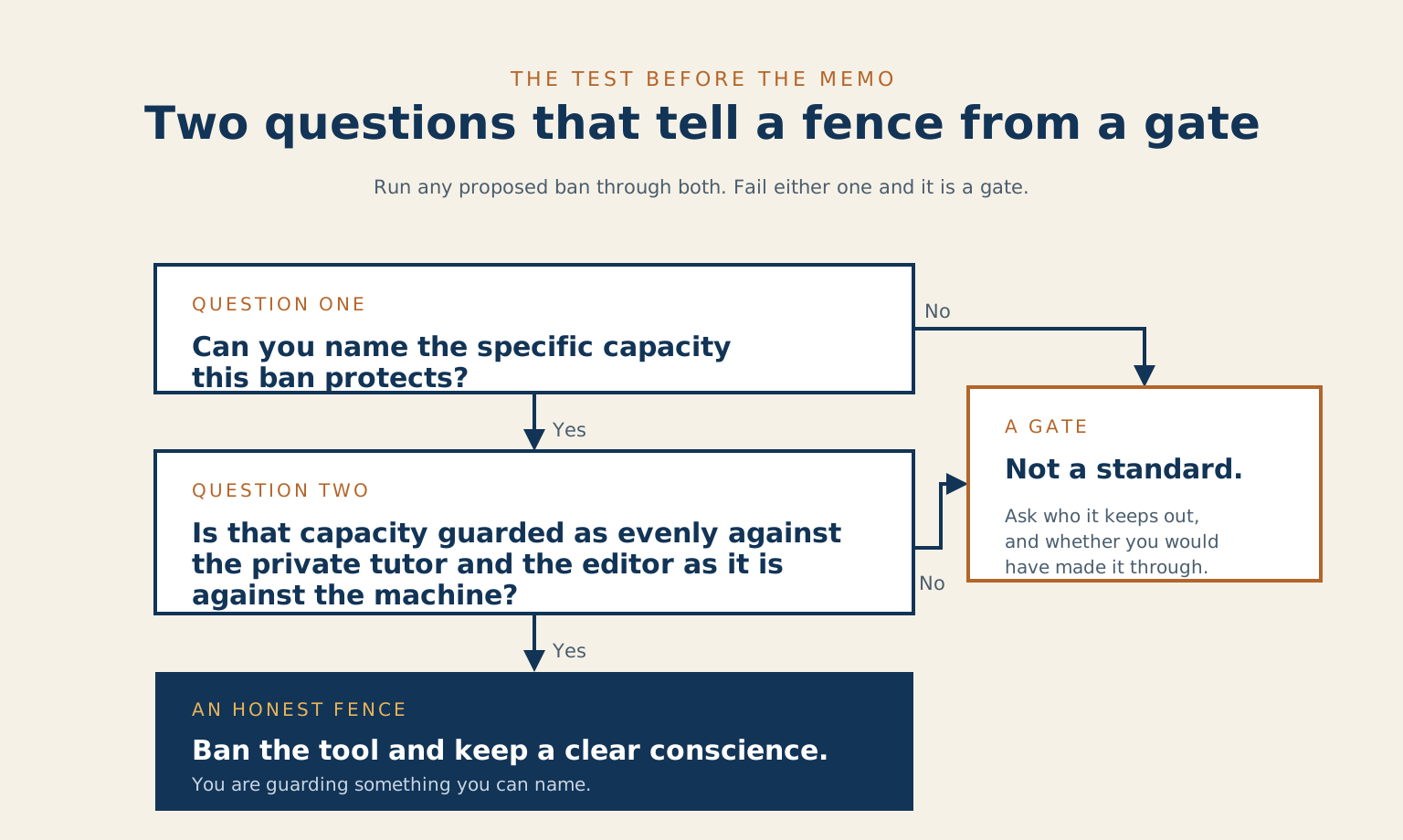
So here is the line I would draw, and I hold the teams I work with to it too. Before you ban the tool, name the specific capacity the ban protects. Then say what makes this tool different from the assisted advantages you already permit, the private tutor or the editor who tidies every draft. If you can name the capacity and defend the distinction, ban the tool and keep a clear conscience. You are guarding something real, and I will back you the way I back the exam room and the secure setting. If you reach for the capacity and find you cannot put it into a sentence, you have learned something worth knowing. You are defending a gate. The honest next question is who it keeps out, and whether you would have made it through yourself.
A word on how this piece was made, the same as everywhere in the series. I drafted it with the kind of tool the essay is about, then argued with the draft until every claim in it was one I would defend as my own. The position is mine.
If you think I have this wrong, I can tell you exactly what you would need to show me. Either that a broad ban can guard a real capacity while it reaches for the machine and leaves the private tutor and the editor untouched, or that a rule reaching for the newest form of help while permitting every older one is guarding a capacity after all. I would read either case with real interest. Bring me the name of the thing the ban protects, and show me it is guarded as evenly against the private tutor and the editor as it is against the machine, and I will defend that ban standing right beside you. I keep asking the question because, so far, the room usually goes quiet.
Common questions
Should schools ban AI? A blanket ban is usually the wrong tool. Banning it inside an exam that tests a skill makes sense, because the point is to measure what the student can do. Banning it everywhere, including for research and drafting, mostly teaches students to hide it. Ban it where it defeats the goal, teach it everywhere else.
Can an employer ban AI use? Yes, an employer can set rules about tools and data, and there are good reasons to, like protecting client information or meeting a contract. The honest question is whether the ban protects something real or just protects the way things have always been done. One is policy, the other is gatekeeping.
When is banning AI justified? When the AI would undercut the actual purpose: an assessment of a person’s own skill, a confidentiality rule, a safety or legal requirement. In those cases the ban protects the thing you care about. When the only thing a ban protects is habit or status, it’s harder to defend.
Do AI bans actually work? Broad bans tend to drive use underground rather than stop it, because the tools are easy to reach and hard to detect. Narrow, well-explained rules work better, because people understand what they’re protecting and why. A ban lands when it’s specific and makes sense.
Where AI draws its lines: the full series
This is one of five connected pieces working out where AI stops helping and starts standing in for the person. Each one holds up on its own, and together they run a single test into the places the argument actually gets fought.
- When does AI cross the line? The test the whole series runs on.
- Is using AI cheating? What the answer depends on.
- When banning AI is right, and when it is just gatekeeping. You are reading this one.
- Where AI actually goes too far, from someone who defends it.
- Will AI widen the digital divide? Only if we let it.
Where this gets practical: if your team is adopting AI faster than anyone is governing it, that gap is what a review is for. My AI operations audit maps where AI is running, what it costs, and where a human decision has gone missing, in a fixed scope. If you would rather talk it through first, book a short call.
Leave a reply