In short: Artificial intelligence (AI) can narrow the digital divide or widen it, and which one we get is a choice. It levels the field when access and plain-language design reach the people left behind, and it stratifies when the tools that matter sit behind money and the know-how to use them.
What the public library settled
There is a building in your town that was put there on purpose, with public money, to fix a problem that looks a lot like the one we are arguing about now. Someone, a good while back, looked at a plain unfairness. People who could buy books knew more than people who could not, knowing more turned into earning more, and the gap kept widening on its own with nobody having to lift a finger. The public library was the answer. It was a door, open to anyone, with the same shelves behind it whether you walked in wearing a suit or came in off a night shift. It held the door without pity, the same for everyone who came through it. The American Library Association's Library Bill of Rights says library resources should be provided for the interest, information, and enlightenment of all people of the community the library serves.
Where the series was heading
I have spent this series on one question, the one I laid out at the start as the test the whole thing runs on: when does a helpful tool stop helping and start standing in for something that was meant to grow inside a person. Cheating. Institutional bans. My own red lines around accountability and being there for the people who count on me. Two of those pieces reached a harder question, looked straight at it, and set it down for later with a promise to come back. This is later. It is also the last one, so it should land where the argument was heading the whole time. Underneath all of it sat a quieter question I kept deferring: whom does AI actually reach.
A capable AI is the first help that does not ask who your parents were.
Ask someone whether AI will widen the gap between the well-off and everyone else, and you get a fast answer in one direction or the other. The honest answer is slower. It is: only if we let it.
The case that it levels
Start with the strongest reason for hope, because it is real and I believe a great deal of it. Every kind of help I have written about in this series came with a price of admission. A private tutor. An editor who reads your draft before it goes out. The mentor who tells you which rooms to be in. The assistant who clears the small tasks off your desk. A well-connected parent who makes a quiet call on your behalf. All of it worked. And all of it began by asking who you already were. If your family had money or a network, the help was waiting. If it did not, you did the same climb with none of it and told yourself that was just how the world was built.
Who the on-ramp is for
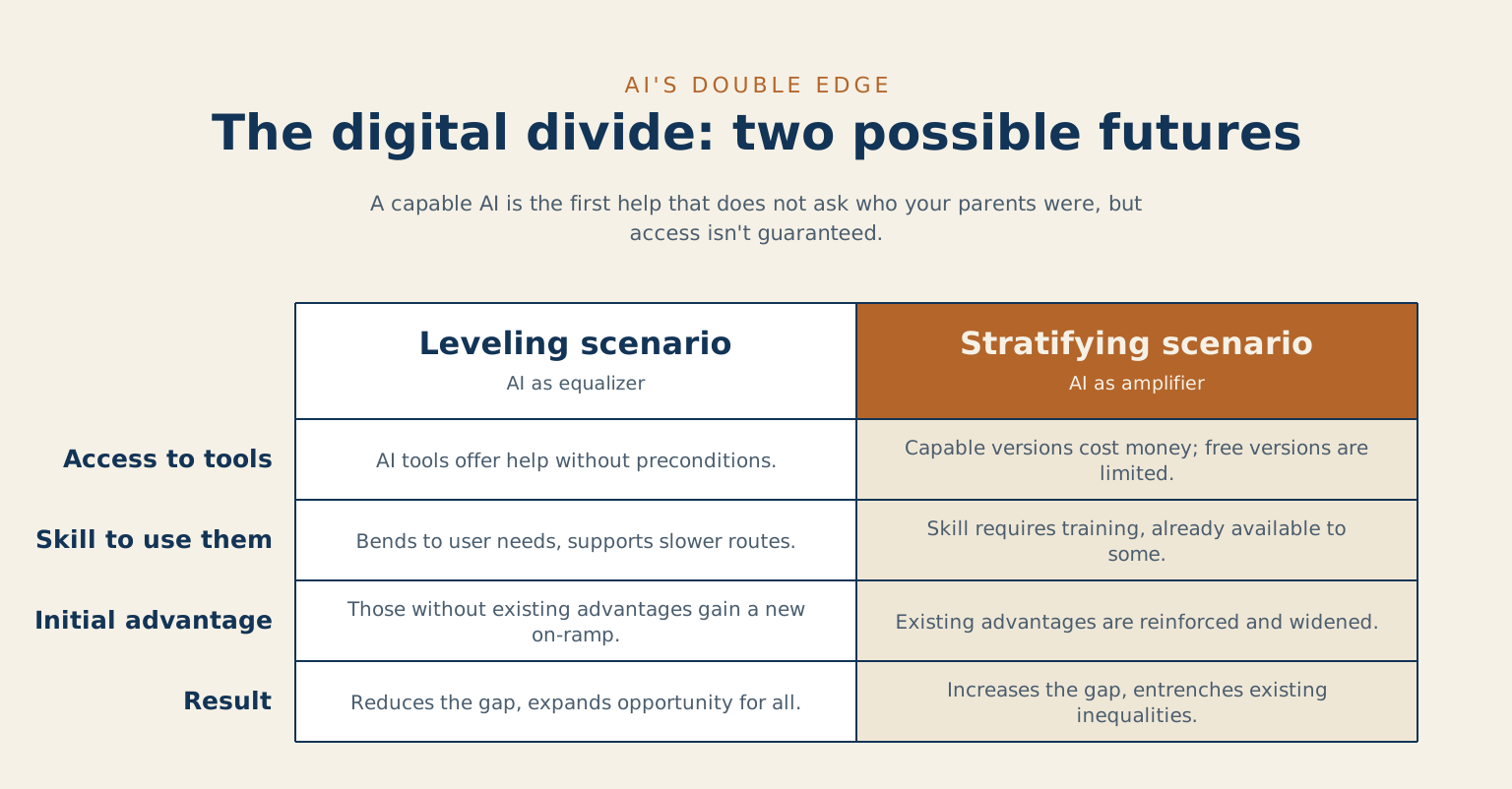
A capable AI tool is the first kind of help in that whole list that does not open by asking who your parents were. The student with no tutor can ask it the question she was too embarrassed to raise in class. The newcomer still finding his footing in a second language can have a page read back to him in words he can actually work with. Someone whose disability makes the standard route slower gets a route that bends toward him instead of one he has to force himself through.
The older worker retraining after the plant closed, the rural family an hour from the nearest person who could actually help, the shift worker whose only free hours fall when every office is shut, the adult who left school early and felt that gap in every job interview since and never had a private, patient place to close it. For all of them, this is the first on-ramp anyone ever built that does not check your pockets at the entrance. Treating that as a threat misreads who is standing at the door.
In a study of 5,179 customer support agents, an NBER working paper reports that access to a generative AI assistant raised productivity by 14% on average and by 34% for novice and low-skilled workers. A preregistered MIT writing experiment found that ChatGPT, on writing tasks, compressed the productivity distribution by benefiting low-ability workers more.
The case that it stratifies
Now the other side, at full weight, because an advocate who cannot say this part plainly has not earned your trust. Access can just as easily stack the deck higher. If the capable version costs real money and the free one is quietly hobbled so that you will pay, then the people who needed the free door get handed the worst tool and they know it. If the skill of using these tools well gets taught in the schools that already have everything and skipped in the ones that have little, then a new kind of literacy sorts people the same way every old literacy did.
Pew Research Centre reported in 2025 that 51% of US adults whose highest degree is a bachelor's had used ChatGPT, against 18% of those with a high school degree or less. The ITU estimates that about one-third of the world's people remain offline in 2024.
What a ban costs
And here is the callback I owe you from the piece on institutional bans: when a school or a workplace bans the tool, the ban doesn’t land evenly. The student who also has a tutor, an editor at home, and a parent who can explain the assignment loses a convenience. The student who had none of that loses the only help he was ever going to get. Same rule, wildly different weight.
Line those up and you have built a machine for compounding advantage. Better tool for the people who can pay. Better training for the people already ahead. Bans that pinch hardest in exactly the places where every other kind of help was already missing. Run that for a generation and AI becomes one more thing that tracks wealth, and the divide we hoped it might close gets wider instead. I raise that because it is a live possibility, and pretending otherwise would turn this into a sales pitch.
Which one we get is a choice
Both cases are true at once, and that is the whole point of the piece. The technology does not settle the matter. It sits at a fork, the same fork the library once stood at, and which branch we take gets decided by people making ordinary decisions in ordinary rooms. Some of these choices are made by countries: UNESCO's 2023 guidance on generative AI in education is written for countries, to help them plan long-term policies and develop human capacity. What does the capable version cost, and who set that price. Who gets taught to use it well, and who gets left to work it out alone. Who is allowed to use it, and who gets told they may not. Where does it get switched on, and where does it get walled off. Every one of those is a choice with a name and an address, made by a platform, an administrator, a lawmaker, a budget committee. None of it is weather.
It can be built like a library, or sold like a private club. The building material is the same either way.
The branch taken on purpose
The library is the proof that a society can take the narrowing branch on purpose. We looked at knowledge tracking wealth and we decided, with public money and real buildings, that it would not. AI stands at that same fork right now. It can be built like a library, an on-ramp anyone can walk up, or it can be sold like a private club where the good rooms sit behind a membership. The choice is the thing that makes the difference, and the choice is ours.
What honest advocacy owes you
The advocate and the people
I am an advocate for these tools, and I want to be careful about what that does and does not commit me to. Advocating for AI commits me to the version that reaches the people who never had any help before, whatever way the tools happen to get sold to us. Those are two different loyalties, and on the day they split I go with the people. The honest job has two halves. Push, out loud, for the deployment that holds the door open, and name, just as loudly, the one that walls it off.
That wall is easy to see when a platform raises it to protect a margin. It is harder to see, and harder to say out loud, when a school raises it to protect standards or a careful administrator raises it to be fair. But it lands on the same student whichever hand built it, and it lands hardest on the student who had nothing else. Say so, and refuse to let the word inevitable do the work that a spine is supposed to do.
My part in this
I want to be clear about my own place in this story. The hero here is the choice, and I am one more person standing at the fork with a vote. I do not get to hold a door open for anyone and then take a bow for it, and the people on the wrong side of this divide only ever wanted to be let in, the same way the library let people in, without the pity and without the paperwork. My part is small and it is the same as yours: notice which branch is being built, and say something while it still bends.
A disclosure
One thing I owe you plainly, and it belongs to this essay more than to most. I wrote this with a capable tool I can afford and reach without a second thought. That is the smaller half of the disclosure. The larger half is that the tool did more for me than it would have done for the person this essay is about, because I came to it already knowing how to ask and able to judge the answer, with an audience waiting for whatever it helped me write. That is the compounding machine from a few paragraphs back, running in plain sight, and I am on the advantaged side of it while I describe it. The help is real. Whether it lands in the hands that need it most, or multiplies again for the hands that already had plenty, is the whole question, and I am writing from inside it.
Make that case to me
If you think the divide is destiny, I genuinely want to know what you are seeing that I am not. You would have to believe that price, access, literacy, and what gets taught in which schools are all fixed and past anyone’s reach. That the choices in front of platforms and schools and workplaces and lawmakers are already settled and cannot be unsettled. That the library was a one-time fluke we could never manage again. Make that case to me.
Or make the harder one, the one I most want to sit across from: that a principled ban is worth its uneven cost, that holding a standard is worth what it takes from the student who had nothing else. A serious person can hold that, and I would rather argue it in good faith than talk around it. But the sentence I have learned to trust the least is the one that says none of this was ever up to us. The question was never what the technology will do to us. It is what we decide to do with it, and that decision has our names on it.
An offer, and one question
This runs close to the work I do, so take the next sentence with that in mind. A large part of my week goes into building learning that reaches people regardless of what they can pay, because access that does not track wealth does not happen by accident. Someone has to design it in on purpose. That is what my learning work is for. If that reads like a pitch, fair enough, set it aside. The argument holds whether or not you ever hire me: on-ramps get built by choice, or they do not get built at all.
Who taught you to use these tools, if anyone did?
References
- Brynjolfsson, Li and Raymond, Generative AI at Work, NBER working paper 31161
- Noy and Zhang, Experimental Evidence on the Productivity Effects of Generative Artificial Intelligence, MIT, 2023
- ITU, Facts and Figures 2024, press release of 27 November 2024
- Pew Research Centre, 34% of U.S. adults have used ChatGPT, 25 June 2025
- American Library Association, Library Bill of Rights
- UNESCO, Guidance for generative AI in education and research, 2023
Checked against NBER, MIT, ITU, Pew, ALA, UNESCO, on 2026-10-11.
Where AI draws its lines: the full series
This is one of five connected pieces working out where AI stops helping and starts standing in for the person. Each one holds up on its own, and together they run a single test into the places the argument actually gets fought.
- When does AI cross the line? The test the whole series runs on.
- Is using AI cheating? What the answer depends on.
- When banning AI is right, and when it is just gatekeeping.
- Where AI actually goes too far, from someone who defends it.
- Will AI widen the digital divide? Only if we let it. You are reading this one.
Leave a reply