Is using AI cheating? It depends what you're being tested on
In short: Using AI is cheating when the task itself is the test, and it's fine when the task is just the point. If the goal is to prove you can write the essay, AI defeats the purpose. If the goal is to get the report done, using AI is only using a tool.
Open a translation app at a restaurant in a country whose language you do not speak and you have done exactly what the tool was built for: made yourself understood across a language you never learned. Open the same app during the exam that certifies you can actually speak that language and you have cheated. Same tool, same phone, two verdicts sitting at opposite ends of the room. The gap between them comes entirely from what the speaking was being asked to prove.
Until you can name what was being measured, the question has no answer worth trusting.
That gap is the whole of the “is AI cheating” question. People ask me whether using AI is cheating as though the answer were a fixed property, true or false the way a stone is heavy. The answer depends on what the task was measuring, and whether AI stepped in for the thing being measured or for the scaffolding around it. Until you can name what was being measured, the question has no answer worth trusting. It only has sides.
The test behind the question
That is the test I laid out in when AI crosses the line: whether AI has crossed a line is settled by what a task is for. When the point is the output, the tool is doing honest work, and no one calls it cheating. When the point is a capacity the person is meant to walk out of the room carrying, AI can quietly occupy the very space the room exists to build. This is the first of the four pieces that take that test into the places the argument actually gets fought, and there is nowhere it gets fought harder than the question I get asked more than any other: whether using AI is cheating.
The assessment was already broken, and AI simply held a mirror up to it.
When using AI is cheating
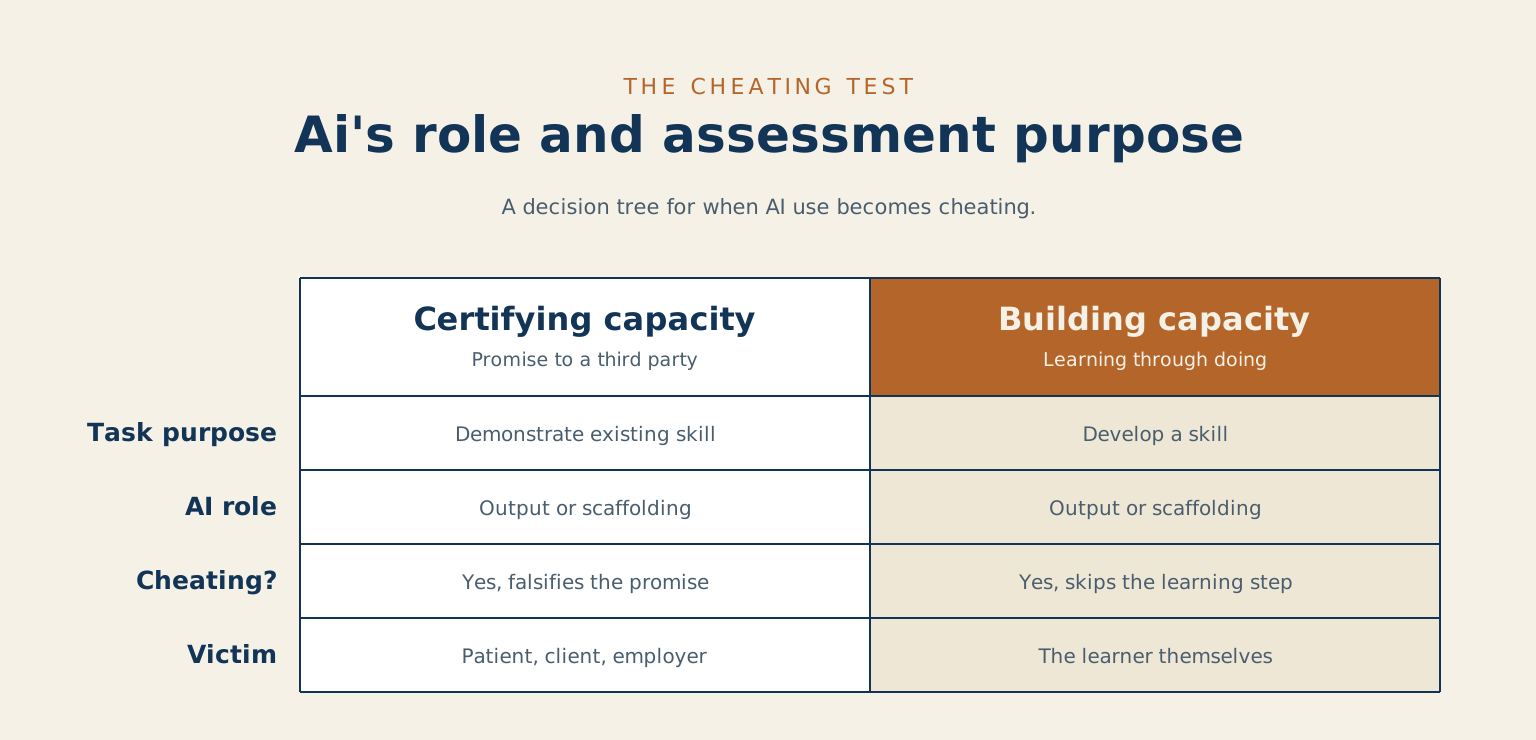
Start with the version of “it’s cheating” that is simply correct, because any honest answer has to carry it on its back. Some assessments exist to certify that a specific person can do a specific thing with their own hands and head. The nursing licensing exam that stands between a student and a patient. A bar exam. A trade certification that tells an employer a welder can lay a sound bead with nobody at their elbow.
The credential a hospital or a courtroom relies on to mean precisely what it says. In every one of those, the assessment is a promise made to a third party who will never be in the room: this person can do it unaided. Bring AI into that and you have falsified the promise, whatever you choose to call it. Naming it “augmentation” is a dodge, and everyone watching can see the dodge for what it is.
The NCLEX candidate rules name any devices or materials that will be helpful in taking the exam as prohibited aids, and the examples include dictionaries. Using one is misconduct, and the result can be withheld or cancelled.
What I concede
I want that conceded at full weight, and conceded early, because everything after it depends on it. Cheating is real. It has victims: the patient, the client, the next employer, the classmate who did the work the slow way. A world where credentials stop meaning what they claim is a poorer and more dangerous world, and AI makes emptying a credential out easier than it has ever been. Anyone who tells you the concept of cheating is now obsolete is selling you something.
Then there is a second case, and it cuts harder because it lives where the work actually happens. Some tasks make no promise to any outsider at all. They exist for a single reason: the learner builds the capacity by doing the work. The essay a student writes in order to learn how to think, with no employer and no licensing board waiting at the other end, certifies nothing to anyone. The doing itself is the entire point of it.
The skipped rep
Hand that essay to a machine and no third party has been deceived, yet the student has quietly skipped the one rep the task existed to make them do. That is cheating too, as plainly as the bar exam is, and it is the case most readers here live inside every day. I grant it as the harder of the two, because there is no wronged patient to point at, only a capacity that failed to arrive and a person who will not discover the hole until they need to reach through it.
The skipped rep shows up in the data. In a field experiment with nearly a thousand high school math students, those who practised with a plain GPT-4 chat scored 17 percent worse on an exam without it than students who never had access.
A preprint that had 54 people write essays with and without a chatbot reported that, over four months, LLM users consistently underperformed at neural, linguistic, and behavioral levels. It is one small study, so I hold it loosely.
When using AI isn't cheating
Here is where I part company with most of the panic. When an institution announces that its students are suddenly cheating with AI in large numbers, it has usually discovered something about itself it would rather not have learned: it never defined what its assessment measured.
The broken assessment
Take the take-home essay of the graded kind, the one whose mark a transcript carries forward later as a claim about the person. If a machine can produce one whole, unattended, and it sails through and earns the grade, then the grade was rewarding two things: that a document of the right shape existed, and that it arrived by the deadline. The capacity everyone pictured behind that grade, the slow assembly of a view a person can actually stand up and defend, went untested the entire time. The assessment was already broken, and AI simply held a mirror up to it. That is a hard thing for an institution to hear, and it is true.
The teacher’s position
I say it to educators with real sympathy, because most teachers inherited the assessment they are stuck administering. They work inside class sizes and accreditation rules that make a genuine test of capacity expensive and a document-shaped proxy cheap. The proxy held up for decades because producing the document used to require doing at least some of the thinking along the way. The coupling between the essay and the effort is what came apart, and it came apart under people who had no hand in designing it. The teacher deserves sympathy here, and the panic aimed at students is pointed at the wrong place entirely.
Redesigning the assessment
Redesigning an assessment so it measures the capacity it claims to measure is real, skilled work, and it is much of what I do when I build learning platforms and courses. The move is always the same: make the thing you actually care about the thing that gets tested, so a person cannot satisfy the assessment while skipping the capacity. An oral defense of an essay reaches something a submitted PDF can only pretend to have. A problem solved live, with the allowed tools on the desk and the reasoning visible, reaches judgment rather than retrieval. All of this stays perfectly friendly to AI. It just insists on honesty about what the grade certifies.
The University of Sydney draws the same split in what it calls a two-lane approach. Lane 1 is where students’ attainment of learning outcomes is checked in a secure environment, and the open lane is assessment for learning, where students learn by completing the task.
AI as the scaffold can be the whole point of a task. In a randomized experiment with 194 Harvard physics students, the median learning gains in the AI-tutored group were over double those of the in-class active learning group. That tutor was built on best practices from pedagogy and educational psychology, so it is a different thing from a blank chat window.
Where the line between help and cheating really falls
So here is the rule, short enough to keep in your head. You cannot call AI use cheating until you can say, in one plain sentence, what capacity the task was building or testing. Name that capacity and the rule writes itself. Was the task there to certify that this person can reason through a legal problem on their own, or to build that reasoning in them one hard problem at a time? Then letting AI do the reasoning is cheating, plainly, and I will not soften it. Was the task there to ship a working marketing plan that helps a real business, with nobody caring whose neurons assembled the first draft? Then AI is a power tool, and reaching for it is ordinary competence. The whole verdict rides on the purpose of the assessment.
Which is why “we caught students cheating with AI” can be the wrong sentence. If you can state the capacity the task was testing, you have caught something specific and you can act on it. If you cannot, you have found an assessment that was measuring the wrong thing, and blamed the person who stumbled into the gap. The gap was already there; the tool only made it impossible to keep ignoring.
How I made this piece
A word on how this essay was built, which matters more here than on almost any other topic. I drafted it with the same kind of AI tool it spends its whole length weighing, then argued with that draft line by line until the claims were mine and I could defend each one out loud. Run it through the rule. The capacity this piece certifies is that I can think this position through and stand behind it in public, and that thinking happened in the argument I had with the draft.
Now the uncomfortable part. Had I let the draft’s first argument stand as it came, unfought, that would have been the cheating, the same tool and the same use, one inch over the line. The capacity was the fight, and you have only my word that the fight happened. So I will not ask you to take my word. The proof is whether this piece survives your strongest objection to it, which is why the closer hands you the doors.
The strongest objection
Here is what you would have to believe to think I am wrong. You would have to hold that when a task’s whole purpose is to build a capacity by doing the work, the essay you write to learn to think rather than to prove anything to an employer, a student who hands the doing to a machine has merely exposed a broken proxy rather than skipped the rep that was the entire point. I do not believe that, and I suspect you do not either. Run that essay through the rule and the capacity it certifies is the thinking itself, so the AI draft is cheating there too, plainly, exactly as I granted up top. The rule cuts toward the writer as easily as away, and a rule that only ever cut one way would be a permission slip.
The other objection
Or you would have to hold that the purpose of an assessment is finally unknowable, that no one can honestly say what a given task was testing, in which case we are all guessing and “cheating” is just a word we reach for to feel in control. I think that one is mistaken too, and I have told you why on the page. If you hold it, you already know which sentence of mine to come at, and I would far rather read your argument than win by default.
Think of the last task you handed to an AI tool. Was it there to produce something, or to make you better at doing it?
If you are looking at an assessment of your own and cannot say what it measures, I would be glad to look at it with you.
Common questions
Is using AI to write an essay cheating? If the essay is being marked to prove you can build an argument yourself, then yes, handing in AI work is cheating, because the writing is the thing being tested. If you're using AI to check your grammar or push back on your draft, that's closer to a study partner. The line is whether the skill is what's being graded.
Is using ChatGPT for homework cheating? It depends on what the homework is for. Homework meant to build a skill through practice loses its value if the tool does the reps for you. Homework that's really just producing an output is fair game. When you're unsure, ask what the assignment is trying to teach.
Can teachers tell if you used AI? Not reliably from detector tools, which flag plenty of honest writing and miss plenty of AI. A 2023 study found detectors consistently misclassify non-native English writing samples as AI-generated. What teachers do notice is a sudden jump in polish that doesn't match your class work, or an answer that's fluent but hollow. The tell is usually the mismatch.
Is using AI at work cheating? Not in itself, because at work the task is the point, and a test of you personally comes up only when someone sets one: where you're being asked to certify your own judgement, or where a client or employer has set a rule. Follow the stated rule, and be honest about what you used.
Where AI draws its lines: the full series
This is one of five connected pieces working out where AI stops helping and starts standing in for the person. Each one holds up on its own, and together they run a single test into the places the argument actually gets fought.
- When does AI cross the line? The test the whole series runs on.
- Is using AI cheating? What the answer depends on. You are reading this one.
- When banning AI is right, and when it is just gatekeeping.
- Where AI actually goes too far, from someone who defends it.
- Will AI widen the digital divide? Only if we let it.
Checked against the NCLEX rules page, on 2026-10-11.
References
- Liang, W., Yuksekgonul, M., Mao, Y., Wu, E., Zou, J. (2023). GPT detectors are biased against non-native English writers. arXiv:2304.02819.
- Bastani, H., Bastani, O., et al. (2025). Generative AI without guardrails can harm learning: Evidence from high school mathematics. Proceedings of the National Academy of Sciences, 122(26).
- Kosmyna, N., Hauptmann, E., Yuan, Y. T., et al. (2025). Your Brain on ChatGPT: Accumulation of Cognitive Debt when Using an AI Assistant for Essay Writing Task. arXiv:2506.08872.
- Kestin, G., et al. (2025). AI tutoring outperforms in-class active learning: an RCT introducing a novel research-based design in an authentic educational setting. Scientific Reports, 15:17458.
- NCSBN. NCLEX rules: terms and conditions. Grounds for dismissal or cancellation of results; test center violations.
- University of Sydney. the two-lane approach to assessment in the age of AI (FAQ page). Teaching@Sydney.