When an organization puts AI to real work, the hard part isn’t adopting it; it’s being able to prove what it cost and trust what it touched.
I build the infrastructure layer that makes AI adoption legible. I designed this service because I needed it for my own work first. Every AI output I ship runs through a routing decision, a specialist check, and an audit log. Most organizations that have adopted AI tools are running them without this layer, the accountability architecture that every other piece of business technology has. Any team member can prompt any model. There is no routing by cost or capability. No audit trail. No quality gate before the output goes anywhere. The CFO asks what AI is costing and nobody has a clean answer. The legal team asks what was reviewed before it reached a client and the answer is unclear. This service is for organizations where adoption has happened and accountability needs to catch up.
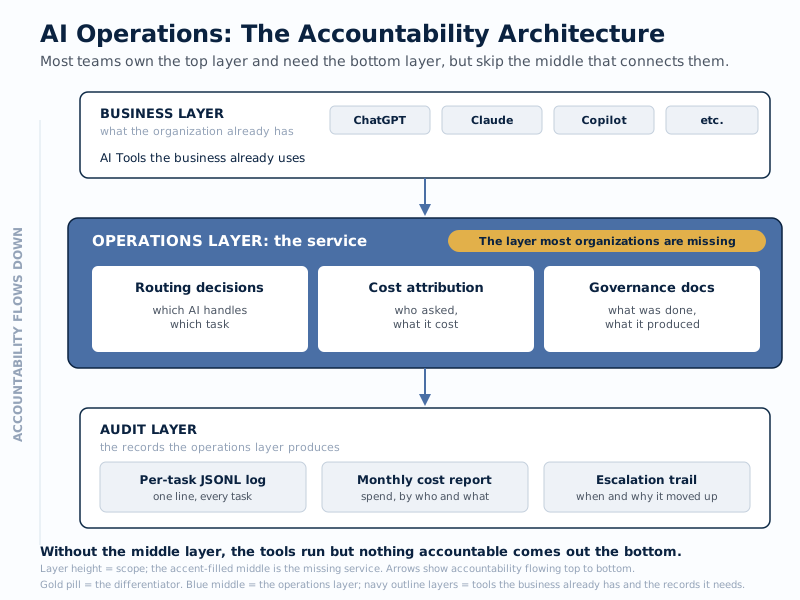
The gap this fills.
Most organizations that have adopted AI tools have adopted them without a governance layer: no routing rules, no cost attribution, no audit trail, and no clean answer when finance asks what it's costing or legal asks who authorized it. In a newsroom that means an editor-in-chief who can’t say what the AI touched, a standards question with no record to answer it, and a disclosure line nobody can back up.
The problem is not the model. It's the missing layer between the model and the organization. That's the layer this work builds.
Built and run in production: AIOS is the AI operations system built for this consulting practice: routing tasks across Claude, Ollama, and GitHub Copilot based on cost and capability, with every run logged with billing attribution. The system maintains 110 distinct agent personas as of 5 August 2026: 67 shared across both agent stores, 29 used only by the orchestration layer, and 14 only by the local model router. That is a deduplicated count from the generated registry, not an estimate. Client implementations are adapted from this architecture rather than designed on paper, and the system runs this practice daily before I propose it to anyone.
Who this is for.
This engagement fits you if:
- Your editorial team is using AI without a routing layer, cost attribution, or a clean answer when the editor-in-chief asks what the AI is actually doing. If the publishing platform itself also needs a rebuild, see publishing infrastructure.
- You run a membership, association, or academic publishing operation with the same question: what is the AI doing, and who signed off on it.
- If you are a college or university putting AI into teaching, the AI in teaching review is the better starting point.
- You have received an AI strategy report and now need the technical depth to build the infrastructure layer the report describes.
This engagement does not fit you if:
- You are still at the "should we try AI?" stage. This work assumes adoption has happened or is imminently decided. For pre-adoption strategy, book a discovery call. The engagement scope is different.
- Your implementation is a single vendor integration, plugging in one product API with no routing, governance, or multi-model architecture required. That is a development task, not an AI ops engagement.
What I build.
Routing architecture
A decision layer that routes tasks to the right model based on cost, capability, and context, not just defaulting everything to the most expensive frontier model. Claude for complex reasoning and voice work. Local models (Ollama) for routine generation, formatting, and syntactic tasks. GitHub Copilot for code generation within the Copilot subscription. The routing rules are documented, auditable, and tunable as the model landscape changes.
Agent persona library
Specialized agent personas scoped to your team's actual roles, not generic chatbots. An editorial agent that knows your style guide. An instructional design agent that works within your curriculum standards. A legal review agent that flags the right things for your organization's exposure. Personas are built from role-specific context, documented, versioned, and maintained as team needs change.
Cost attribution and billing
A logging layer that captures every AI task: model used, tokens consumed, estimated cost, routing decision, and the team or project it belongs to. Output is a structured ledger that answers "what did AI cost this week, by team," not an estimate and not a vendor dashboard. Finance can read it; so can a procurement audit.
Governance documentation
The documentation layer that makes AI adoption legible to stakeholders who aren't running it: routing policy, model selection rationale, human-review thresholds, data handling rules, and the approval trail for decisions that have downstream accountability. Written for legal and compliance review, not for developers. Structured to survive a procurement question or a board inquiry.
WordPress and LMS integration
For newsrooms whose publishing runs on WordPress: the AI ops layer integrated directly into the existing stack, not a parallel system that lives outside the tools your team already uses. AI-assisted editorial workflows and the audit trail that survives a compliance review inside the platform your team already operates.
Engagement model.
AI ops audit
$4,800 CAD flat
Ten-day diagnostic of your current AI adoption: what models are in use, what tasks are being routed to them, what the governance gaps are, and what the infrastructure layer needs to look like. Written report and a 90-minute debrief session. If you proceed to implementation within 90 days, the audit fee is credited in full.
The audit is where every engagement starts. I do not scope an implementation without first understanding what is actually in place. Organizations that can implement internally use the audit as the specification. Either way, the audit is the right first move.
AI ops retainer
from $2,800 / month CAD
Ongoing advisory and maintenance for organizations that have implemented the infrastructure and need a senior technical voice as the model landscape evolves: new model evaluation, routing rule tuning, governance documentation updates, and a monthly review session that keeps the system calibrated.
How this connects to the rest of the system
- The same accountability that governs AI inside your walls is now what earns you visibility outside them, because search runs on AI too. That outward-facing version of the work is Technical SEO.
- Putting AI into an editorial workflow without governance is how a newsroom loses track of what shipped, so AI Operations is the disclosure discipline a publishing platform needs applied to your organization instead of mine.
- AI inside a learning platform touches student data and assessment; for colleges and universities that work starts with the AI in teaching review.