In short: Social desirability bias is the tendency to answer questions in the way that looks good to others rather than the way that’s true. It shows up whenever people sense a “right” answer, and it quietly skews surveys, interviews, and feedback. You reduce it by making honesty feel safe and anonymous.
Part 1 of Trust Your Own Data, a four-part series on whether you can believe the numbers your business collects about itself.
Social desirability bias is the habit people have of answering a question the way they think will please or protect them, rather than the way they actually feel. It is quiet, it is common, and it can be sitting in your best survey results right now.
Here is where I ran into my own version of it.
For years I have built training and then stood in the room while people take it. After each session I survey the group, and the answers come back warm. Strong delivery. Useful. Would recommend. For a long time I filed that as evidence the training had worked. Then I would remember the newsrooms I started in, where an editor leaned over every green reporter and repeated the line I still carry: people lie, usually to be kind.
What the dinner did to the answers
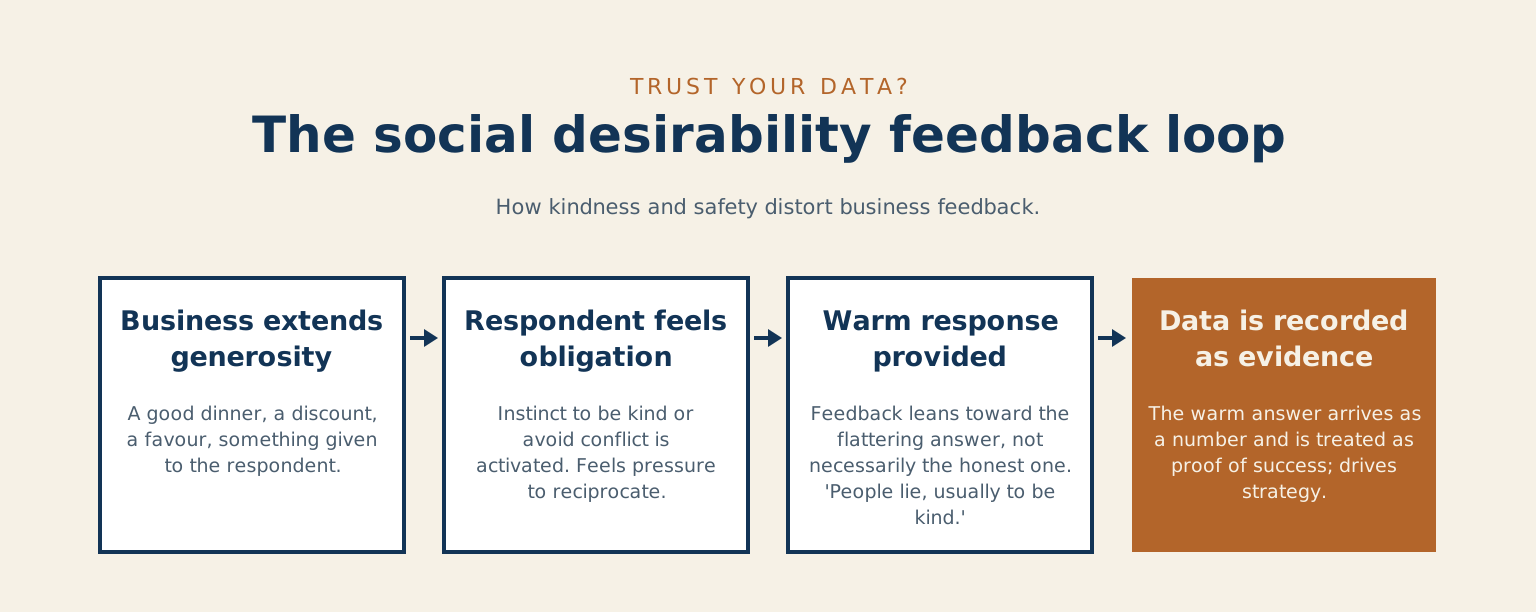
Look at the moment I collect those answers in. By the time the survey goes around, I have bought a good dinner, handed out the shirts and the certificates, and made a fuss over people who do not get one every day. Some of them had never had a steak dinner, let alone one in Niagara Falls, until it went on my card. Then, a day or two later, I ask them what they thought, and I write the warm answers down as findings. How much of that is the training, and how much is the steak?
A piece of feedback is only as trustworthy as the moment it was collected in.
The instinct behind social desirability bias
Those people are being kind to me. They are giving the answer that fits the moment, which is a different thing from lying. Researchers who study survey behaviour have a name for it. In a well-known 1985 review, the psychologist Anton Nederhof mapped how social desirability bias creeps into answers, and the methods researchers use to catch it and correct for it. People lean toward the flattering answer, and Pew Research Centre found they lean further that way with a human interviewer on the phone than on a web form. They lean hardest when the person asking has just been generous to them, or holds some power over them. That part is my own read of the room, and none of these sources says it.
That second half is the part I almost missed myself: who is holding the clipboard changes the answer. A researcher’s own position shapes the research, which is why qualitative researchers are expected to name their position out loud before they gather a word, a practice the field calls positionality. An employee rating their manager’s workshop is in a loaded seat. So is a customer answering a survey stapled to a discount. So am I, standing at the front of a room I just fed.
Where your surveys collect praise you manufactured
Once you see the pattern, you see it everywhere in the ordinary machinery of business feedback. The satisfaction survey goes out while the box is still new and the buyer still feels good about the decision. You measure your Net Promoter Score® right after a win, or right after you have waived a fee. You run the engagement survey, and the invitation comes from the boss whose team is being asked to grade him. You ask your happiest customer, the one who just thanked you, to leave the review.
Every one of those is real data about something: a faithful record of how people behave when they want to be kind or want to be safe, collected in the exact conditions that invite a kind and safe answer. Whether it is also data about the thing you meant to measure is a separate question. You did not set out to rig it. The instinct did that for you.
None of it feels like a mistake while it is happening. It arrives in a spreadsheet with a number attached, and it flatters you, so you treat it as evidence and you act on it. That is how a company ends up genuinely confident in a strategy that rests on politeness.
When to distrust a warm survey answer
Before you act on a piece of feedback, look at the moment it was collected in. A few signs the answer may be kind rather than true:
- It arrived right after you gave something: a discount, a gift, a good dinner, a favour.
- The person asking holds some power over the person answering, like a manager, a landlord, or an instructor.
- The response was only nominally anonymous, or the person answering had reason to doubt it was.
- It came from a single touchpoint at a single moment, with no way to check it against how people actually behaved later.
The feedback still has worth. The anonymity sign is the one you can change: a 2026 systematic review of ways to reduce the bias expects more anonymous settings to cut it, and recommends self-administered online surveys wherever possible. Each of these signs means the number is telling you about goodwill or safety first, and about the thing you meant to measure only second, if at all.
What a feedback number is actually worth
Here is the idea the rest of this series is built on. A piece of feedback is only as trustworthy as the moment it was collected in. Good evidence cannot be separated from the conditions that produced it, and so much business feedback is produced in moments that were built, without anyone intending it, to return a nice answer instead of a true one.
Your data can still be worth something. You just have to know which kind you are holding. The score that comes back after the steak dinner tells you something honest about goodwill and something close to nothing about whether the work changed anyone’s behaviour. Those are different facts, and trouble starts the moment you mistake the first one for the second.
So before you trust any piece of feedback enough to build on it, run one question over it: was this collected in a moment designed to get a real answer, or a kind one? If you cannot say, you do not yet have evidence. You have a warm impression wearing a number’s clothes.
Where the series goes next
Seeing the problem is where it starts. In the rest of this series I get to the harder and more useful part: why consent is the safeguard most feedback quietly skips, the common ways businesses fool themselves with their own research, and the practical checks that make your numbers worth trusting. If you only read one, read the last.
Trust Your Own Data is a four-part series: (1) the steak-dinner problem, (2) consent you can trust, (3) how businesses fool themselves, (4) data worth trusting. It runs alongside my weekly newsletter, Artificial intelligence (AI) Learning, Keeping It Human, where I take the same sober eye to the week’s AI and learning news. If you want to be the person in the building who can tell a real number from a flattering one, that is the whole project.
Christopher Ross builds training and advises businesses on measurement they can trust. If this landed, the two ways teaching with AI goes wrong comes at the same problem from the learning side. Or see how I can help.
References
- Nederhof, A. J. (1985). Methods of coping with social desirability bias: a review. European Journal of Social Psychology.
- Latkin, C. A. et al. (2017). The relationship between social desirability bias and self-reports of health, substance use, and social network factors among urban substance users in Baltimore, Maryland. Addictive Behaviors.
- Pew Research Centre (2015). Where Web surveys produce different results than phone interviews.
- Pew Research Centre (2017). Appendix B: Mode effects as a source of error in political surveys.
- Holmes, A. G. D. (2020). Researcher positionality: a consideration of its influence and place in qualitative research. Shanlax International Journal of Education.
- Zaal, E. et al. (2026). Unraveling honest responding: a systematic review on the effectiveness of social desirability bias reduction methods in survey research. Quality & Quantity.
Common questions
What is social desirability bias in simple terms? It’s when people tell you what they think they should say instead of what’s actually true. They’re not lying to deceive you, they’re trying to look reasonable and avoid judgement. That small nudge toward the “acceptable” answer is the bias.
How do you reduce social desirability bias in surveys? Make answers anonymous, and make sure people believe it. Word questions neutrally so no answer feels like the obviously approved one, and give an easy “prefer not to say” out. Asking about behaviour (“in the last week, how many times”) gets you closer to the truth than asking about attitudes.
What is an example of social desirability bias? A survey asks how many days a week you exercise, and people round up, because being active is the answer that looks good. The same thing happens with questions about voting, giving to charity, or reading the terms before clicking agree. The reported number drifts toward the flattering one.
How is social desirability bias different from response bias? Response bias is the umbrella term for any systematic way answers drift from the truth. Social desirability bias is one specific kind of it, the drift caused by wanting to look good. So every social desirability bias is a response bias, but not every response bias comes from wanting to impress.
Trust your own data: the full series
A four-part series on whether you can believe the numbers your business collects about itself. Each piece stands on its own; together they build one test.
- The steak-dinner problem. Why your warmest feedback may be your least honest. You are reading this one.
- Consent you can trust. The yes most business feedback quietly skips.
- How businesses fool themselves. The everyday ways your own data flatters you.
- Data worth trusting. The toolkit for collecting honest answers.
Leave a reply