Consent you can trust: the yes most business feedback skips
A discount for a five-star review is not a request, it is a purchase. What real consent looks like, and why feedback collected without it quietly stops being evidence.
Part 2 of Trust Your Own Data, a four-part series on whether you can believe the numbers your business collects about itself.
A week after I bought a set of clamps online, the email arrived. It thanked me for my order, hoped the clamps were working out, and then got to the point: leave a five-star review, take ten percent off my next order. There was a button. The button was already the colour of the stars.
Nobody asked whether they could have my opinion. They asked me to sell it to them, and named their price.
The clamps were still in the box by the back door, unused. The company wanted my honest opinion of a product I had not opened, and it had quietly attached a price to the answer it was hoping for.
In the first part of this series I wrote about the steak-dinner problem: how a warm room and a good meal make people tell you the kind thing instead of the true thing, and how a piece of feedback is only ever as trustworthy as the moment it was collected in. That clamp email is the same problem in a different coat. But there is a second thing wrong with it, one I set aside in Part 1, and it is the thing this piece is about. Nobody asked whether they could have my opinion. They asked me to sell it to them, and named their price.
Informed consent: what a clean yes needs
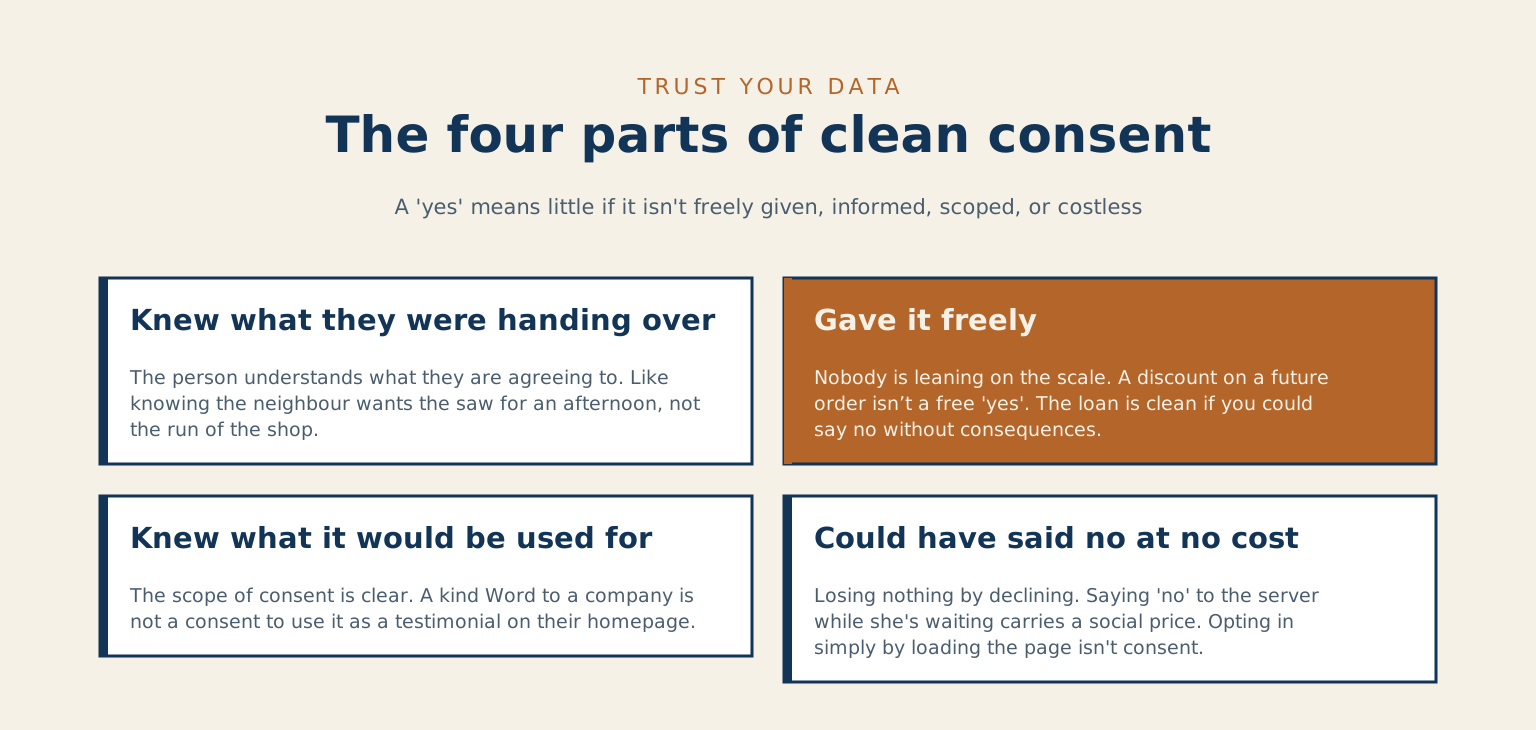
Real consent, the thing itself and not the checkbox at the bottom of a form, has four parts. The person knew what they were handing over. They gave it freely, with nobody leaning on the scale. They knew what it would be used for. And they could have said no and lost nothing by it. Pull out any one of those and the yes stops meaning what you think it means.
Research ethics treats the freely given part the same way. The Tri-Council Policy Statement, Canada's rules for research on people, says consent has to be given voluntarily and names incentives as one of the things that can undermine it.
Lending a table saw
I think about it the way I think about lending tools. When a neighbour knocks and asks to borrow my table saw, the loan is clean if a few plain things are true. He told me what the job was. I could have said no and still waved him over for coffee the next morning. And nobody was standing behind me making the no awkward. Change any one of those and the borrowing turns into something with a worse name. If he lifts the saw off the bench while I'm out, the word for that is taking. If the man asking holds the lease on my shop, my yes was never fully mine to give. The saw ends up in his truck either way. What changed is whether I handed it over or it left without me.
The neighbour also knows what he is getting: the saw for an afternoon, and the rest of my shop stays mine. That matters more than it sounds, because a lot of consent failures in business are failures of scope. People agree to one small thing and a larger thing is taken under cover of the same nod. Canada's privacy commissioner asks that people be made aware of all the purposes their information is used for, in meaningful language rather than a vague label like "service improvement".
Given or taken
Feedback works the same way as the saw. The number can land on your dashboard whether it was given or taken. What changes is whether it means anything once it's there.
Where the yes gets skipped: incentivised reviews and staff surveys
Once you can see the four parts, you start noticing how much ordinary business data quietly skips at least one of them.
The clamp email fails on freely given. A discount is a thumb on the scale, and everyone involved knows it. The US FTC consumer reviews rule prohibits buying reviews that are conditioned on the sentiment they express, and ten percent off for five stars fits it. The employee engagement survey fails harder: it lands in your inbox from the manager whose own numbers depend on the answers, promises it's anonymous, and asks you to be candid about the person who signs your reviews. The little "we value your feedback" card the server sets down while hovering fails on cost, because saying no while she waits carries a social price you can feel in your face. Analytics and session recording are the quietest failure of the lot, a yes so absent that nobody even staged the moment to ask for one. You were opted in by loading the page.
Then there is the kind word that becomes a testimonial. You send a company a friendly note, one human being to another, and months later a sentence of yours is sitting on the homepage beside your name and your town. You consented to say something nice to a person. A billboard was never part of what you agreed to. The words are accurate. The use was never agreed to, and accuracy was never the thing in question.
The same failure from the other side
Here is the through-line, and it is why consent belongs in a series about whether you can trust your own data at all. Every one of those examples collects feedback in a moment engineered to produce a compliant answer. Part 1 was about moments engineered to produce a kind one. They are the same failure arriving from opposite directions. Flattery makes the honest answer feel rude. Coercion makes it feel expensive. Either way the person's freedom to tell you the truth has been removed before they open their mouth, and either way you will read the result as signal and act on it.
The real cost here is practical rather than moral. The data lies to you, and it looks exactly like data that doesn't. A five-star average built on a standing discount, and a staff survey full of warm words about the boss, are careful measurements of the pressure you applied, dressed up as measurements of what people think. You can chart them and average them, watch them climb quarter over quarter, and be more confident every month about something that was never true.
From extracting feedback to earning it
The repair is a change in posture rather than a cleverer form: from extracting feedback to earning it, and earning it costs you the very things that make extraction feel like it's working.
What earning it looks like
You ask when the person has nothing riding on the answer. You tell them plainly what it's for, before they give it, and not buried in a policy they will never read. Privacy law asks for the same: the GDPR says it shall be as easy to withdraw as to give consent. You make no the cheapest option in the room and you mean it, which means the survey some people ignore is doing its job rather than failing at it. And you take the reward off the table, because a reward is just you paying in advance for the answer you were hoping to hear. That last one stings, because rewards do work. They lift your review count and your response rate and every graph your boss checks on a Monday morning. They also wreck the single thing the whole exercise was supposed to buy you, which is an honest picture of what people think when they have no reason to perform.
Why it goes unnoticed
Which number on your own dashboard would you least want to find out was bought?
I have watched organisations gather feedback carefully for years and never once ask whether the moment they gathered it in was honest. The care was real. Consent is just invisible when it's missing. The survey still runs, the reviews still arrive, the graph still climbs, and nothing on the screen tells you that you have been reading compliance as approval the whole time. Working out which of your numbers were freely given and which were quietly taken is slow, unglamorous work, and it is a large part of what a measurement audit is for.
Common questions
Is it legal to offer a discount for a review?
The Competition Bureau of Canada says that when influencers are compensated to promote a product, they must disclose the relationship, and that a lack of transparency would be misleading to consumers. The US rule linked above names bought reviews directly, and Google's Maps policy does not allow merchants to offer incentives such as discounts in exchange for posting a review. Legality is only the floor though. The practical trouble is that the incentive changes the answer, so you have paid for data you cannot afterwards rely on.
What is informed consent in customer feedback?
Four things holding together at once. The person knew what they were handing over. They gave it freely, with nobody leaning on the scale. They knew what it would be used for. And they could have said no and lost nothing by it. Pull out any one and the yes stops meaning what you think it means. The checkbox at the bottom of a form satisfies none of the four on its own, which is worth sitting with, because the checkbox is what a business believes it has when it says it has consent. European law goes a step further and presumes bundled consent was not freely given.
How do I ask for a review without buying it?
Ask after they have actually used the thing. Say plainly what the review is for, before they write it. Make no part of it conditional on what they say. And make declining genuinely free. A short stack of honest reviews is worth more than a long one you have to discount in your own head. The version of this I use myself is to wait until somebody has had the thing long enough to have an opinion worth having, then ask once, plainly, and let it go if they do not answer. It feels slower. It is slower. What you get back is a small number of sentences you can put in front of a prospect without privately wondering whether the discount wrote them.
Trust your own data: the full series
A four-part series on whether you can believe the numbers your business collects about itself. Each piece stands on its own; together they build one test.
- The steak-dinner problem. Why your warmest feedback may be your least honest.
- Consent you can trust. The yes most business feedback quietly skips. You are reading this one.
- How businesses fool themselves. The everyday ways your own data flatters you.
- Data worth trusting. The toolkit for collecting honest answers.
Checked against the Tri-Council Policy Statement, chapter 3, the FTC rule notice, the Competition Bureau page, GDPR Article 7, Google's Maps policy and the privacy commissioner's consent guidelines, on 2026-10-11.
References
- Tri-Council Policy Statement 2, chapter 3: the consent process
- US FTC, trade regulation rule on the use of consumer reviews and testimonials
- Competition Bureau Canada, false or misleading representations
- GDPR Article 7, conditions for consent
- Google Maps user-contributed content policy, fake engagement and incentivized reviews
- GDPR Recital 43, freely given consent
- Office of the Privacy Commissioner of Canada, guidelines for obtaining meaningful consent