
The first time I gave this talk, in November 2011, the premise was still something you had to defend. Free software was obviously good for the world. Whether it was good for your own bank account was an open question, and I spent a decent chunk of that session making the case before I could get to the mechanics. I gave it in Toronto that month and again in Detroit a week later, and a rebuilt version of it went to Buffalo in 2023.
Phoenix was to be the fourth outing, and the first one at a flagship event. The session was accepted for WordCamp US 2026 as a breakout on Tuesday, August 18. In July I withdrew, because my passport would not be renewed in time to cross the border for the August dates and I could not find a way around it. The organisers were a pleasure to deal with. The talk stands, and I would still like to give this version somewhere before the year is out. What follows is what it was built to say.
Why not a rerun
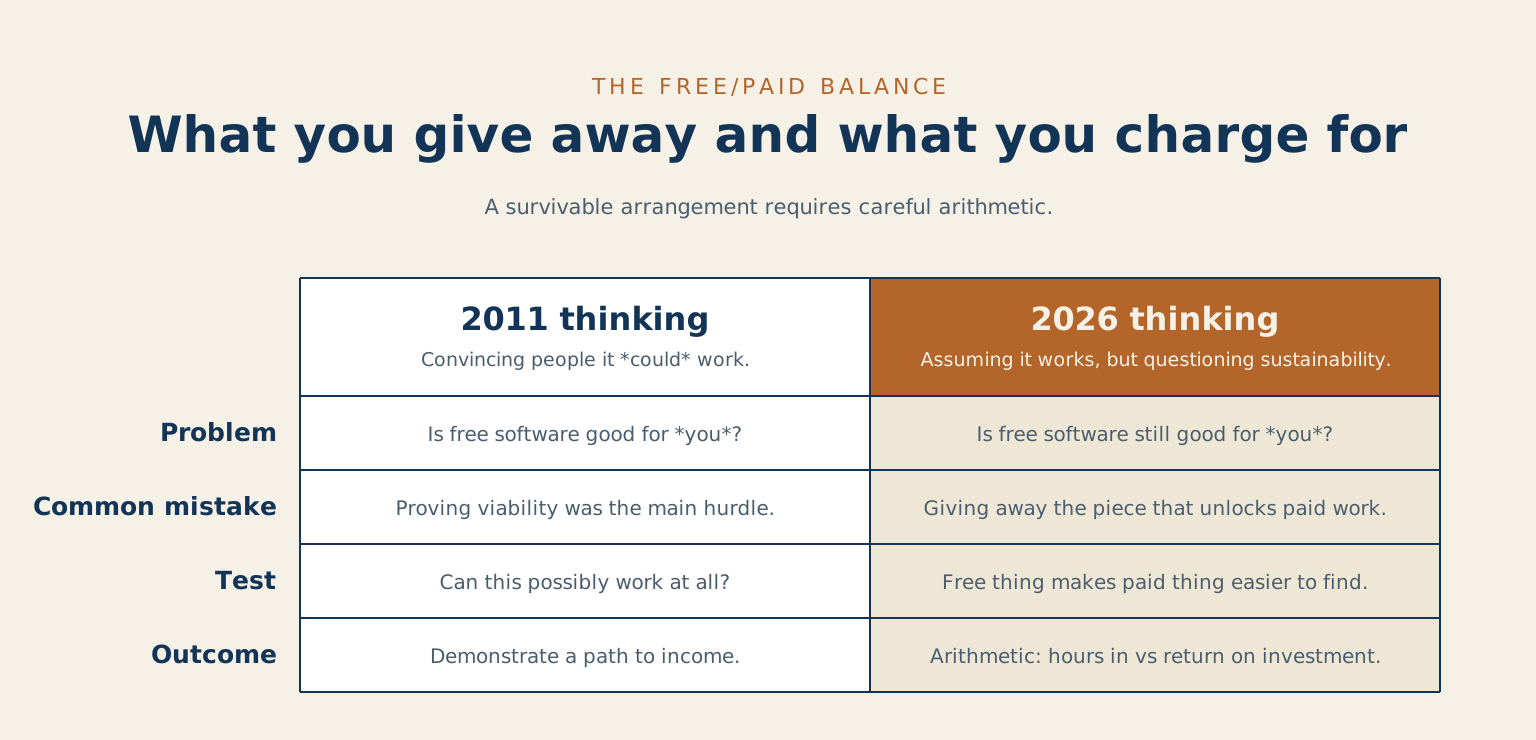
I did not want to simply dust off the 2011 deck, because the question has changed shape underneath it. Nobody in that room was going to need convincing that a person can build a career adjacent to work they gave away. The people I talk to have already done it. They maintain a plugin with a few thousand installs, or they wrote the tutorial that a whole category of developer learned from without ever knowing whose name was on it. What they are doing in 2026 is arithmetic. They are looking at the hours going into the free side of the ledger and asking, out loud in a way they were not asking five years ago, whether the return is still there.
So the sceptical questions still come, just from a different direction. In 2011 people wanted to know whether this could possibly work at all. In 2026 they want to know whether it still does, and for whom, and that is a better question than the one I started with. It deserves a session built for it rather than a rerun. I wrote about the acceptance, and about what a strange week it arrived in, in Behind the Scenes: a WordCamp US yes, and four machines that lied to me politely.
What the session actually covers
I want to be careful about what I am promising here, because there is a version of this talk I am not qualified to give. I do not know what large language models finally do to the economics of open source labour. My opinions on that are held loosely, and I am wary of anybody currently selling certainty about it, so that question stays out of the room.
What I can speak to
What I do have is thirty years of doing this in public, and most of that getting paid for it. I have been building for the web since 1996 and working in WordPress since 2007, and for most of that time some meaningful portion of my output has been free to anyone who wanted it. Plugins, documentation, and a great many whole afternoons. The small things that do not need a talk go on the monthly Free Shelf. Thirty years is a long enough run to have made most of the available mistakes at least once, and to have noticed which ones cost real money.
The paid side of that same work, when a team wants the documentation or the plugin built properly rather than handed over for free, is what my writing work covers.
Which is which
The talk is about what you give away and what you charge for, and mostly about how you work out which is which before the giving is already done. That order matters. The people I know who got into trouble with this got into it retroactively, discovering after the fact that the free thing had become the whole product.
Where the line sits
Think about how a restaurant handles bread. The basket arrives before you have ordered anything, nobody itemises it, and no owner in the world thinks of it as a loss. It gets you seated and comfortable, and it makes the thing you are about to pay for taste like part of a larger experience. The bread is doing work you are not being billed for. Every operator who does this well knows precisely where the bread stops and the meal starts, and they know it before service, not halfway through it.
How the line moves
The failure that costs the most is not giving too much away. It is giving away the piece that was holding the paid work up, one reasonable decision at a time. A free plugin picks up a feature that used to be the reason somebody hired you. A generous answer in a forum turns into an unpaid implementation. The wall moves on its own, because nothing in the day-to-day forces you to look at where it is standing.
The test I use is boring and it works: the free thing should make the paid thing easier to find and more obviously worth paying for. When the free thing starts substituting for the paid thing instead of pointing at it, you have crossed a line, and the sooner you notice the cheaper the correction. That is the core of what the talk argues, with the specifics of how I have priced and occasionally reversed my own decisions over the years.
The test I use is boring and it works: the free thing should make the paid thing easier to find and more obviously worth paying for.
What the licence and the directory already settle
Some of the line is drawn for you. WordPress is released under the GPLv2 or later, and the project says plugins and themes are derivative work that inherit that licence. The GPL itself says you may charge a fee for the physical act of transferring a copy, and the Open Source Definition says a licence shall not restrict any party from selling or giving away the software as part of a larger distribution.
The plugin directory adds a rule of its own. Its guidelines rule out trialware, so a plugin cannot lock functionality behind a payment or an upgrade. Paid functionality in services is allowed, as long as all the code inside the plugin is fully available.
The project has a formal way to give back, too. Five for the Future lets organisations contribute time or sponsor resources toward the project’s sustained growth. Those are the walls; your own line sits inside them.
Who it is for
This one is aimed at people who contribute to open source, maintain a plugin or a theme, or otherwise give work away as a normal part of how they operate, and who would like that arrangement to keep being financially survivable. It assumes you already know why you give things away, so the case for open source stays outside the door; the room will have made that case with its own labour long before it walked in.
The Buffalo 2023 outing is on the site if you want to see where the material stood then.
Which of the things you give away has quietly started doing the job of the thing you charge for?
If your own event needs a version of this, or something else entirely, my speaking page has the details. The arguments I get in the hallway are the reason this talk keeps changing, and I still want the next version to be different again. If your room is where that happens, you know where to find me.
Checked against the WordPress.org license page, the Plugin Directory guidelines, GPL version 2, the Open Source Definition and Five for the Future, on 2026-10-11.