The week of July 10 had one good headline and one bad habit running underneath it, and the bad habit turned out to be the more useful story.
The week in short:
- WordCamp US accepted my talk, Make a Living Giving It Away. (The trip did not survive; see the update at the end.)
- My nightly caretaker graded three hundred and five posts against the wrong rulebook.
- Four checks recorded “nothing was judged” as a failing grade, four times in one week.
- Housekeeping: a stray API key revoked, five old portfolio links fixed, and feature photos generated for a fraction of the cost.
WordCamp US said yes
Make a Living Giving It Away got accepted for WordCamp US. I first gave a version of that talk at WordCamp Toronto in 2011, then in Detroit a week later, and again in Buffalo in 2023, and the fact that a talk about giving your work away for free has now outlived three of my own business models is a joke I intend to make on stage rather than here. I rebuilt the 2026 version from the studs. Open source sustainability looks different when half the room is quietly wondering whether a language model just ate their billable hours. If you want me to bring it to your room instead, that is what the speaking page is for.
That is the good headline. Now the habit.
Seventeen failures, and fourteen of them were not real
My site runs a nightly caretaker that reads my own posts and tells me which ones fall below my writing bar. On Wednesday it sent me a list of seventeen failures. I built that list myself, so I read it the way you read a bad review of your own restaurant.
Then I checked one. Then another. Fourteen of the seventeen were not real.
Two days earlier I had added an exception to the rubric, a clause saying that an evocative narrative headline on a column is allowed to be evocative. The exception named two of my own titles as examples of what to permit. The audit then failed both of those exact titles. My fix had been sitting there doing nothing at all, because the rubric has a version number and I had not touched it, so every judgment was still being served from a cache built against the old rules. Three hundred and five entries, all confidently graded against a rulebook nobody had read.
The fix was one digit. Finding it took most of a morning.
Four failures wearing a verdict’s clothes
Here is the part that earned its place in this post, because it happened four times in one week and I only noticed because it kept happening.
The audit had been recording “no verdict available” as a failing grade. Not a crash, not an alert, just a quiet zero that looked exactly like bad writing. One of my pages had been carrying three of those for days.
Then I tested a cheaper model for the same job. It was good, genuinely, but it answers in Python where my parser wanted JSON, so every answer it gave would have landed as a failing grade. I nearly shipped that.
Then my image checker started scoring a photograph at zero. The vision model behind it was replying “I’m sorry, I can’t assist with that” to a picture of a beige computer, and my code was translating that apology into a failing score.
Then, about an hour after I finished writing all of that down, I wrote a script that scored an empty result as zero out of a hundred and called it a mismatch. Same bug. Fresh from the lecture.
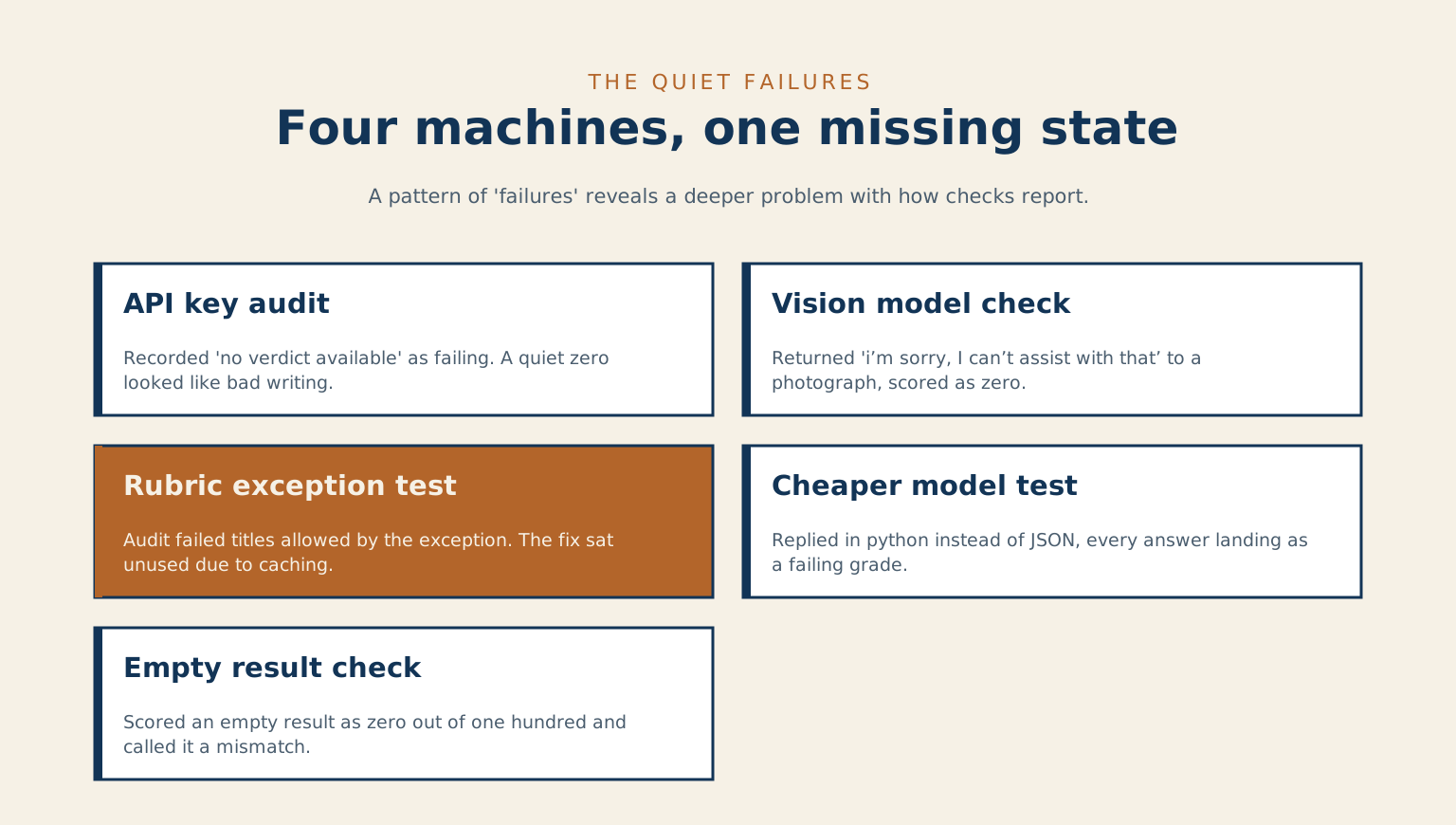
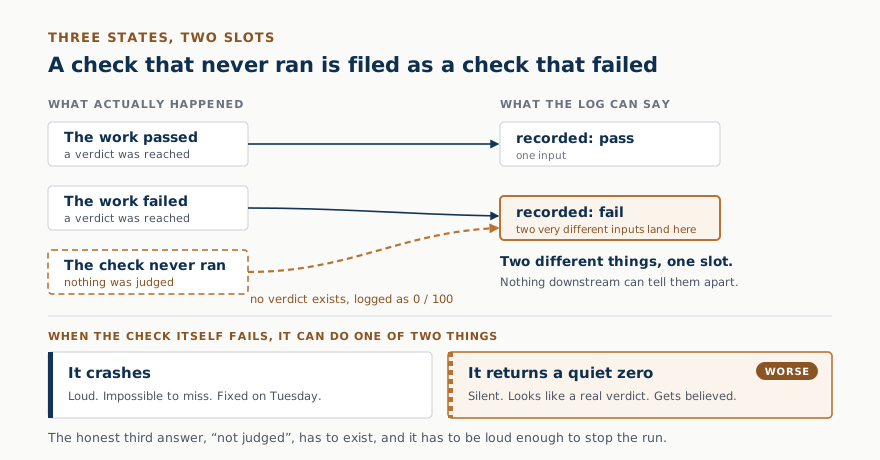
All four told me something had been judged when nothing had been judged at all. A crash gets fixed on Tuesday. A quiet zero gets believed.
A check that cannot fail loudly is not protection. It is company.
Here is the part I enjoyed less. This is the fourth week running that I have written some version of this. First a WooCommerce bug that hid from its own test. Then a nightly bot that kept un-fixing its own fix. Then a contact form my own gate waved bots straight through. Now four more in a week.
So I spent a paragraph up there pleased with myself for spotting a pattern after four repetitions in one week, while sitting inside the same pattern for a month. The machines are not the slow learner here.
A check that cannot fail loudly is not protection. It is company.
Housekeeping, and images at a fraction of the price
The rest of the week was cleanup. I found an API key on my own account with no expiry date, unused for a week, quietly holding the keys to three doors. Revoked. I found five old portfolio links pointing at the wrong archive, sending a decade-old bookmark to my case studies instead of the actual project. Fixed, and a reminder that the boring half of an audit is where the money hides.
I also tested generating feature photography through Cloudflare’s image models instead of the expensive ones. Same quality bar, same automated register check, about one sixty-fifth of the cost. A batch of nine came in at half a cent. The surprising part is that checking the images now costs more than making them, a sentence I did not expect to write in 2026.
Four of those nine cleared my own quality bar. One of them my tooling refused to make at all, on the grounds that staging a photo of a real event I lived through would be fabricating evidence. It was right. That is the only time this week a machine argued with me and won.
Update, July 2026: the yes above was real, but the trip will not be. My passport will not be renewed in time to reach Phoenix in August, so I have had to withdraw from WordCamp US 2026. The talk stands; the outing does not. Everything else here, about four machines that lied to me politely, is unchanged.
Leave a reply