From layoff to consulting: what the first year costs you
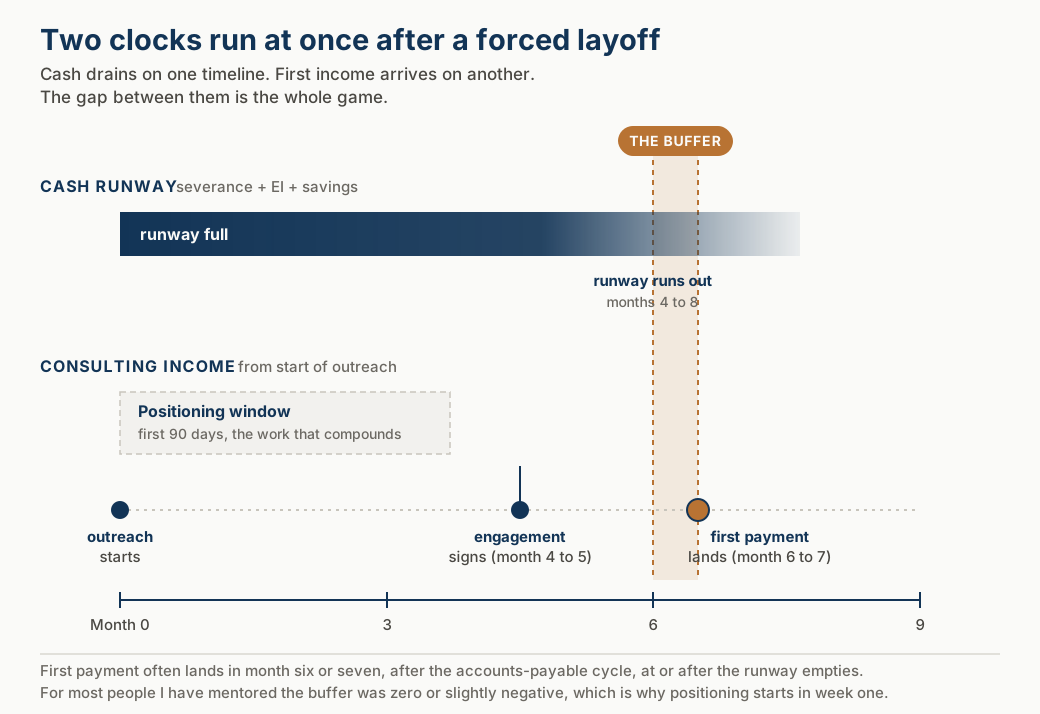
Severance and Employment Insurance buy four to eight months. The first consulting payment usually lands in month six or seven. Here is the pattern I have watched senior professionals hit, and why the positioning work starts in week one.

I came to consulting by choice, and I want that on the table before the first piece of advice lands. A lot of what gets written about the jump from a job to a practice is written in a voice that implies a scar, and mine is a different kind of scar. As a kid I watched the Cape Breton coal mines die, which is its own essay and the reason this subject will not leave me alone. Most of the senior people I have mentored through this transition did not get to pick their timing. So what follows is their pattern rather than my memoir: the months between a layoff and a second income, and the practical decisions inside those months that either compound or fail to.
Key takeaways
- A forced transition runs on a faster clock than a chosen one. Four to eight months of runway in Canada, with the identity question landing at the same time as the practical work.
- Two things decide the next eighteen months: how honestly you answer “what was I actually paid for?”, and how early you start saying that answer out loud to people who know your work.
- Practices stall in the first year when the founder builds on the last job description. The market is usually buying something narrower.
- Most transition advice assumes you picked the timing. The forced case needs its own playbook.
- The work that compounds is positioning. Three months tightening it carries further than twelve months pitching the wrong thing.
Quick answer
If you have been laid off from a senior role and consulting is the next step you are considering, the first 90 days set the next eighteen months. The work in those 90 days isn’t finding clients. It’s deciding what you’re going to be paid for. The natural place to start is continuity: I did X at my employer, so I will do X for clients. Look for the slightly different X the market will pay for. The people who find it early end up with the cleanest practices.
Forced and voluntary transitions are different problems
Almost all the consulting and freelancing literature assumes the voluntary case. You already have a side gig, you saved twelve months of runway, you picked the date. I had a version of that luxury when I went independent, and I want to be plain that it is a luxury. The forced case runs on three constraints the chosen one gets to skip.
- Shorter runway. Severance plus Employment Insurance (EI) typically buys four to eight months in Canada, where the voluntary case usually starts with twelve. Every decision arrives on a faster clock.
- Identity tied to the job. When you choose to leave, you walked away. When the job walks away from you, the question of “who am I now?” lands harder, and it lands while you are also doing the practical work. I teach career-changing adults at the M.L. Campbell Training Center, and the ones who land well are consistently the ones who treated that question as a real task with time booked against it.
- The network reactivation problem. A senior professional with a job has a network they have not been tending. The first reach-out without “it’s me from [former employer]” under your name feels different, and the warmth you remember turns out to have been partly the letterhead.
Everything below assumes the forced case. The timeline is harder, and in one small way the strategy is cleaner, because a fixed clock makes the sequencing obvious.
The “what was I actually paid for?” pivot
This is the highest-value question of the first 30 days, and the first answer people reach for is the continuity one: what I did at my last job.
What you think you were paid for is usually some version of your job description, which is how I get answers like “I was the senior product manager for the platform team” or “I was the head of marketing on a learning-management system.” What you were actually paid for is usually narrower and far more transferable than the title, and it sounds like this instead: I made cross-team coordination cheaper, I took the risk out of two vendor relationships, and by my second year onboarding-related churn was measurably lower and people knew why.
The narrower answer is the one consulting clients buy. What they are purchasing is six months of cheaper cross-team coordination. Same underlying skill, described from the buyer’s side of the table, and that shift in description is most of the distance between a service page that converts and one that reads like a résumé.
There is a reason this question has more teeth in 2026 than it did five years ago. A growing share of the forced transitions I sit with trace back, directly or at one remove, to a company reorganizing around AI, and AI is good at exactly the kind of task that fills a job description. So if your answer to “what was I paid for?” is a list of tasks, you have just described the part most exposed to being automated. The durable answer is the judgment underneath the tasks: the coordination you made cheaper, or the read on a situation that needed someone who had seen it go wrong before. That is what a buyer still pays a person for, and it is the part worth building a practice on.
A practical way to find your version: list ten outcomes from your last three years in the role. For each one, ask “would the company have noticed if I hadn’t done this?” The two or three outcomes that get a clear yes are what you were actually paid for. That is the starting point for your positioning. I have been on the web since 1996 and I built and ran a development company, Rodonic, before I went independent, so I have run this exercise on myself as well as on other people. It is humbling every time.
The work in those 90 days isn’t finding clients. It’s deciding what you’re going to be paid for.
The runway math, in plain numbers
Here is the arithmetic, and then the part the arithmetic hides.
For a senior Canadian professional that lands at four to eight months. The first engagement usually signs in month four or five of focused outreach, assuming the outreach started in week one. Then the invoice cadence has its say. A signed engagement in month four does not mean revenue in month four. It means an invoice in month five and a payment that lands somewhere in month six or seven, after the client’s accounts-payable cycle has done its work.
Put those two clocks beside each other and the honest headline is that the money usually arrives at or after the point the runway empties. For most of the people I have sat with, the buffer came out at zero or a little negative, bridged by a line of credit, a patient partner, or a few months of spending nothing at all. That is the pattern I have watched senior professionals hit, and it is the whole argument for starting the positioning work in week one instead of month four.
I sail the Great Lakes, and the thing a crossing teaches you fast is that the weather window belongs to the lake. Erie will do what Erie does on a Tuesday in October regardless of your opinion. The only part you genuinely own is what you did at the dock: fuel, charts, reefing lines run and cleated, all of it boring on a calm morning and decisive at four in the afternoon when the wind clocks around. Runway works the same way. You will never negotiate with an accounts-payable department, and you will never talk a buyer into a shorter sales cycle, so the only part you can improve is what you prepared before you cast off.
Where the math slips in practice: people overestimate severance, because it is a gross figure and the lump sum is taxed at marginal rate, and they underestimate burn, because commute and lunch costs disappear while health benefits and a home-office setup arrive to replace them. And a signature is easy to read as a deposit.
The reach-outs, and why the first one feels awful
“Tell your network you’re available” is right as far as it goes. One version is a LinkedIn post that reads well, collects a warm round of likes from people who genuinely wish you well, and produces four kind messages and no conversations that turn into work. Nobody did anything wrong there, and the people who liked it meant it. The post asked the network to remember you, when what it needed to do was give the network something to act on.
What I coach instead:
- Personal email, one at a time, to the thirty people who actually know your work. Specific enough that the reader knows why the note came to them: “I’m setting up a consulting practice focused on X. The reason I’m reaching out to you specifically is Y. I’d value twenty minutes to ask three questions about positioning before I commit to the direction.”
- Three questions, asked as questions. “Where have you seen people pay for this kind of work? What’s the title of the person who buys it? What does the buying conversation actually sound like in your experience?” You are gathering market intelligence, and people are startlingly generous with it, partly because answering feels like helping and mostly because it is.
- Follow-up that carries something useful. A month later, send each of those thirty people something you learned along the way. By then you have become a person who brings things to the network, and the ask you eventually make lands in a different register.
Positioning is the work that compounds
The trap I watch early consultants fall into looks like this: take the first paid engagement that comes along, deliver hard against it, burn most of the runway on one or two clients, and arrive at the next sales cycle still unable to say in one sentence what the practice is.
The discipline that runs the other way is to spend the first three months on positioning ahead of output.
- What is the practice called?
- Who is it for?
- What specific outcome does it produce for that buyer?
- What does it cost?
- What does the engagement look like full-cycle from the buyer’s side?
That work, done patiently, makes the month-four sales conversation dramatically faster than the month-two version would have been.
Signals that the positioning has landed: you can describe what you do in one sentence without trailing off, and the people you describe it to start recommending you within a week or two. The engagements that close are ones you would have chosen.
Common mistakes in the first six months
- Generic offerings. “Strategic consulting” and “fractional leadership” are categories. The first paying client buys a named outcome with a name they would use themselves.
- Hourly billing on senior work. Hourly billing locks you into a wage. Senior consulting is project- or value-priced, and switching models later is much harder than starting on the right side of that line. I publish my rate for exactly this reason.
- Building infrastructure before clients. A logo, a website, a customer-relationship management (CRM) tool, and a pricing-tier table feel like progress. The first three engagements typically close on a personal email exchange and a calendar link, which is roughly the amount of infrastructure they require.
- Targeting the wrong buyer. Senior consultants tend to sell at peer level, to other vice presidents and other directors. The buyer for early engagements usually sits one level above peer, where the budget approval lives.
- Confusing rest with momentum loss. The first month after a layoff includes grief and identity work that don’t show up on a productivity dashboard. Build the rest in deliberately rather than fighting it. A few weeks of restored energy tend to carry the practice further than a longer stretch of half-strength output ever would.
When to bring in someone outside
Most of this work is yours to do. The pivot question is one only you can sit with. The runway math is yours to track every week whether you enjoy it or not, and the personal emails have to come from you, in your own words, or they will not land at all. Where an outsider compresses the timeline is narrow, and worth naming precisely.
A six-page site with the right positioning outperforms a sixteen-page site with the wrong positioning, and you need to know the right shape before either one goes live.
“What were you actually paid for” is genuinely hard to answer alone, because the honest answer usually sits underneath a decade of job-description language, and you are the person least able to see through it. A mentor or a peer who will ask the questions you are avoiding often saves a month of solo circling. Positioning has the same shape: it reads more clearly from the outside, and a second pair of eyes on the offering and the buyer it is aimed at can save the wrong-positioning year some consultants spend before they work it out.
The website and the wider online presence deserve their own caution, because they eat time out of all proportion to what they return early. A six-page site with the right positioning outperforms a sixteen-page site with the wrong positioning, and you need to know the right shape before either one goes live. Building the site is the pleasant, controllable task that feels like progress during the weeks when outreach feels like rejection, which is exactly why it will expand to fill whatever runway you hand it.
If you are four months in with three months of runway left and the practice still feels like a search rather than a business, the next 90 days matter more than the last 90 did, because a reframe at that point still leaves enough clock to act on it. That is the conversation I would rather have with you at month four than at month seven. Mentoring is how I live, and it has never been a line on an invoice, so if that is where you are sitting, ask.