The bandaid and the wither: what dying coal towns taught me about the AI layoffs
The Cape Breton mines died for decades while everyone pretended otherwise. What coal towns, a letter from St Kilda, and “learn to code” teach about the AI layoffs.
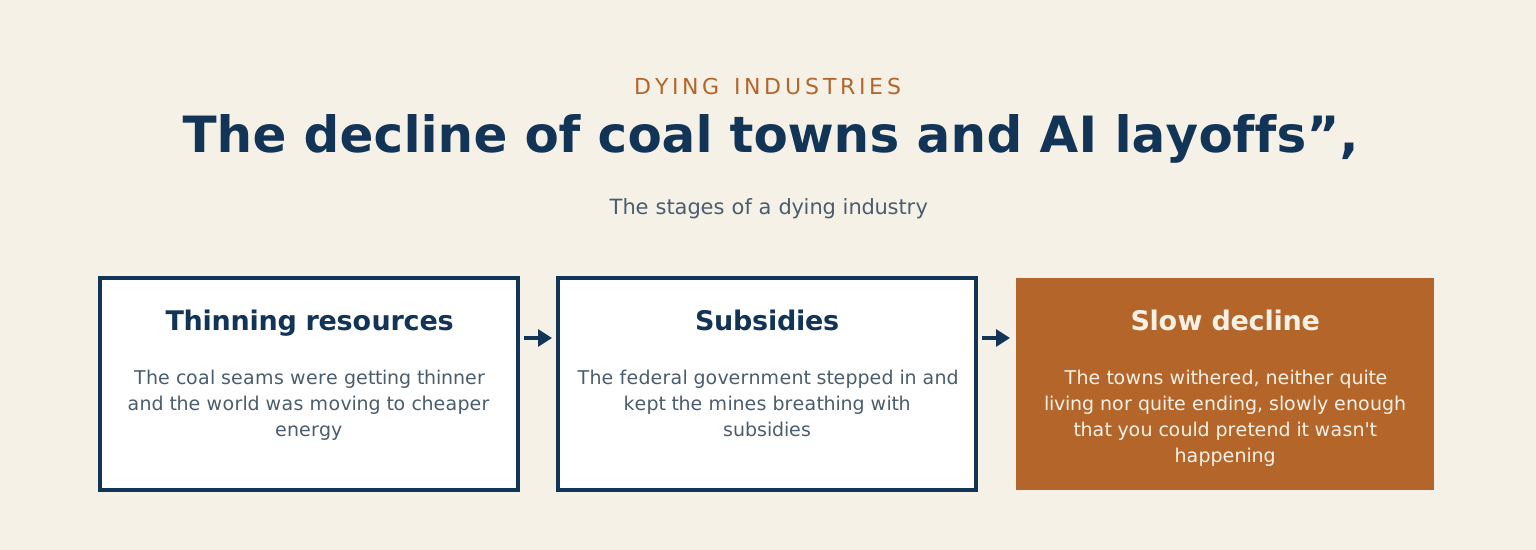
I formed my opinion about this year's AI layoffs a few decades before there was an AI to blame. I was a kid, and the Cape Breton coal mines were dying, and the strange part is that everybody knew. The seams were getting thinner and the world was moving to cheaper energy, and the numbers had stopped working long before anyone with a microphone was willing to say so.
The short version:
- Dying industries die of several causes at once. The coal seams were thinning for years before any closure announcement gave people a date to be angry at.
- My read is that AI is riding this wave of layoffs more than steering it. The economics of building software started shifting well before the robots arrived.
- "Learn to build" repeats the old "learn to code" mistake. The slogan is cheap, and the real offer, sitting down to actually teach someone, is not.
- If you lead a team through a shift like this, the honest conversation early beats the slow wither, and that early warning is the kindest thing you own.
Towns on life support
When the company is the town, honesty feels like violence. Tearing the bandaid off would have killed those communities outright, everyone understood that, so nobody tore it. The federal government stepped in and kept the mines breathing with subsidies, decade after decade, and what I watched growing up was the third option nobody designs on purpose. The towns withered, neither quite living nor quite ending, slowly enough that you could pretend it wasn't happening and fast enough that every graduating class had fewer reasons to stay.
The Senate committee that studied the Cape Breton Development Corporation quotes the Minister of Natural Resources in 1997 saying governments are no longer in the business of mega-projects or the subsidization of business and industry. Its report also says poor geological conditions contributed in large measure to the corporation's production problems.
I suspect Pennsylvania coal country could tell the same story with a different accent, and so could the steel towns that followed, the mill towns after them, and half the fishing ports on either coast. The pattern is the point: when an economy shifts underneath a community, protecting the roles looks like the kind thing to do, and the kinder thing takes more courage.
The other road
A while back I watched a documentary about island communities off the west coast of Scotland, places where the old way of life collapsed underneath the people living it. The most famous of them, St Kilda, did something in 1930 that the subsidized mines never managed: the residents wrote to the government and asked to be evacuated. A whole community, sitting down together and signing a letter that says, in effect, it's over here, help us start again somewhere it isn't.
For the record, UNESCO's listing says external pressures led to decline and, in 1930, to the abandonment of the islands. The National Trust for Scotland says the islanders wrote a letter petitioning to leave.
Imagine drafting that letter. Imagine being the person who reads it aloud before the signatures go on. It might be the bravest paragraph anybody wrote that decade, because it names the ending early enough to afford a beginning.
AI in the passenger seat
Which brings me to the layoff headlines, and the thing I think they get backwards. My read is that AI is accompanying this change in our industry rather than shepherding it. People with better data than mine disagree, and the honest position is that the split between the two is still being argued. The economics of building software started shifting years ago: tooling got dramatically better, teams learned to do more with fewer people, whole categories of work got absorbed into platforms, and budgets noticed. The robots arrived late and took the blame, the same way the coal seams were thinning long before the closure announcements gave everyone a date to be angry at.
Reading the balance sheet
Yale’s Budget Lab found that shifts in the occupational mix were well on their way during 2021, before the release of generative AI. The New York Fed's 2025 survey of firms found that only 1 percent of service firms had let workers go in response to AI over the past six months.
It is easier to blame the machine than to read the balance sheet, and I have caught myself doing it. Blaming the machine feels like something happened to you, while reading the balance sheet suggests the ending had been arriving for years, politely, while everyone looked away, and honestly, that version is harder to live with.
It is easier to blame the machine than to read the balance sheet, and I have caught myself doing it.
What you owe the people in the fading roles
A few years ago, people in my industry told laid-off manufacturing workers to “learn to code,” and I won't pretend I stood up and objected at the time. This year, in a twist of fate almost too neat to be accidental, the same professionals are hearing “learn to build” delivered with the same breezy certainty. The advice stings twice as much when you understand what it misses: work like this is a trade, and a trade is not just an income. It's an identity. Ask the miner. Ask the developer. Ask me. I build websites the way a tradesperson works a bench, and losing the trade would cut somewhere well below the wallet.
If you have lived through a shift like this in your own town or trade, when did you first know the ending was coming?
For anyone leading a team
The bandaid beats the wither: if a role in your shop is fading, the kindest thing you own is the honest conversation, early, while there's still runway to do something with it. Retraining works best when it starts before anyone needs it, which is what my training work is for and a large part of why I answer every question a beginner asks me. And if you're ever tempted to tell someone to learn to build, remember that the slogan is useless and the offer is priceless, so sit down and actually teach them.
Nobody in Cape Breton got to write the St Kilda letter. The withering wrote it for them, one moving van at a time, over thirty years. As the economics shift under our industry, we get to choose which letter we write, and when. I hope we're brave enough to write ours early.
References
- Special Senate Committee on the Cape Breton Development Corporation, report, 36th Parliament, 1st Session
- National Trust for Scotland, 90th anniversary of the evacuation of St Kilda
- UNESCO World Heritage Centre, St Kilda
- Yale Budget Lab, Evaluating the Impact of AI on the Labor Market: Current State of Affairs
- Federal Reserve Bank of New York, Are Businesses Scaling Back Hiring Due to AI?
- Wikipedia, St Kilda, Scotland
Checked against the Senate committee report, National Trust for Scotland, UNESCO, Yale Budget Lab and New York Fed pages on 2026-10-11.