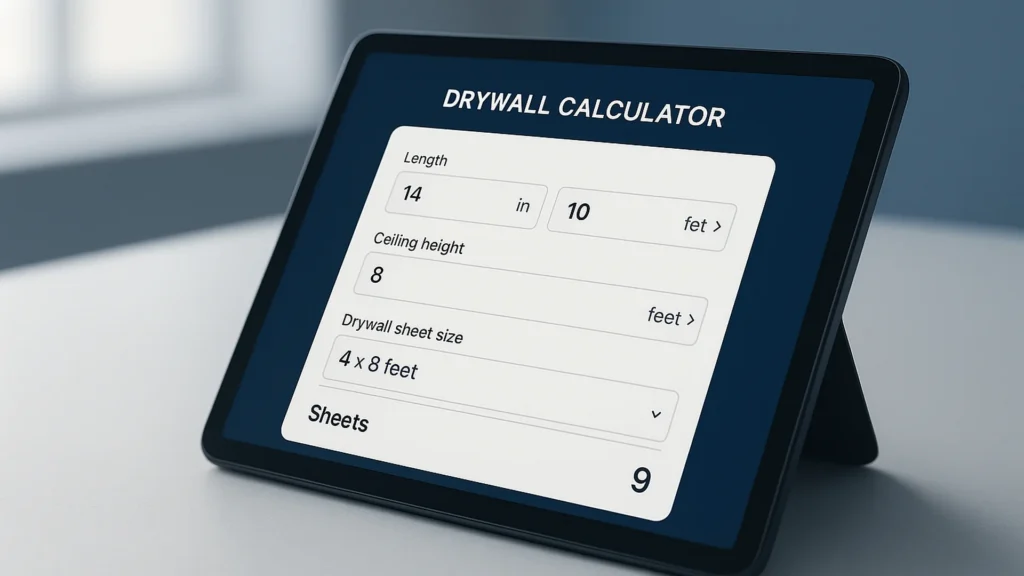
Estimate drywall sheets and optional cost with area unit conversion and wastage controls.
How this calculator works
Total surface area, plus a wastage allowance for offcuts, divided by the coverage of one sheet.
sheets = ceil( area × (1 + wastage%) ÷ coverage_per_sheet )
- Standard sheets: 4×8 (32 sq ft), 4×10 (40 sq ft), 4×12 (48 sq ft). Larger sheets mean fewer joints to tape.
- 10% wastage covers offcuts on a typical job; complex layouts with many openings can push it to 15%.
Common questions
Should I use 4×8 or 4×12 sheets?
4×12 sheets create fewer butt joints (the hardest to finish invisibly) and are the pro choice when ceilings allow. 4×8 sheets are easier to handle solo, easier to stair-haul, and fit through standard doorways without tipping.
Do I subtract doors and windows from the area?
Rule of thumb: deduct openings of about 25 sq ft or larger — patio doors, large picture windows, garage doors. Leave standard interior doors (around 21 sq ft) and standard windows (around 15 sq ft) in the area; the waste allowance absorbs them, and the offcuts are useful in the closet.
What about ceiling drywall?
Add ceiling area to wall area when both use the same sheet thickness. Ceilings often want 5/8″ for sag resistance while walls use 1/2″ — in that case, calculate them separately.
About This Drywall Calculator
This drywall calculator is designed to turn measurements into practical planning numbers you can use immediately. After entering wall and ceiling measurements, sheet sizes, waste percentages, fastener assumptions, and optional pricing, the calculator processes those values into sheet count projections, install readiness, and better coordination between estimating and field execution. The goal is to replace rough guesswork with a repeatable method that works for homeowner projects, contractor estimates, and field-level decision support. Instead of manually converting units and checking formulas in multiple places, you can complete the process in one workflow.
In day-to-day use, this drywall calculator works best when measurements are taken carefully and entered in one unit system from start to finish. That makes results easier to compare and easier to share with suppliers or team members. It is especially useful for room remodels, basement finishes, office fit-outs, and patch-to-full replacement planning where quick quantity checks can prevent under-ordering, over-ordering, and schedule changes. Using consistent inputs each time also helps standardize estimating habits across repeat jobs.
The most reliable outcomes come from combining calculator output with practical project checks. For this drywall calculator, that means planning seam layout, cut loss, and finishing material allowances before install day. Treat the result as a planning baseline, then adjust for site conditions, product availability, and project standards before final purchase or scheduling commitments. This approach gives you a safer buffer against costly surprises and keeps conversations with clients, vendors, and crews focused on clear numbers.
Use this drywall calculator as an early planning assistant, not a replacement for final site validation. It helps you test scenarios quickly, compare alternatives, and move from idea to workable estimate with fewer delays. When paired with accurate measurement habits and a final field review, the calculator can improve confidence at every stage: draft budgeting, quote preparation, procurement planning, and pre-install coordination. Revisit it whenever dimensions, material assumptions, or scope details change.