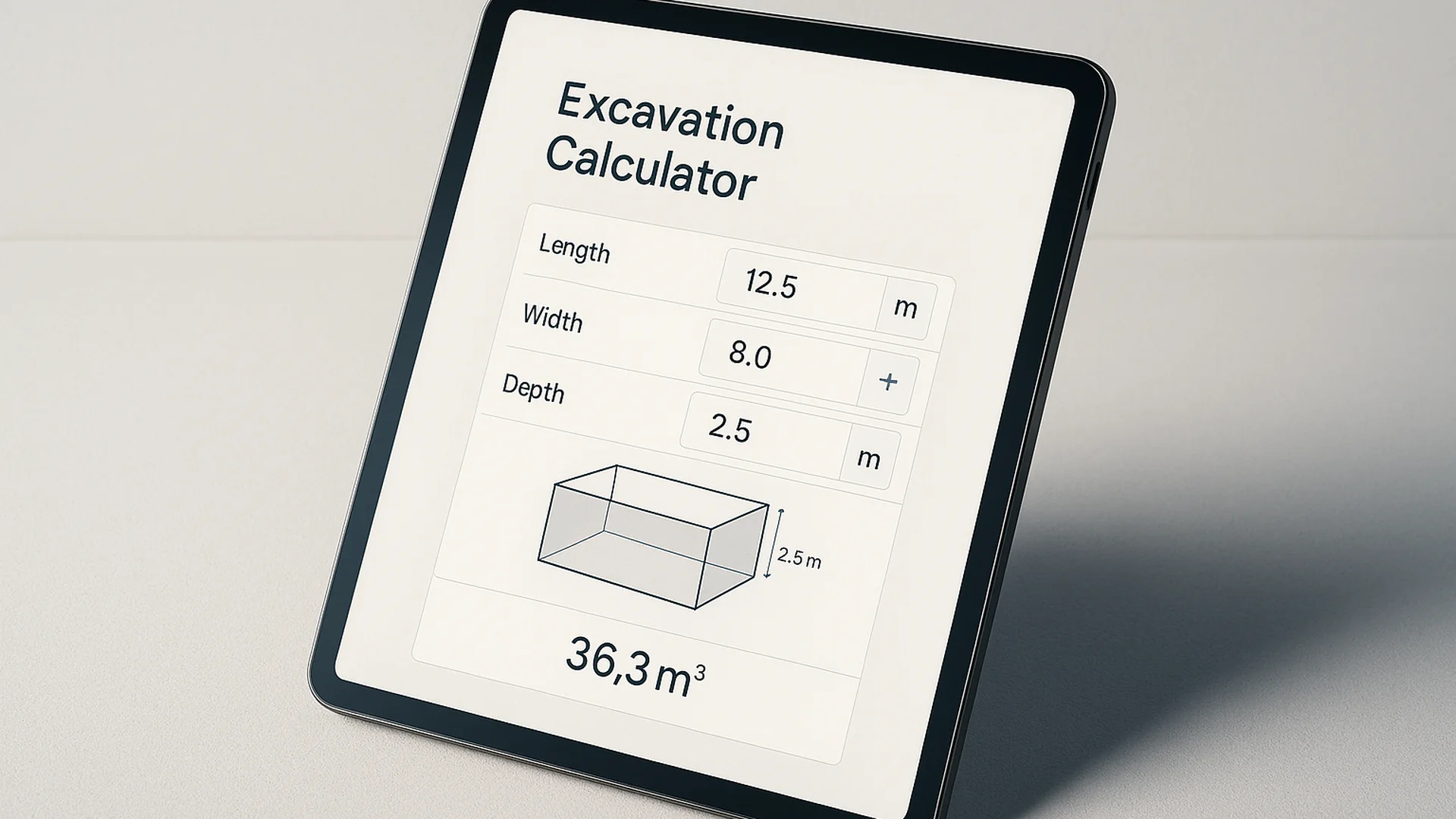
Estimate how much material to remove from a dig site, the swell factor for hauling, and the cost to excavate. Use the Fill Calculator if you are bringing material in rather than removing it.
How this is calculated
Volume is length × width × depth, with wastage and a compaction factor stacked on top.
cubic_feet = length × width × depth × (1 + wastage%) × (1 + compaction%)cubic_yards = cubic_feet ÷ 27Excavated material expands ("swell"), typically +20–30% over in-place volume, so a positive compaction factor accounts for haul tonnage.
Some authorities require a soil-management plan above a certain cubic-yard threshold; check before mobilizing.
How much does excavated soil expand?
Most soils swell 20–30% when excavated; clay is on the higher end, sand on the lower. Use a positive compaction factor (e.g., +25%) so your haul tonnage matches the loose volume coming out of the hole.
Do I need a permit to excavate?
It depends on volume, location, and what you're digging near. Most municipalities have soil-management or fill-control bylaws above a certain cubic-yard threshold. Always call locates before any dig.
Should I include over-dig in my volume?
Yes. Set the wastage allowance (typically 5–10%) to cover the over-dig that always happens at the perimeter when an excavator scoops outside the design line.
How much dirt comes out, and how much you haul
The hole you dig and the pile you truck away are never the same number, and the bill follows the bigger one. If you are pricing a dig, that gap is what you need to get right before you quote it.
A worked example
Say you are stripping a 24 ft by 24 ft area down 1 foot. That is 576 cubic feet, or 21.3 cubic yards measured in the ground. But soil swells once you break it loose, and clay is on the high end at around 30 percent. So 21.3 times 1.30 gives you 27.7 loose cubic yards on the trucks. You dig 21, you haul away nearly 28.
Common mistakes
- Quoting haul by the in-ground figure. Dirt expands the moment it leaves the bank, so you pay to move the swelled volume, not the neat hole.
- Using one swell number for everything. Clay expands the most, sand the least, so a clay site hauls more per cubic yard dug than a sandy one.
- Putting a bucket in the ground before locates. Call before you dig, every time. A struck gas or fibre line is not a rounding error you can budget around.
Everything here runs in your browser, and nothing you enter is sent anywhere or stored.
Excavation pricing scares buyers because they cannot see the number. Put a tool like this on your site and the number stops being a mystery. Book a discovery call
On the same job you may also need fill volume or concrete volume. Every calculator here is free and runs in your browser.
Leave a reply