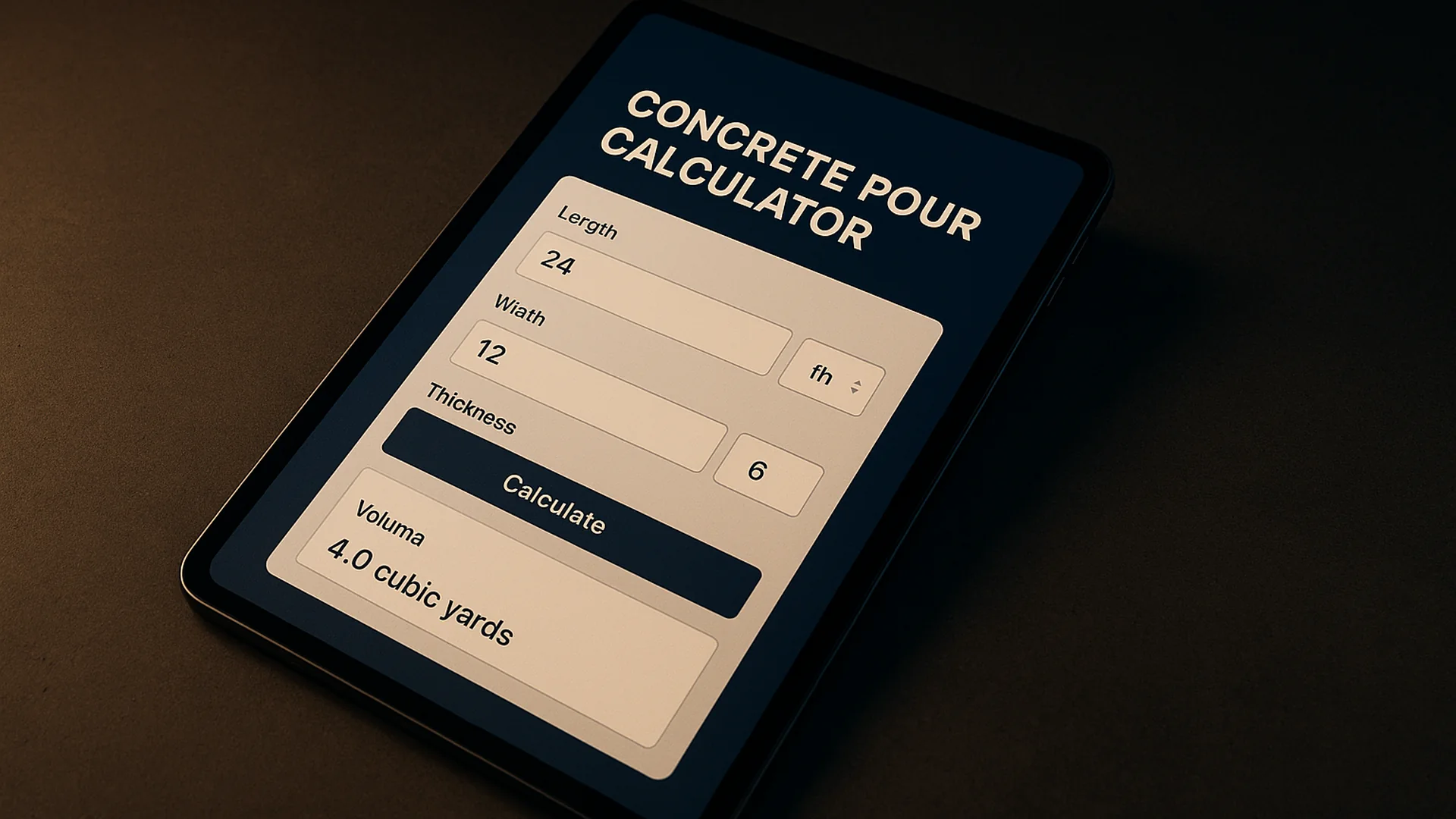
Estimate concrete volume, ready-mix yards, or bag count with unit conversion and wastage controls.

Slab Details

Slab length.

Slab width.

Unit for slab length and width.

Slab thickness.

Unit for slab thickness.

Planning Inputs

Ready-mix is sold by the cubic yard. Bags suit small jobs and post holes.

Allowance for over-excavation and finish losses.

Adjust required volume for project-specific expansion or consolidation.

Price per cubic yard or per bag, matching how you're buying.

How this calculator works

Slab volume in cubic feet, then converted to yards for ready-mix or to bags for small jobs.

  1. cubic_feet = length × width × thickness × (1 + wastage%) × (1 + compaction%)
  2. cubic_yards = cubic_feet ÷ 27
  3. bags = ceil( cubic_feet ÷ cu_ft_per_bag )
  • Ready-mix is sold by the cubic yard, often with a half-yard minimum. Bags suit small jobs, post holes, and patches.
  • 60 lb bags yield ≈ 0.45 cu ft; 80 lb bags ≈ 0.6 cu ft. A cubic yard ≈ 60× 60-lb bags or 45× 80-lb bags — past about 0.5 cu yd, ready-mix wins on price and labour.

Common questions

Bags or ready-mix?

Switch to ready-mix once you cross about 0.5 cubic yards. At that point, the bags-vs-truck math favours the truck on price, time, and consistency — and small ready-mix suppliers will deliver as little as a half-yard.

What thickness do I need?

4″ for a typical residential slab, walk, or patio. 5–6″ if vehicles will sit on it. 6″+ with rebar for driveways used by trucks or RVs. Always over a properly compacted granular base.

Should I add wastage?

I default to 10%. Drop to 7% if your forms are tight and the subgrade is dead level, hold at 10% for the typical residential pour, push to 15% on irregular forms or sloping subgrade. Wastage covers over-excavation, sub-base unevenness, and the small thickness variation between forms. Order a touch heavy; running short mid-pour is far worse than throwing a wheelbarrow extra in the back.

Spotted a bug, want a number checked, or got an idea for a calculator we don't have? Send a quick note.

The math behind a concrete order isn’t hard. The expensive part is being wrong: order short and you pay a short-load surcharge plus the cost of a second truck; order long and you pay for a yard you have to dispose of. This calculator gives you both numbers — the one that physically fits your form, and the one you actually order — so the conversation with the supplier starts from a defensible figure.

Inputs and outputs at a glance

Enter slab length, width, and thickness in any unit system, then tune two planning factors: a wastage percentage (extra to order against form irregularities and finish losses) and an optional compaction-or-expansion percentage. The calculator returns base volume in cubic yards, the inflated order volume, and — if you supply a price per cubic yard — an estimated material cost.

A sample pour

Say you’re pouring a 12 ft × 16 ft patio at 4 inches. The base volume is length × width × thickness, normalised to cubic yards:

Vbase = 12 ft × 16 ft × 0.333 ft = 64 ft³ ≈ 2.37 yd³

Add 10% wastage and the order volume — the number you take to the supplier — is:

Vorder = 2.37 yd³ × 1.10 ≈ 2.61 yd³

At $230 per yard the supplier’s quote should land around $600 plus delivery. If your supplier short-loads anything under three yards, that 2.61 number tells you exactly where you sit on the pricing band — and whether dropping the wastage to 7% (and accepting the risk) saves enough to matter.

Where this stops being useful

This is a rectangular-volume calculator. It handles patios, shed pads, garage floors, walkways, and simple strip footings or pier pours well. It is not the right tool for multi-pitch slabs, curved or radial pours, or foundation systems with grade beams and pile caps. For those, use it as a first-pass sanity check and confirm against a structural drawing or a supplier walkthrough.

On wastage: 10% by default, with a floor of 7%

10% is the figure most ready-mix supply houses recommend as a starting point for ground-level slab work, and it’s the calculator’s default. Bump to 15% if your formwork is irregular, your subgrade is sloping, or you’re pouring on a windy day with the finishing crew under pressure. Drop to 7% only if you’ve poured this exact form before and know your losses; going below that on a single-truck pour rarely saves enough to outweigh the short-load risk.

The two formulas to take away:

Vorder = Vbase × (1 + wastage% + compaction%)
cost = Vorder × price per yd³

One cubic yard equals 27 cubic feet (≈ 0.76 cubic metres). Delivery, short-load surcharges, and tax are not included — confirm those with your supplier. If you’re scoping something larger than a weekend pad — a multi-pour foundation, a structural slab, a job where sequencing matters more than the math — a sit-down with a contractor who can validate the numbers on-site is usually cheaper than getting them wrong.

Other calculators on this site

If you’re scoping a whole project, you’ll usually need more than one of these. They share the same approach — plain math, honest about edge cases, with the practical notes someone who has done the work would actually need.

  • Asphalt Calculator. Tonnage for a driveway, parking patch, or walkway pour, including the depth-to-tonnage curve a supplier will quote against.
  • Drywall Calculator. Sheets of drywall and bundles of mud for a renovation room, plus the cut and waste allowance.
  • Excavation Calculator. Cubic yards of dirt to remove for a basement, pool, or footing — including the bulking factor that surprises first-timers.
  • Fence Calculator. Lineal feet of fence, post count, rails, and gates for a property line that is rarely perfectly straight.
  • Fill Calculator. Cubic yards of fill for a regrade, a backyard level, or a low spot, plus a sensible compaction factor.
  • Lumber Calculator. Board feet for a deck, frame, or addition, in the rough framing pattern a supplier will price against.
  • Paint Calculator. Gallons of paint for a room, plus the coverage difference between primed and unprimed surfaces.
  • Tile Calculator. Square footage of tile for a floor or wall, plus the breakage and cut waste a real installation needs.

Next step

What happens next

If this is relevant to your goals, we can scope practical next steps for your Concrete Pour Calculator engagement.

A 20-minute scoping call A tailored proposal within 48 hours

Book a 20-min call