
My prices are on my website. Actual numbers, in public, where my competitors can copy them and my clients can read them before we’ve ever spoken. Other developers tell me this is a mistake, that pricing needs context, that I’m leaving money on the table. Maybe they’re right. But I keep thinking about the lumber yard.
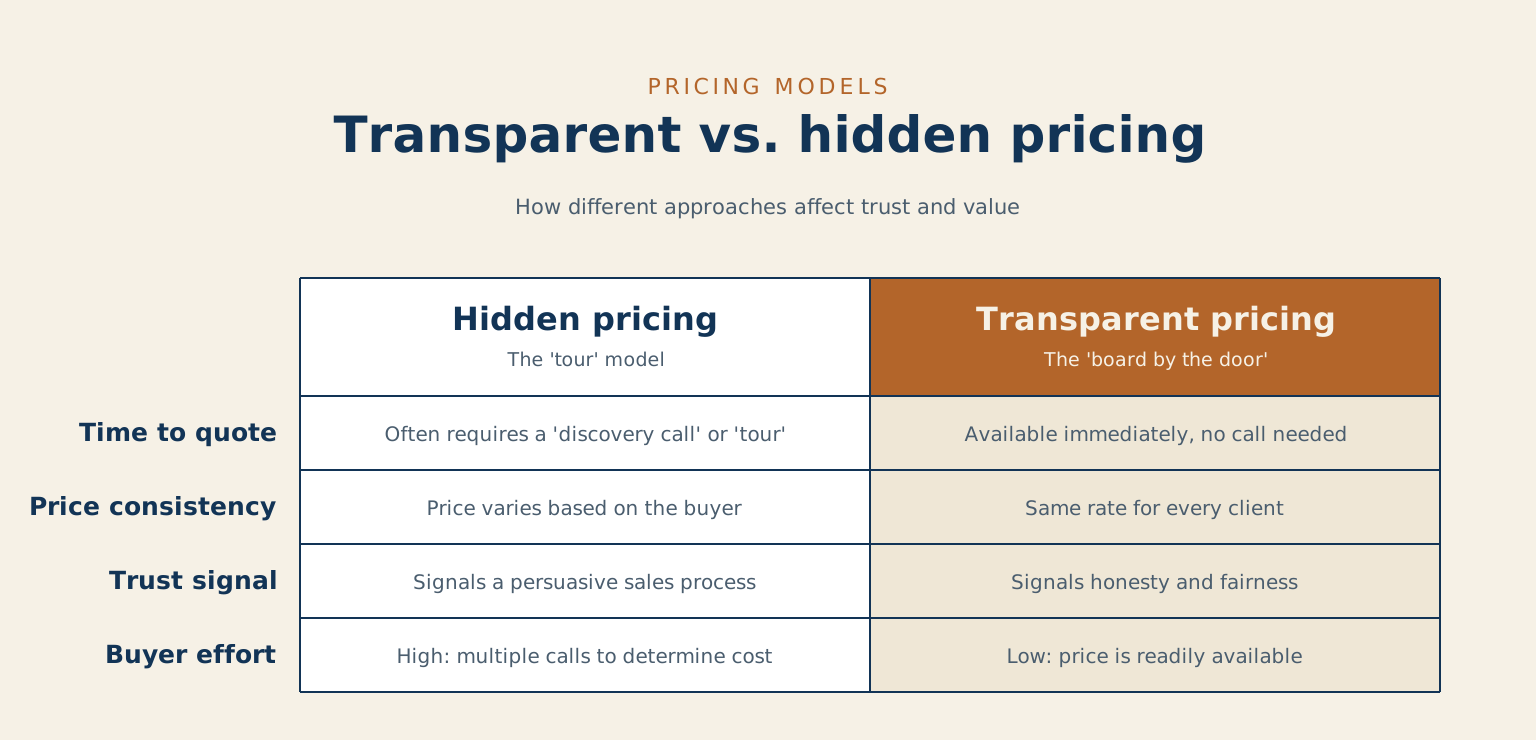
My lumber yard has a board by the door with the prices on it. Plywood, dimensional lumber, delivery, all listed, and nobody has ever booked a discovery call to learn what a sheet of good plywood costs. The board does two jobs at once. It respects your time, and it makes a quiet promise: a yard that posts its prices is telling you it charges everyone the same. You trust the board precisely because it was written before you walked in. Nobody haggles at the board either, and that’s half of why everyone trusts the yard behind it.
The tour: why vendors keep prices off the phone
Hidden pricing sits against more than one of my core values, and I learned why at a job I held years ago at a private college, where the admissions team was trained never to give prices over the phone. The reasoning was straightforward sales logic: get the family to come in for a tour, and the tour closes the expensive investment far more often than a phone call does.
Take a moment to appreciate what I’m not saying. The school was, by the numbers, a good deal. The diploma cost roughly three times what the same credential cost at a public institution, and it was earned in about half the time, which put graduates into the workforce fourteen months ahead of their public-school counterparts. Fourteen months of salary covered the premium with room to spare. The price could have stood proudly on its own merits.
They sold it as if it couldn’t. That was the part that never sat right with me. The problem was never the number, it was the choreography around the number, the decision to route every family through a persuasion pipeline instead of educating them and letting a genuinely good deal speak.
A rate that only exists in a sales conversation protects the vendor. A rate on a public page protects the buyer.
What hidden pricing costs the buyer
If you’ve ever compared three vendors whose quotes all said “it depends,” you already know the cost. Hours of calls to pry loose a figure each vendor knew perfectly well in the first minute. And the vendor who does name a number early has told you something valuable beyond the number itself: they’ve done this work often enough to know what it costs, and the buyer can feel that experience.
It matters double for anyone buying on behalf of an institution. A procurement officer comparing vendors has to defend the shortlist to somebody, and “their pricing was published and consistent” is a sentence that survives every review meeting it will ever be read into. A rate that only exists in a sales conversation protects the vendor. A rate on a public page protects the buyer.
How I price, in the open
My model is the board by the door. Fixed-price engagements where the scope genuinely supports it, time-and-materials where the work honestly doesn’t, published starting prices on the services themselves, and the same rate for every client, because a rate that moves depending on who’s asking is just the tour wearing a different jacket. I hold myself to the same rule on the side: annapolistools.com lists every price on the product page, no quote request required. It’s the same instinct behind my writing on what a records-heavy migration really costs: the buyer deserves the expensive truth early, before the tour has even started.
And here’s a fair test to carry into any vendor conversation, mine included. A vendor who wants to understand your needs before quoting is being sensible, since nobody can price work they haven’t seen. So ask what a typical engagement cost last year, smallest and largest. Anyone who has done the work can answer from memory, and the answer tells you more about how they’ll treat you than any brochure will. Ask me, and I’ll show you the board.
So here is the board. My prices are on the services pages, in public, the same for everyone, written before you walk in. If you want to talk through which engagement fits your situation, ask me and I will show you exactly where you would land.
Leave a reply