
I teach adults for a living, and my students go back to a production shop the same week I teach them. Some have been finishing wood for thirty years, some have never held a spray gun, and every one of them will be standing at a bench on Monday where the training either shows up or it doesn’t. That deadline has taught me more about instructional design than anything I’ve read for my degree.
The classroom is a flattering mirror
Here’s the pattern every trainer learns to plan for: somebody nails a technique in the session, with the instructor standing right there, and two weeks later, back under production pressure, it’s gone. Especially if they haven’t practiced in between. The learner did nothing wrong and the lesson wasn’t bad. The demo dazzles and the day job decides, and whatever survives Monday morning is the only part that was ever real.
Think about how you actually learned to drive. The classroom portion of driver’s ed taught you the signs and the rules, and then you learned to drive on the road, badly at first, with somebody calm in the passenger seat, over weeks of repetition. Workplace skills are built the same way. A day in a training room is the classroom portion. The road comes after, and most training programs simply end before the road.
Backwards design, in plain terms
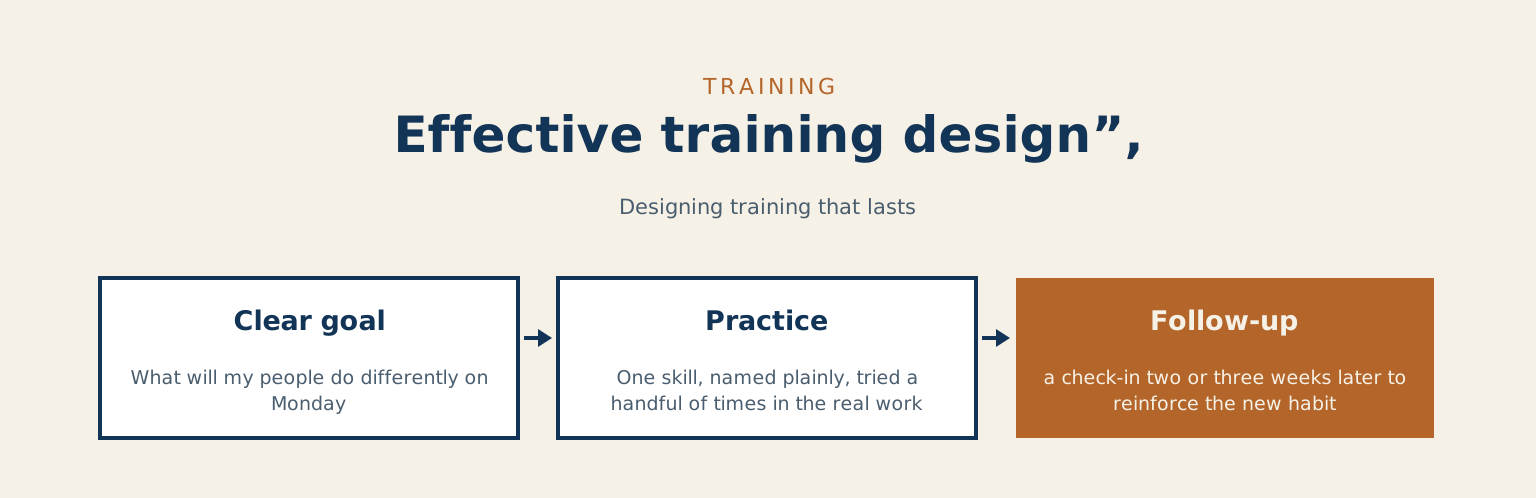
When I build a course now, I start at the end. I write down what a participant should be doing differently at their bench, or their desk, three weeks after the room empties, and I build backwards from that list. Content earns its place by serving one of those behaviours, and the pile of interesting-but-unused material I’ve cut over the years would fill a second course nobody needs.
The practice layer matters just as much as the session. Skills fade on a schedule, and the schedule is short. A session plus a practice plan plus a check-in two or three weeks later will beat a brilliant standalone workshop every time, because the follow-up lands right where the fade begins.
A practice plan sounds grander than it is. It’s one skill, named plainly, tried a handful of times in the real work over the following two weeks, with somebody expected to notice. That last part carries most of the weight. A learner who knows their supervisor will ask about the new technique on Thursday practices differently than one who suspects nobody will ever mention it again. Arranging that costs nothing, and it roughly doubles the return on whatever the session itself cost.
What to demand when you’re the buyer
If you’re responsible for buying training this year, for safety, software, sales, anything, you can evaluate every vendor with one question: what will my people do differently on Monday? It’s the question I build my own training work around, and it’s the spine of how I once compressed a newsroom’s WordPress training into two days without losing the part that transfers.
Ask it in the sales call and watch what happens. The trainers worth hiring will start talking about your shop floor instead of their slides. They’ll ask what your people do all day, what the common mistakes cost, who reinforces the new habit after they leave. The other kind will steer the conversation back to modules and learning objectives, and that tells you where their course ends.
A good proposal names the Monday behaviours in writing, builds practice into the session instead of saving it for a rushed final exercise, includes a follow-up touch after the fade has started, and briefs your managers on what to look for and encourage. Each of those items is cheap. Their absence is what an expensive workshop that changes nothing looks like from the inside. And if the proposal offers a handsome certificate but no follow-up, you’ve learned the course was designed to end at the classroom door.
Training is a purchase like any other: the receipt tells you what you paid, and only the bench tells you what you bought.
Measuring whether training changed anything is a design problem, not a survey problem, and it is what I build learning platforms to do. If you want a training program that can prove it worked, that is the heart of my learning platform work. Start with a call.
Leave a reply