The case for the second draft
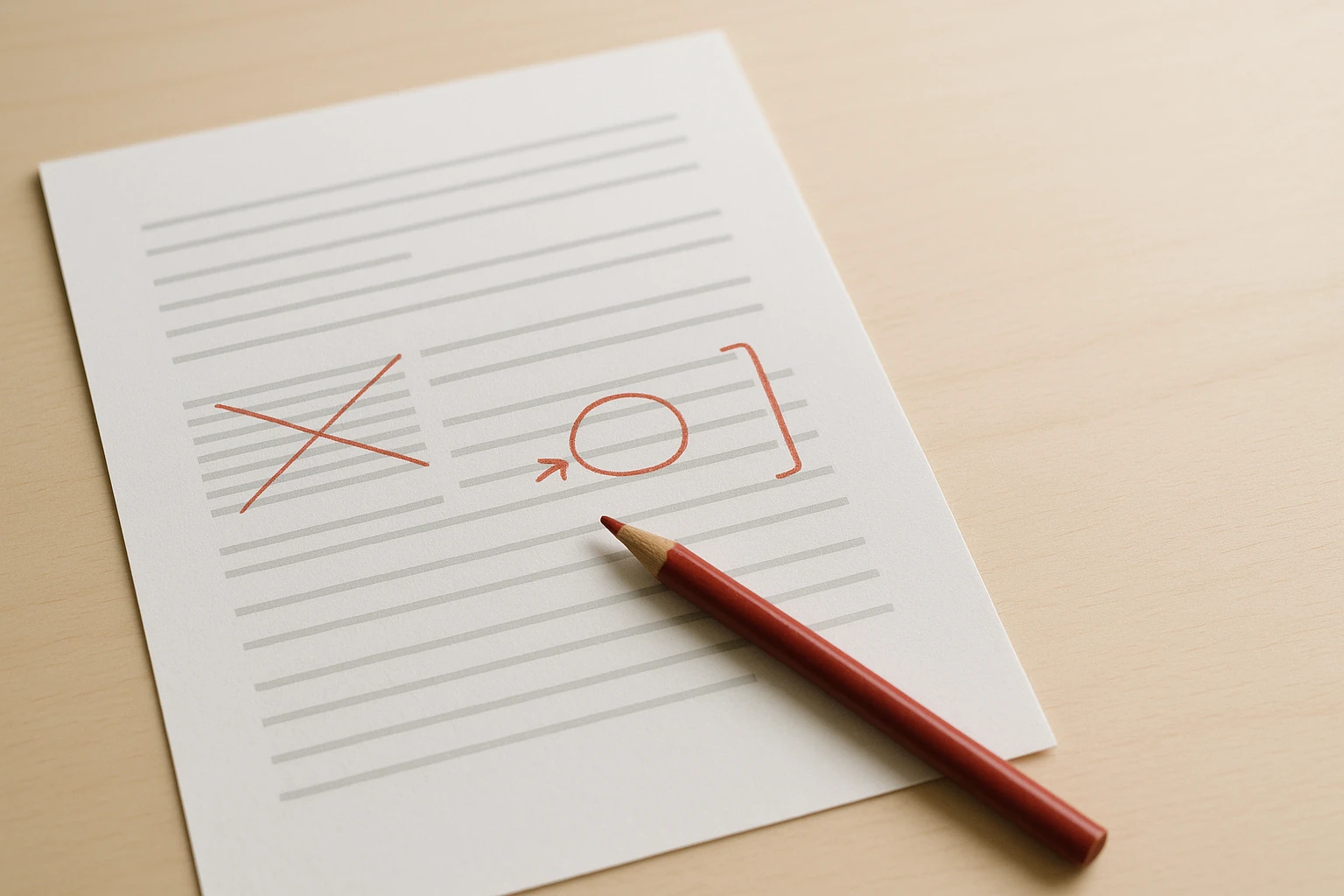
I finished a paragraph this morning, read it back, and felt that small private satisfaction of having said the thing. It was all there, the argument and the example both. And then I read it again, slower, and noticed it wasn’t a paragraph at all. It was four half-formed thoughts that happened to be sitting next to each other, holding hands, pretending to be a sentence with a destination.
That gap, between having said the thing and having said it well, is the whole reason second drafts exist.
The short version
- A first draft is for thinking. It is where you find out what you mean.
- The second draft is for the reader. It reorders and trims so a tired person can follow it in one pass.
- It gets skipped because the draft already says the thing, so it feels finished when it isn’t.
- One more pass doesn’t need a calm afternoon. Twenty minutes and fresh eyes can do it.
- The rule worth keeping: don’t send it the same day you finish it.
Here is what I think happens, and I’ve watched it happen in my own work for years. A first draft is where you find out what you think. You sit down without the argument and write your way toward it. The sentences are doing double duty, carrying meaning while also discovering it.
That’s exhausting work even when it goes well. So when you reach the end and the point is finally on the page, your brain files the job as done. The relief of arrival feels identical to the satisfaction of completion, and the two are different things. What you have is the raw material. The thing itself still needs making.
A mistake that catches capable people
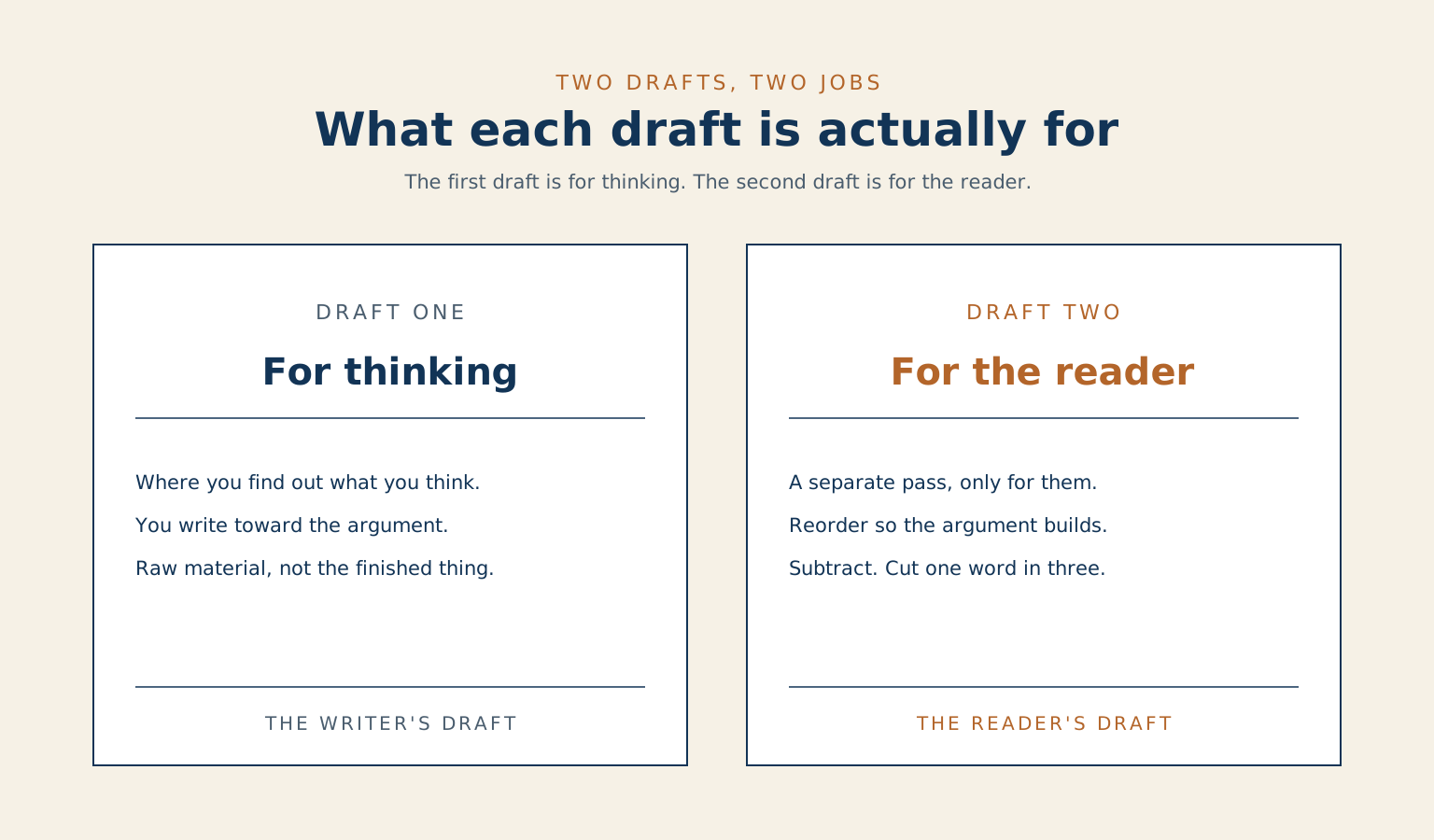
The first draft is for thinking. The second draft is for the reader.
Digital.gov’s plain language guide lists write for your audience as its first rule.
Confusing those two different jobs is a writing mistake that catches otherwise capable people, developers writing documentation, founders writing proposals under a deadline. They write until the meaning is present, and then they ship, because the meaning is present and they can see it. The trouble is the reader sits outside your head. They get what’s on the page, in the order you put it, in the words you happened to reach for first.
Nancy Sommers compared student writers with experienced adult writers in 1980. The experienced ones described their main aim in revising as finding the form or shape of their argument.
The first draft is for thinking. The second draft is for the reader.
What a second draft changes
So let me show you the difference with something specific, because “revise more” is useless advice and I’d rather give you something you can recognize.
A while back I was writing the opening of a project proposal. The first-draft version of one paragraph went roughly like this: “We have extensive experience with high-traffic publishing sites and have handled migrations of significant complexity, and our approach focuses on minimizing downtime while ensuring that editorial workflows are not disrupted during the transition period.” Every word in that sentence is true. I knew exactly what I meant. And it is a genuinely bad sentence, for reasons I couldn’t see until I came back to it the next day with the thinking already done.
Four problems in one sentence
Look at what’s wrong once you’re not the person who wrote it. The structure buries the one thing the client actually cares about (their newsroom not going dark) under a pile of throat-clearing about us. The flow stalls on “ensuring that editorial workflows are not disrupted,” which is six words doing the job of two. The tone is anxious, a person listing credentials instead of a person who has done this before. And the precision is approximate: “significant complexity,” “minimizing downtime,” “the transition period.” These are gestures at meaning. They point at it without landing on it. They’re the placeholders my first draft used while it figured out what to say.
Jakob Nielsen’s 1997 test of web pages found that 79 percent of test users scanned any new page they came across, and only 16 percent read word by word.
What the rewrite does
The second-draft version was one line. “When we move a newsroom to a new platform, the newsroom keeps publishing. That’s the part we obsess over, because it’s the part that’s hard.” Same claim. The reader now lands on their concern first, follows one clean thought to the end, hears someone who’s relaxed because they’ve done it, and reads words that mean precisely what they say. All of that came from a separate pass whose only job was the reader. The thinking was already finished before that pass began.
That’s the real shape of a second draft, and it works on a few things at once. Structure: does the argument arrive in the order that builds it, or in the order you discovered it? Those orders aren't the same, and nothing makes them line up. Flow: can a tired person read it once and follow it, or do they have to double back? What you’re left with after those two is harder to name.
| Check | The question to ask of the draft |
|---|---|
| Structure | Does the argument arrive in the order that builds it, or in the order you discovered it? |
| Flow | Can a tired person read it once and follow it, or do they have to double back? |
| Voice | Does the voice hold steady the whole way through, or lurch between confident and apologetic because the two halves were written in different moods? |
| Word choice | Do the words you reached for first mean the exact thing you said, or the roughly-correct thing your draft grabbed while it was busy thinking? |
It’s whether the voice holds steady the whole way through instead of lurching between confident and apologetic because you wrote the two halves in different moods, and whether the words you reached for first mean the exact thing you said or the roughly-correct thing your draft grabbed while it was busy thinking. Approximate writing is the tell of a draft that was never revised. It reads as fog because it was written while the writer was still finding the path.
Where the second pass goes missing
People skip this for two reasons, and neither one is the obvious one. Time, yes. There’s never a calm afternoon for a second pass; there’s a thing due, and the first draft is good enough to send, and good enough wins. But the harder reason is the one nobody admits out loud: the false sense of completion. The draft says the thing. You can read it and the meaning is right there. So it feels finished, and asking yourself to revise something that feels finished is like being asked to fix a chair you’re already sitting in comfortably.
Reading it as a stranger
The time problem is real and I won’t pretend it away. But a second draft doesn’t need the calm afternoon. It needs twenty minutes and one true thing: the willingness to read your own work as a stranger would, with the meaning no longer glowing in your head. That’s the trick the relief of arrival steals from you. When you’ve just written something, you read the page and see everything you meant. A day later, or even an hour, you read the page and see only what’s actually there. The second draft happens in that second reading. It is a refusal more than a skill: the refusal to let “I said it” pass as “they’ll get it.”
The second draft is a refusal more than a skill: the refusal to let “I said it” pass as “they’ll get it.”
Economists have a name for being unable to ignore what you know. In a 1989 paper, Camerer, Loewenstein and Weber called it the “curse of knowledge” and reported that better-informed people could not ignore what they knew, even when ignoring it was in their interest.
What the unrevised draft cost me
I think about the proposals I sent in my first-draft years, before I learned this, and I don’t wince at the writing. I wince at the cost. Every one of them was a moment where someone smart was deciding whether I knew what I was doing, and I handed them fog and trusted them to find the meaning underneath. Some did. The good ones probably moved on to the next vendor whose first sentence respected their time. I’ll never know which, and that’s the part that should bother you too: the readers you lost to the draft you decided was finished, the ones you never got to see.
Before you send it
In practice, the first draft of anything I write is 30 to 50 percent longer than what I keep. The second draft is where I do the subtraction. When I revise, I cut about one word in every three. The work is subtraction, and subtraction takes discipline. Orwell’s rule was to cut a word out whenever it is possible.
So here is the one rule worth trying on the next thing you write: don’t send it the same day you finish it. Give it an hour away from your desk, or even just a coffee, then read it back for who it’s for instead of what it says.
The UNC Writing Center makes the same point: something that sounded brilliant the moment you wrote it can prove to be less-than-brilliant once it has had a chance to incubate.
The paragraph I wrote this morning is fixed now. It took 11 minutes. The version you’d have read first was just me thinking out loud, and you were never supposed to see that part.
How long do you have to stay away from a draft before it starts to read like someone else wrote it?
Where this shows up in my work
The second-draft habit is the core of what I do on other people’s copy. If you want another set of eyes on your words, that is the writing work, and it is the same pass behind the proposals and posts I help publishers ship. The same two-pass idea applies when you ask an AI to review your work, which I wrote up in After the review, the harder problem. If you’d rather talk it through first, get in touch.
References
- Nielsen, Jakob. How users read on the web, 1997.
- Camerer, Colin, George Loewenstein and Martin Weber. The curse of knowledge in economic settings: an experimental analysis. Journal of Political Economy, 1989.
- Sommers, Nancy. Revision strategies of student writers and experienced adult writers. College Composition and Communication, 1980.
- Digital.gov. Plain language principles.
- Orwell, George. Politics and the English language, 1946.
- UNC Writing Center. Revising drafts.