
Elementor is cutting roughly 30% of its workforce, about 100 people, and the reason on the record is the speed of technological disruption in the Artificial intelligence (AI) era. That follows Wix making its own cuts about a month earlier. Two of the biggest names in visual website building, trimming hard inside a few weeks of each other, both pointing at the same culprit.
I want to be careful here, because there are real people in this. The folks clearing out their desks are almost never the ones who chose how the company would meet this moment. I have no interest in second-guessing them. My quarrel is with the explanation, not the workers, and I think the explanation deserves a harder look than it is getting.
Because when “AI” becomes the headline, it quietly does a job for everyone telling the story. It makes the change sound like weather. Something that rolled in from offshore, too fast and too strange to have planned for. And that is only part of what happened to the page builders.
The short version:
- Elementor and Wix cut staff and named AI as the cause.
- For five years, WordPress core has been absorbing the theme-building work page builders used to sell, in the open, on a published roadmap.
- The block editor now builds headers, footers, templates, and archives natively, with no extra plugin and no licence key.
- The shift was readable years in advance, so the real question was always whether to adapt to it.
What WordPress core actually took
For the last five years, WordPress core has been absorbing the exact value page builders used to sell, and it did the absorbing in plain sight. The AI framing skips that part entirely.
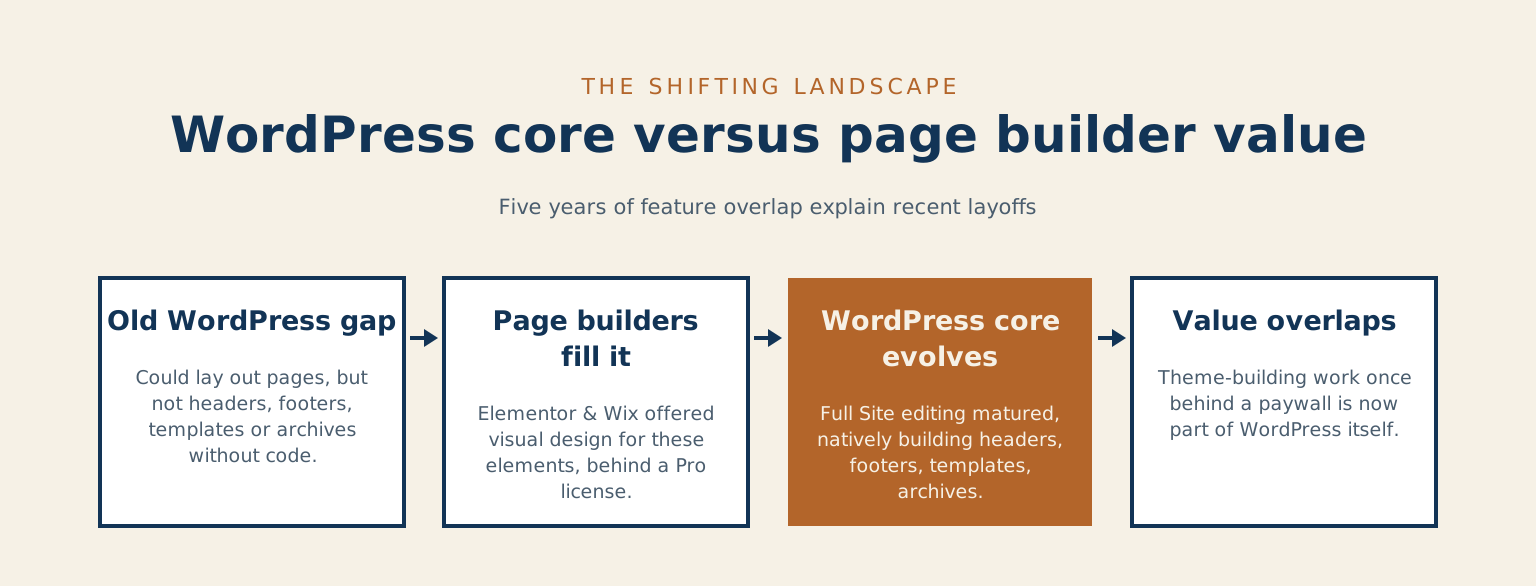
If you have been away from WordPress for a while, a quick bit of background. A page builder like Elementor existed because the old WordPress could lay out the inside of a page well enough, but it could not let you design the parts of the site that wrap around every page: your header and footer, and the template that decides how a blog post looks or how a category archive is arranged. To control those without writing PHP, you bought a builder, and usually a Pro licence on top of it. That was the gap, and it was a real gap. People paid for it gladly because the alternative was hiring a developer.
Then WordPress closed the gap itself. Full Site Editing matured. The Site Editor learned to build headers, footers, templates, and archives natively, inside the same screen where you edit a page, with no extra plugin and no licence key. The theme-building work that used to sit behind a Pro upgrade became part of the thing you already had.
Block themes came along as the default direction of the project, and they tend to be lighter and faster than the builder-heavy stacks that came before. That last part matters more than it sounds. Lighter, faster pages pass the Core Web Vitals that Google uses as a ranking signal, so the native path is cheaper and can also score better on the exact thing site owners are trying to win. The reason to keep paying for the builder got thinner with every release.
None of this was a leak or a surprise. It shipped on a public roadmap, version after version, discussed in the open by anyone who wanted to follow along. If you read it, you could see the destination years before it arrived. The market was being reshaped in slow motion, and the page builders were not the only force doing the reshaping. AI is real. So is a core platform that spent half a decade walking up to your business model.
So you can blame AI for the cuts, or you can blame WordPress for changing the game. Both are the same move: pointing at the tool, when the harder thing was always the decision about whether to adapt to it.
The sawmill that nobody wanted
There is a much older version of this story, and it has nothing to do with software.
In 1593, a Dutchman named Cornelis Corneliszoon van Uitgeest bolted a crankshaft onto a windmill and built the first wind-powered sawmill. It cut timber about thirty times faster than men sawing planks by hand. Thirty times faster. That changes what a country can build.
Amsterdam’s sawyers’ guild saw exactly what it meant for their members, and they got the machine restricted inside the city. The craft had to be protected, and so did the jobs, so they held the line. From where they stood it was the responsible thing to do.
A few miles north, in the Zaan district, nobody had the authority to ban anything. So the Zaan simply said yes. Within decades it had hundreds of sawmills and had become the workshop that helped power the Dutch Golden Age. The ships that turned a small country into a naval and trading superpower were cut there, on the machines Amsterdam had shut out.
The guild kept those jobs out of the city, and the work simply moved to where it was welcome. The sawing still got done and the ships still got built, and so did the fortunes, none of it in the city that voted to keep things as they were.
That is the part nobody wants on a slide. The companies that are still hiring through all of this tend to be the ones that treated AI and the new WordPress core the way the Zaan treated that crankshaft, as a way to multiply what their people could already do.
The change was readable in advance
The disruption did not blindside anyone who was paying attention. AI arrived roughly as promised, and so did the roadmap. It shipped in public, one release at a time, for anyone who cared to read it. The information needed to see this coming was free, dated, and sitting in plain view.
The information needed to see this coming was free, dated, and sitting in plain view.
I think that is the useful lesson buried under the layoff headlines, and it is worth taking even if you never build a website in your life. When a tool shows up that does part of your work much faster, the disruption is rarely the surprise it gets reported as. The roadmap is usually published, and the shift is usually slow enough to read. The hard part comes after: deciding what to do once you have read it, while the change is still a few releases away and easy to ignore.
So I will leave you with a question, and it is one I have to answer for myself too. When the sawmill showed up at the door, were we the Zaan or were we the guild? I know which answer sits better with me, and I know it carries an uncomfortable implication for anyone who spent the last five years hoping the change would stop on its own. I would rather sit with that honestly than file it under “AI moved too fast.” If you have watched this play out from inside the WordPress world, or from inside any trade where the machine arrived early and got argued about late, I would genuinely like to hear where you land.
Common questions about page builders and AI
Do I still need a page builder on WordPress? For most sites, no. The block editor now builds the headers, footers, templates, and archives that used to sit behind a Pro licence. If you are not sure whether to keep yours, I am happy to talk it through.
Should I move an existing site off a page builder? Only with a plan. A working site is worth more than a tidy stack, and a rushed move can break things that were fine. If the builder is slowing your pages down or costing you on licences, that is when a planned maintenance pass or a careful rescue starts to make sense.
Is AI really why these companies are cutting jobs? AI is part of it, and it is real. But the WordPress roadmap spent five years walking up to the same value these builders sold, out in the open. Blaming the tool is easier than talking about the decision to adapt to it or not.
Leave a reply