Somewhere in your building there is a report with names down one side and dates across the top, and somebody more senior than you looks at it about four times a year. That report is the thing your training program actually gets judged on, ahead of the content and a long way ahead of the platform. And if you have ever had to explain a blank cell next to a name, you already know the strange position internal training puts you in.
I have built learning platforms on both sides of that line, and the two jobs are almost nothing alike. When you sell a course to strangers, your problem is getting anyone to show up at all. When you run training inside a company, everyone shows up, because someone told them to, and your problem is that showing up is not the same as learning anything. Internal training has a failure mode the commercial side never sees: a module completed in about the time it takes to read the first screen, by somebody who has a truck to load and every intention of getting back to it later.
What you are buying with your budget is whether the work changes on Monday, and whether you can show that to a CFO who has never once asked to see your course.
The short version:
- The completion report, not the content or the platform, is what your program actually gets judged on.
- Attendance was never in question. The budget buys whether the work changes on Monday.
- Scope the build backward from the worst reporting question you could be asked.
- Split the work honestly: the knowledge goes online, the skill stays in the room.
- Build it so your team can keep it running after the builder leaves.
Your learners are guests at a dinner they did not RSVP to
Here is the way I explain this to people who have only ever bought training, never delivered it. A restaurant and a dinner at your house are both about feeding people, and that is where the similarity stops. The restaurant’s whole business is convincing a stranger to walk in, and once a diner has paid, she can hate the soup and never come back. Dinner at your house is different. Everyone is coming, that part is settled, and your actual worry is whether anyone eats, including the one guest with the shellfish thing. Then there is the second worry, which is whether you can serve this again next month without losing your Saturday to it every time.
The completion report, not the content or the platform, is what your program actually gets judged on.
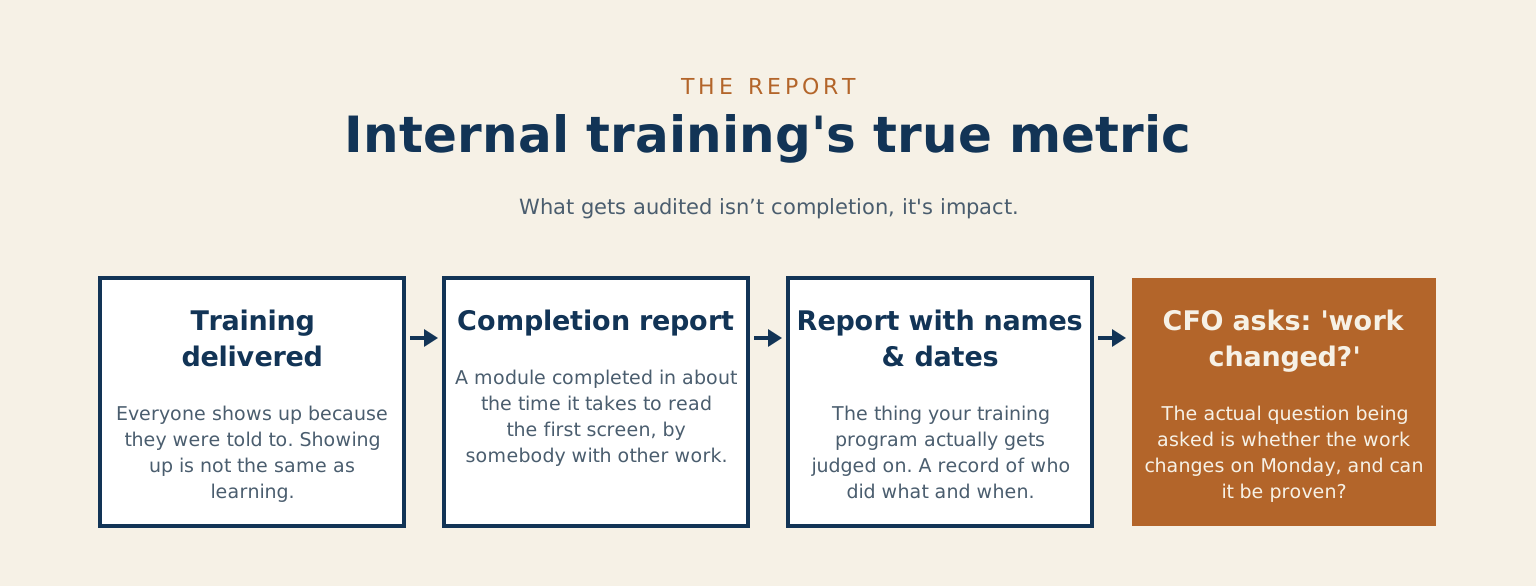
Internal training is the dinner. Attendance is not your metric because attendance was never in question. What you are buying with your budget is whether the work changes on Monday, and whether you can show that to a CFO who has never once asked to see your course.
This is why so much of the advice out there lands wrong on your desk. Most of it is written for people selling seats. If you want to see the difference for yourself, the same platform used commercially is a genuinely different design problem, and I have written that side up separately in How to sell online courses with WordPress. Useful, but it is a restaurant book, and you are hosting.
The completion report is a promise you are making on someone else’s behalf
Ask most vendors about reporting and you get a screenshot of a dashboard. Green bars and a nice export button. It looks like the answer. It is worth being slow about this, because that dashboard is answering a question nobody in your company is asking.
The questions that actually arrive, usually with no warning, sound like this. Which of our people are cleared to handle this product line, as of today. Can we prove the safety module was completed before the incident, not after. When this rep left for a competitor, what had we actually taught him. Every one of those is a question about a person on a date, and it usually needs to survive being read by someone outside your department who is unimpressed by green bars.
So when I scope an internal platform, I start at the far end. I ask what the worst reporting question you could be asked looks like, and then I make sure the system can answer that one, in writing, without anyone rebuilding a spreadsheet by hand at eleven at night. Everything else in the build is downstream of that. Honestly, this is the single question that most often changes what we build, and it takes about ten minutes to answer.
Nobody learns to spray a finish from a slide
I ran the learning platform for Sherwin-Williams’ M.L. Campbell line, serving distributor and sales teams across North America. Wood coatings. The people I was training had to go into a customer’s shop and be trusted on a product that either lays down beautifully or ruins a kitchen’s worth of cabinet doors. You cannot teach that entirely through a screen, and I would be suspicious of anyone who told you otherwise.
What worked was splitting the job honestly. The things that are knowledge went online, where somebody could take them at seven in the morning before the branch opened, and take them again in December when they had forgotten. The things that are skill stayed in the classroom and in the application lab, with product in hand. What the online side earned its keep doing was making that lab time worth flying people in for, because they arrived already knowing the vocabulary instead of spending the first morning getting there.
I am not arguing that everything should be hybrid. Plenty of compliance content is genuinely fine as a ten minute module with a quiz, and pretending otherwise wastes money. I am arguing that you should be able to say out loud which of your content is knowledge and which is skill, because a program that treats those the same is either boring people or failing them, and both show up in the report eventually.
Build it so your team can run it after the builder leaves
The M.L. Campbell program started as in-person only, which meant it lived and died on travel calendars. Rebuilding it into a hybrid was the visible work, and the part I care more about is that the team has kept it running since, without me. That was the actual design goal, and it changed decisions all the way down. Who can publish a lesson without filing a ticket, and what happens to every module that mentions a product when that product changes.
Earlier in my career I was Director of Corporate Technology for Yorkville, where I deployed LMS infrastructure across an education group and owned access management for roughly thirty six thousand students, tying Captivate, Moodle, WordPress and Salesforce together. At that scale you learn something uncomfortable quickly. The hard part is identity, permissions, and the boring question of who is allowed to see what, a long way ahead of the courseware, and most vendor demos skip it while every real deployment lives inside it.
That is also the honest test for whether your current platform is the problem. If your complaint is that the interface is dated, that is a design job. If your complaint is that you cannot get people in or get data out without filing a support ticket, the platform is the problem, and I have laid out how I think through that fork in moving a course library off Moodle.
Where I would spend the first month
Before any platform conversation, I would write down three things and take them to whoever signs off on your budget.
- The specific behaviour on the job you want different in ninety days, in the words a supervisor would use.
- The reporting question you are most afraid someone will ask.
- The name of the person who will own this in two years when you are doing something else.
Those are harder to answer than they look, and most programs have never faced them in that order. If you want to talk through what your version looks like, that is the learning platform work I do, and the first conversation costs you nothing but the ten minutes it takes to answer those three questions.
Common questions about internal training platforms
What should an internal training platform be judged on? The completion report, ahead of the content and a long way ahead of the platform. Attendance was never in question inside a company, so what you are really buying is whether the work changes on Monday, and whether you can show that to a CFO who never asked to see your course.
How do I tell if my current platform is the problem? If the complaint is a dated interface, that is a design job. If you cannot get people in or get data out without filing a support ticket, the platform is the problem, and a plain platform audit will tell you which of the two you are looking at.
Which training belongs online and which stays in the room? Put the knowledge online, where someone can take it early in the morning or take it again months later when they have forgotten. Keep the skill in the classroom or the lab with product in hand. The online side earns its keep by making the in-person time worth travelling for.
Leave a reply