Moodle to WordPress: when the move is the upgrade, and when it isn't
When moving off Moodle is the upgrade, when connecting it to WordPress is smarter, and when to stay put, with the SCORM, quiz and upgrade facts checked against the documentation.
Moodle gets a reputation it only half earns. I've sat with training teams who talk about it the way you'd talk about an old car that still starts every morning: a little embarrassed and a little loyal, quietly certain that replacing it will cost more than they want to say out loud.
Moodle is good software, and it isn't fringe. Its own statistics page counts roughly 148,000 registered sites across 237 countries,1 and a University of Windsor review of learning systems, published in January 2022, found it at 28 of the 87 Canadian higher-education institutions the team researched.2 It's open-source and free to license,3 and for plenty of institutions it is still the right tool.
If your organization has a central learning-management team and someone whose job title actually includes the letters LMS, for learning management system, you can stop reading here. Keep Moodle.
I'm writing for the smaller groups, a single department or a corporate training team, who didn't choose Moodle so much as inherit it. Usually the person who set it up has moved on, and nobody left knows how to make it do half of what it can.
Move only if the move pays for itself within three years, and when the pages that sell your courses matter more than the gradebook inside them.
Two things before the substance. I build learning platforms on WordPress, with LearnDash and Sensei among the tools, so I have a stake in half of this argument and you should weigh it that way. And a platform move changes your costs, your risk and who can look after the thing. It doesn't, by itself, change whether people use the training.
In short: keep Moodle if someone in your building really knows it and plans to stay. The pain usually sits in everything around the teaching: the patching, the hosting, the dated login screen, and the marketing pages Moodle was never built to run. Move only if the move pays for itself within three years, and when the pages that sell your courses matter more than the gradebook inside them. Check which SCORM version you run before you decide, because the case for staying is narrower than it sounds. And you may not have to move at all: you can connect Moodle to a WordPress front door and keep both.
Somebody in the building knows Moodle well enough to fix it on a Tuesday afternoon.
What Moodle does well
Its strengths are exactly what you'll miss if you move for the wrong reasons. Moodle takes assessment seriously: its documentation lists 17 question types, including calculated questions, three drag-and-drop variants, and embedded-answer (Cloze) questions where several answers sit inside one passage of text.4
Compliance content is where Moodle's reputation is strongest, so I want to be precise about it. SCORM is the packaging standard that lets a course made in an authoring tool run inside an LMS and report back on it. Moodle's own FAQ says SCORM 1.2 is supported and passes the conformance test suite of the Advanced Distributed Learning initiative, that SCORM 2004 is not supported and native development on it has stopped, and that the newer xAPI standard runs through third-party plugins.5 So the "stay for SCORM" case is real for a catalogue of SCORM 1.2 packages, and thinner for SCORM 2004, where staying buys you nothing native.
The WordPress side isn't a clean win either. LearnDash's documentation says SCORM 1.2 and SCORM 2004 packages run through a third-party add-on, and that content built inside LearnDash is not itself SCORM-compliant; xAPI needs a plugin plus a separate record-keeping service called a learning record store.6 That page is dated 2019, so confirm it with the vendor. Sensei's FAQ says it has no built-in SCORM support,7 and LifterLMS's own blog walks through a third-party plugin to do it.8 The gap is how SCORM 1.2 packages run and report, and I found no published comparison of that reporting. Install a trial, run one real package, and pull the completion report you'd hand an auditor. If it comes out clean, SCORM stops being a reason to stay.
Where it starts to pinch
Most of the trouble lives in everything around the teaching. Licensing is the free part. The running cost is the person who patches it, the hosting quick enough that learners don't wander off, and a developer on call for the morning an upgrade breaks a plugin and nobody in the building knows why. That last one is documented. Moodle ships a major release every six months and publishes support windows: 4.5, a long-term support release, gets security fixes until 4 October 2027, and 5.3, released on 5 October 2026, gets them until 1 October 2029.9 The upgrade documentation tells you to test on a copy of your production site and to check that every third-party plugin has a version for the release you're moving to.10 I've watched departments spend more keeping a "free" Moodle alive than a licensed platform would have cost them outright. I can't give you a dataset for that, and most of that spend stays invisible until the day something breaks.
Then there's how it feels to use. Unless someone has put real effort into theming it, the Moodle a learner logs into in 2026 looks like the software it is: capable but dense, and behind what people now expect from anything with a login screen. That's opinion. And the part that often holds the real value, the public catalogue that talks someone into enrolling at all, plus the landing pages and instructor profiles feeding it, Moodle was never built to be good at. Most of the teams I've worked with end up running a marketing website on one system and their courses on another, paying to maintain two things that barely speak to each other.
The honest case for WordPress
A WordPress LMS earns its place when the pages around the course matter more to you than the gradebook inside it. If the pages that sell the course are more strategic than the mechanics of delivering it, WordPress lets you run both in one place, with one team, on a stack your marketing people may already know. The course engine itself is a plugin: LearnDash, LifterLMS or Sensei, depending on the shape of your curriculum. If the budget is what decides this, my LMS cost calculator puts WordPress, Moodle and Canvas on the same multi-year footing. It's my model, with its assumptions on the page, and it leaves out migration, single sign-on, accessibility work and staff training time, which you'd add yourself.11
Quizzes are where migrations get specific. LearnDash's documentation lists eight question formats: single choice, multiple choice, free choice, sorting choice, matrix sorting choice, fill in the blank, assessment and essay.12 That list has no calculated, drag-and-drop or embedded-answer type, and fill in the blank is only a partial stand-in for Cloze. I haven't checked LifterLMS's or Sensei's lists, and I can't give you a conversion rate because I found no published one. Count your questions by type. That's step two below, and it's the cheapest way to find out how much of your quiz bank is straightforward.
If your catalogue is public and earns search traffic, the move has to protect those web addresses. Google's guidance is to map each old URL to its specific new destination with server-side permanent redirects and keep them in place for generally at least a year, and to expect temporary ranking fluctuation while the move settles.13 Moodle's long, messy course addresses make that fiddly, and a catalogue that breaks its links on launch day undoes goodwill you spent years building.
The real cost of the move is ownership. On WordPress you pick the hosting, the backups and the plugins, and you're the one who gets the call when one of them misbehaves. Some teams want exactly that. If yours was quietly hoping someone else would hold the pager, it's worth knowing before you sign. I built a consolidation like this for the M.L. Campbell distributor training network, where a custom WordPress and LearnDash build replaced an off-the-shelf platform that billed per seat.14 That's my own account, and it wasn't a Moodle exit.
| Decision factor | Argues for staying on Moodle | Argues for moving to WordPress |
|---|---|---|
| Assessment depth | Your quizzes use calculated, drag-and-drop or embedded-answer questions, which Moodle lists natively and LearnDash's list doesn't include. | Your quizzes are mostly single choice, multiple choice and essay, all of which LearnDash lists. |
| SCORM and xAPI | Your catalogue is SCORM 1.2 packages and the completion report your auditor sees already works. | You need SCORM 2004, which Moodle doesn't support, or xAPI, which is a plugin on both platforms. |
| Pages around the course | The surrounding pages aren't doing strategic work, so there's little to gain by consolidating them. | The landing pages, instructor profiles and public catalogue matter more than the gradebook, and WordPress runs both in one place with one team. |
| In-house expertise | You have real in-house Moodle expertise, people who know the platform and keep it healthy. | You're carrying the invisible cost of patching, hosting, and a developer to phone when an upgrade breaks a plugin. |
| Three-year payback | The migration would cost more than three years of what Moodle costs you now. The numbers aren't there. | The move pays for itself inside three years. If the maths misses, the case is riding on preference and should wait for a better budget year. |
| Locked integrations | Moodle syncs enrolment overnight from your student information system, and recreating a sync nobody notices is expensive. | No locked integration stands in the way, so the pages and ownership case can decide the move on their own terms. |
When to stay put
I'd tell you to stay on Moodle in four cases, and I mean each of them.
- Somebody in the building knows Moodle well enough to fix it on a Tuesday afternoon, and that person isn't about to retire or resign. In-house knowledge is the cheapest support contract you will ever hold.
- Your compliance courses are SCORM 1.2 packages and the completion report you hand an auditor already comes out of Moodle clean.
- Your Moodle syncs enrolment from your student information system and it runs overnight without anyone thinking about it.
- Three years of what Moodle costs you now adds up to less than the migration quote, once you've added the staff hours that never make it into a quote.
That last case is the one I'd test first. If you can't show the move paying for itself inside three years, it's a want, not a plan. The three-year test is my own rule of thumb, but the hidden part has evidence behind it. In a study of a Canadian university's learning-system migration, faculty reported that they hadn't anticipated the time the conversion required, and the institution had decided at the outset that no compensation was available.15 That was Nipissing University moving between two proprietary systems, WebCT and Blackboard, so treat it as an analogy for Moodle. It matches the pattern I see: the staff hours are the line that never makes it into the quote.
The costs procurement tends to miss
If you do decide to move, video hosting is the line that surprises people. A WordPress LMS carrying real video usually wants a dedicated host such as Vimeo, Wistia or Bunny Stream, and those bill by storage and delivery. Bunny Stream's pricing page, for example, lists storage and delivery per gigabyte, with free encoding and a monthly minimum,16 so check the currency on the day you read it and run your own viewing hours through the maths. Plugin licensing across the LMS, video, payments and sign-in is the next line, and SCORM and xAPI tooling behind it means licences and a learning record store to budget like any other line.
Then there's the part nobody enjoys, and it depends on what kind of organization you are. If you're in Ontario and you're a public-sector body, or a business or non-profit with 50 or more staff, the province's guidance says your public website and web content posted after 1 January 2012 must meet the Web Content Accessibility Guidelines (WCAG) 2.0 at Level AA, with live captions and pre-recorded audio description excepted.17 The W3C says content that conforms to WCAG 2.2 also conforms to 2.0, so building to the current version should cover the level Ontario names.18 The federal Accessible Canada Act and the Official Languages Act reach you if you're federally regulated or a federal institution; on my reading, a provincial college or a private trainer sits outside both.1920
On privacy, the useful question is where your learner records will live. The federal privacy commissioner's summary says municipalities, universities, schools and hospitals are generally covered by provincial laws rather than the federal Personal Information Protection and Electronic Documents Act (PIPEDA), which may apply only in certain situations.21 If your LMS or video host keeps learner data outside Canada, the commissioner's cross-border guidance, which dates from 2009, says PIPEDA doesn't prohibit it, as long as you use contracts or other means to give the data comparable protection.22 In my experience either platform can meet all of this if you plan for it at the start, and that's a lot cheaper than finding the gap in an audit. I'm not a lawyer, and I read Ontario's plain-language guidance rather than the regulation, so have yours confirm which of these apply to you.
How the conversion actually works, step by step
People ask me what the move looks like in practice, so here is the shape of the Moodle to WordPress conversions I've run. The order matters more than the tools. Skip the first two steps and you find out what you lost on cutover morning, which is the expensive way to learn it.
- Audit what you actually have. Export the course list, the enrolment counts and the question bank. In my projects, inherited Moodles have usually carried years of dead courses and duplicate quizzes, and the audit has shrunk the job by about a third before anyone builds anything.
- Map every question type. Compare your bank against the target plugin's list. Ordinary multiple choice generally has an equivalent. Calculated, drag-and-drop and Cloze usually don't, and you decide now whether to rebuild, simplify or drop each one.
- Export the records you are obliged to keep. Moodle's grade export offers Excel, OpenDocument, plain text and XML.23 Completion data, grades and certificates stay archived as the audit trail. You don't migrate history into the new gradebook; you preserve it where a regulator can read it.
- Choose the course engine and build the shell. LearnDash, LifterLMS or Sensei, picked by the shape of your curriculum. Courses, lessons and topics are created empty first so the structure can be reviewed before content pours in.
- Move the content, then rebuild the assessments. Moodle's course backup is built to transfer a course to another Moodle site,24 so don't expect another LMS to read it; text and files move by script or by hand. Quizzes are rebuilt from the map in step two, and every quiz is taken once by a person before it's called done.
- Map the old web addresses. Every public Moodle course URL gets a permanent redirect to its new page, so the search traffic and the bookmarks survive the move. This is the step that gets skipped when the budget is tight, and in my experience it costs the most to skip.
- Run both for a short overlap, then turn Moodle off. Learners finish in-flight courses where they started. New enrolments go to WordPress. When the last cohort is out, Moodle goes read-only, then dark.
In my own projects, a department with a few dozen courses and a clean question bank has moved in six to ten weeks, and a catalogue with hundreds of courses, SCORM packages and a student-information-system sync has taken a season. Those are my records, not an industry benchmark. The sync is the part to scope first.
You might not have to move off Moodle at all
Everything above assumes you're leaving Moodle. Plenty of people should. But there's a second door: connect the two and keep both. Migration is moving to a new house, where you pack everything and hand back the keys. Integration is an addition to the house you have: the old rooms stay as they are, you add the space you were missing, and you cut a door between them.
When migration is the right call
Move off Moodle when Moodle itself is the problem: the thing that keeps breaking, the thing that's hard to update, the thing nobody on your team wants to log into. When I was Director of Technology for the Yorkville group of schools, the Moodle at Toronto Film School crashed constantly, because a film program throws enormous video and media files at the system and the file handling buckled under the load. There was no three-year payback maths to run. Students couldn't reliably reach their own coursework, and that's its own kind of emergency. I built them a working tool on WordPress that held up to what their students needed. This one's from memory, with no public write-up behind it.
When connecting is the right call
Connect rather than replace when Moodle is doing a job it does well and you only need to add something around it. Your courses run fine and your people know it, and what you need is a better front door: a public website that markets the courses, signs people up, and sends them into the Moodle they already have.
How the connection actually works
There are three ways to connect them, and they aren't interchangeable. Which one you need depends on what you want the learner to notice.
| Option | What it does | Effort | Watch for |
|---|---|---|---|
| The front door | WordPress runs the public site, the catalogue and the enrolment form; each course page links the learner into Moodle. Nothing syncs | The cheapest option | The learner sees two systems |
| Shared sign-in | Both systems trust one identity, so a learner signed in on WordPress is already signed in on Moodle | A configuration job on both sides, not a build. OAuth 2 and LDAP are core; SAML2 is a third-party plugin from Catalyst IT | The plugin joins the list of things to keep current. Not available on MoodleCloud standard plans |
| Enrolment sync | A purchase or sign-up on WordPress creates the Moodle enrolment, and completion in Moodle writes back to the learner's WordPress record | A small plugin on the WordPress side, talking to Moodle's web services | What you buy when the marketing site has to know who finished what. Not available on MoodleCloud standard plans |
The front door. WordPress runs the public site, the catalogue and the enrolment form, and each course page links the learner into Moodle to take the course. Nothing syncs. It's the cheapest option and it's honest about the seam: the learner sees two systems.
Shared sign-in. Both systems trust one identity, so a learner who signs in on the WordPress side is already signed in when they land in Moodle. Moodle's core sign-in options include OAuth 2 and LDAP,25 and SAML2, the standard many universities and large employers run, is a third-party plugin from Catalyst IT.26 That's a configuration job on both sides rather than a build, though the plugin joins the list of things to keep current.
Enrolment sync. A purchase or sign-up on WordPress creates the enrolment in Moodle, and completion in Moodle writes back to the learner's WordPress record. Moodle's web services let other systems log in and perform operations,27 so in my experience this is a small plugin on the WordPress side talking to Moodle. It's what you buy when the marketing site has to know who finished what.
One warning for the second and third options. MoodleCloud, Moodle's own paid hosting, doesn't allow you to install plugins or integrations on any of its standard plans.28 If you're hosted there, a SAML2 plugin or a custom sync isn't available until you move to a partner or to your own hosting. If a second login screen is acceptable, the front door may be all you need, and it costs a fraction of the other two.
How to tell which one you need
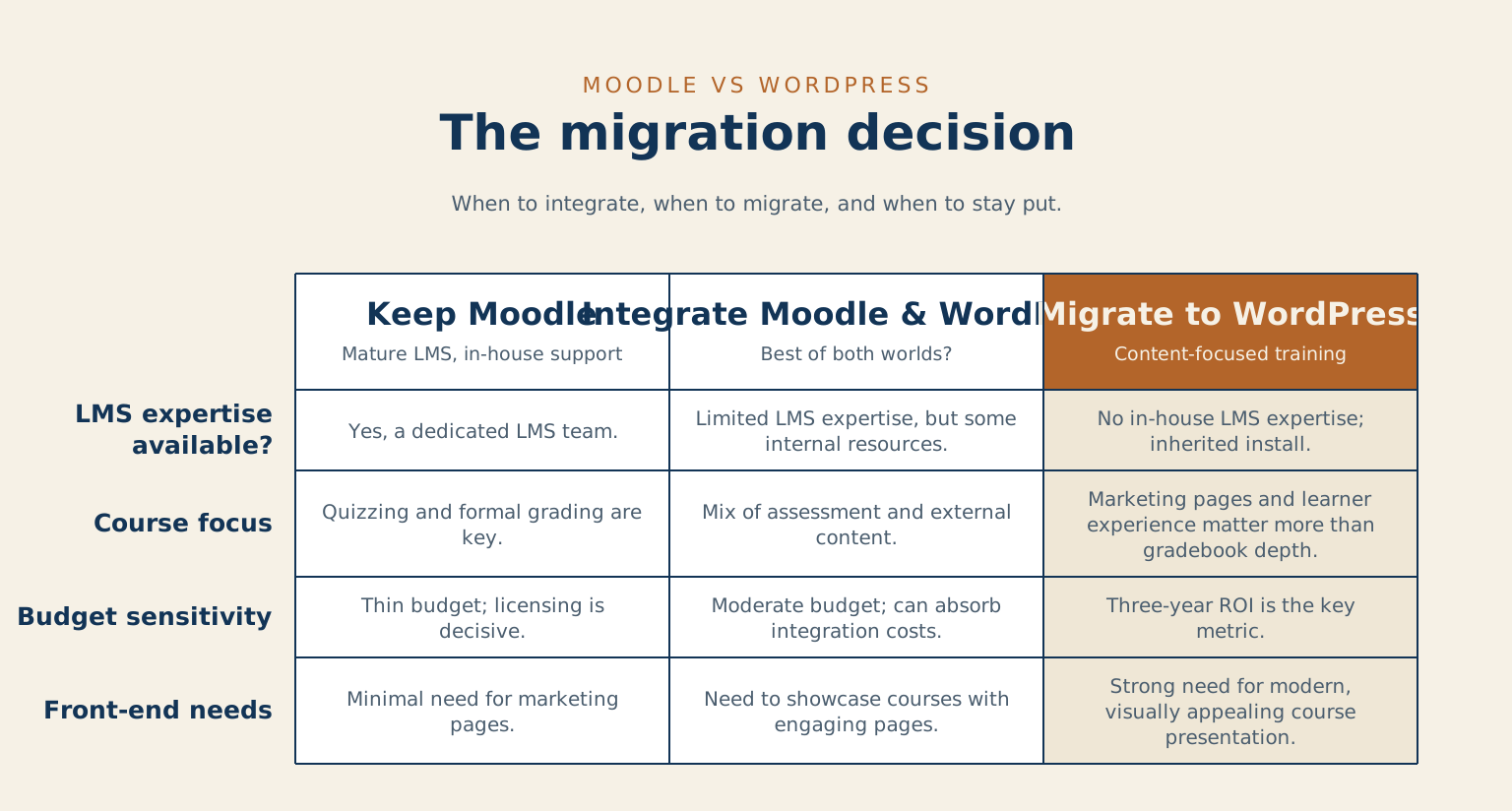
Ask the plain question: is Moodle the problem, or is the gap around Moodle the problem? If Moodle is the thing that breaks, frustrates or limits you, migration is on the table and everything above applies. If Moodle is fine and the gap is the marketing, the sign-ups and the public site, integration keeps what works and adds what's missing.
| Your situation | The call | Why |
|---|---|---|
| Somebody in the building knows Moodle well and isn't about to leave; your compliance courses are SCORM 1.2 and the audit report comes out clean; enrolment syncs overnight from your student information system; or three years of Moodle costs less than the migration quote | Stay on Moodle | Any one of the four is enough. If the move can't pay for itself inside three years, it's a want, not a plan |
| Moodle itself is the thing that keeps breaking, is hard to update, or nobody wants to log into | Migrate | Moodle is the problem, so everything about the move applies |
| Moodle is fine and the gap is the marketing, the sign-ups and the public site | Connect and keep both | Integration keeps what works and adds what's missing |
Common questions about moving off Moodle
Will my Moodle quizzes survive the move?
Some will and some won't, and I can't give you a percentage. Moodle lists 17 question types and LearnDash lists eight, so the straightforward types have equivalents and calculated, drag-and-drop and embedded-answer questions generally don't. Count yours by type during planning rather than on cutover morning. The mapping is step two of the conversion process above.
Can I keep my Moodle gradebook when I move to WordPress?
Not as a live gradebook. Grades and completions are exported from Moodle and archived as the record, and the WordPress LMS starts a new gradebook from the day it goes live. If a regulator or an auditor needs the history, they read the archive.
Does WordPress support SCORM?
Not out of the box. LearnDash and LifterLMS rely on a third-party add-on to run SCORM packages, and Sensei says it has no built-in SCORM support. Moodle supports SCORM 1.2 natively and not SCORM 2004. If most of your catalogue is SCORM 1.2 compliance content, test the completion report on a trial before you decide.
How long does a Moodle to WordPress migration take?
In my projects, six to ten weeks for a department with a few dozen courses and a clean question bank, and a season for a catalogue with hundreds of courses and a sync to a student information system. The sync and the URL mapping stretch a schedule, so scope them first.
How do I know it is worth the money?
Run the three-year test first. If you're still not sure which side of the line you fall on, tell me about your setup and I'll give you a straight answer. And if you want to see what a connected build looks like, I wrote up my approach in how to build a corporate training platform.
What's documented and what's mine
Moodle's licence, release schedule, question types, SCORM support and authentication options come from Moodle's own documentation. The WordPress plugins' SCORM positions come from their vendors. Google's redirect guidance, Ontario's accessibility rules and the privacy commissioner's guidance come from their publishers. The three-year test, the six-to-ten-week range, the audit shrinking the job by a third, what I say about Toronto Film School and M.L. Campbell, and the view that someone's knowledge is the cheapest support contract are mine, from my own projects, with no study behind them. A few sources have age on them: the LearnDash SCORM page is from 2019, Moodle's SCORM FAQ was last edited in April 2024, and the cross-border privacy guidance is from 2009. I couldn't open the Advanced Distributed Learning pages that define SCORM, so I've described it from Moodle's and the vendors' documents. I read these on 11 October 2026. If something here is wrong, tell me, and I'll add a dated correction at the foot of the post rather than editing it in silently.
References
- Moodle HQ, Moodle statistics. No date shown on the page; the count drifts. Read 11 October 2026.
- Dhillon, R., and Delic, H., LMS review 2021: environmental scan, University of Windsor, cover dated January 2022.
- MoodleDocs, About Moodle, last edited 20 July 2026.
- MoodleDocs, Question types, last edited 22 August 2025.
- MoodleDocs, SCORM FAQ, last edited 16 April 2024.
- LearnDash documentation (hosted by Nexcess), SCORM and xAPI, published 14 April 2019.
- Sensei LMS, Frequently asked questions. Undated.
- Von Ahnen, K., How to display SCORM on WordPress using LifterLMS, LifterLMS blog, 16 March 2023 (modified 21 June 2024). A vendor blog post, not formal documentation.
- Moodle HQ, Releases, Moodle Developer Resources, updated 4 October 2026.
- MoodleDocs, Upgrading, last edited 5 October 2026.
- Ross, C., WordPress LMS cost calculator (vs Moodle, vs Canvas, vs LearnDash), thisismyurl.com, July 2026. My own model; its assumptions are stated on the page.
- LearnDash documentation (hosted by Nexcess), Quiz questions, last updated 2 July 2026.
- Google Search Central, How to move a site, last updated 20 August 2026.
- Ross, C., M.L. Campbell's distributor training center: a custom LearnDash LMS, thisismyurl.com, 26 May 2026. My own case study.
- Ryan, T. G., Toye, M., Charron, K., and Park, G., Learning management system migration: an analysis of stakeholder perspectives, International Review of Research in Open and Distributed Learning, January 2012.
- Bunny.net, Bunny Stream pricing. Undated; read 11 October 2026.
- Government of Ontario, How to make websites accessible, last updated 21 September 2026.
- World Wide Web Consortium, Web Content Accessibility Guidelines (WCAG) 2.2, W3C Recommendation, 12 December 2024.
- Justice Laws Website, Accessible Canada Act (S.C. 2019, c. 10), current to 21 September 2026.
- Justice Laws Website, Official Languages Act (R.S.C., 1985, c. 31 (4th Supp.)), current to 21 September 2026.
- Office of the Privacy Commissioner of Canada, Summary of privacy laws in Canada, modified 31 January 2018.
- Office of the Privacy Commissioner of Canada, Guidelines for processing personal data across borders, modified 27 January 2009.
- MoodleDocs, Grade export, last edited 24 November 2025.
- MoodleDocs, Course backup, last edited 7 November 2025.
- MoodleDocs, Authentication, last edited 19 August 2026.
- Catalyst IT, SAML2 single sign on, Moodle Marketplace, latest release 2 April 2026.
- MoodleDocs, Web services, last edited 1 October 2026.
- Moodle HQ, MoodleCloud standard plans. Undated; read 11 October 2026.