
Most businesses looking for SEO help end up talking to agencies that lead with rankings dashboards and monthly reports packed with metrics that look important but don’t explain much. If you’re in the Buffalo-Niagara area and you’ve been through that experience, you already know what I mean: the reports arrive on schedule, the rankings don’t move, and nobody quite explains why.
Usually the answer lives one layer below the rankings. It’s in the site’s technical structure, which search engines either read cleanly or can’t navigate at all. Content and backlinks matter; they matter a lot. But they’re working on top of a foundation, and when the foundation has problems, no amount of content strategy fixes them.
I’m Christopher Ross, based in Niagara, Ontario. I do technical SEO consulting and SEO training for teams who want to understand what’s actually going on with their site, not just receive a monthly report about it. Most of my work is done remotely, which means geography is largely beside the point.
What the technical side of SEO actually covers
Think of your website like a library, and Google’s crawler like the librarian whose job is to catalog every book in the building. If the books are shelved in the wrong section, some aisles are locked, the catalog system is broken, or half the titles are duplicated under different call numbers, the librarian can’t do the job right, no matter how well-written the books are. Technical SEO is the work of making sure the librarian can get in, find everything, and file it correctly.
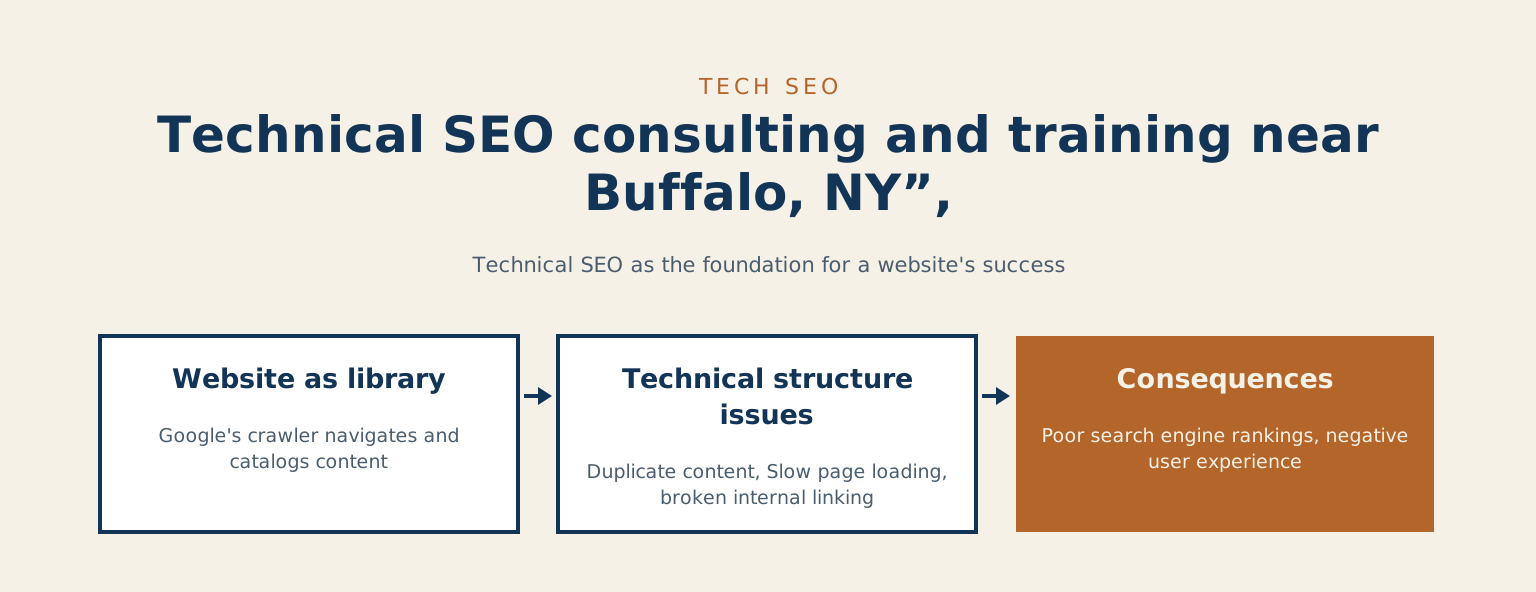
In practice, that covers crawl efficiency (whether search engines can actually reach your pages), indexability (whether the right pages are in Google’s index and the wrong ones are excluded), page speed, mobile usability, structured data, canonical tags, internal link structure, and how your site handles JavaScript. Most of this is invisible to your visitors. None of it is glamorous. But it’s the floor everything else sits on, and a site with foundation problems will underperform no matter how much you invest in content or links. The table below shows some of the patterns I see most often and what they cost.
| Technical problem | How it shows up | What it costs you |
|---|---|---|
| Duplicate content without canonical tags | Multiple URLs serving the same page | Ranking signals split between versions; neither ranks as well as it should |
| Slow Core Web Vitals | Pages that load sluggishly on mobile | Lower rankings on mobile searches; higher bounce rates |
| Crawl budget waste | Bot time spent on low-value or auto-generated pages | High-value pages indexed less frequently or not at all |
| JavaScript-rendered content | Text your users see that search engines miss | Content that exists on the page but doesn’t appear in the index |
| Broken internal linking | Dead ends and orphaned pages with no inbound links | Pages search engines can’t reach, and users can’t navigate to |
What I offer
There are two ways I typically work with clients on SEO.
The first is consulting. If you have a site that isn’t performing the way it should, I’ll audit what’s technically wrong, explain it in plain language, and give you a clear picture of what needs to be fixed and in what order. I work with marketing teams, IT departments, and business owners who want to know what they’re actually dealing with, not just a list of automated scan results from a tool they could run themselves. You can read more about my technical work on the services page.
The second is training. I run SEO training sessions for teams who want to build this skill in-house rather than outsource it indefinitely. These aren’t generic slides with tips about keyword density. We work through real examples from your actual site so your team leaves understanding the specific problems on their specific pages and the reasoning behind how to address them. I run these sessions online for teams across Canada, and in person for Niagara-region clients. This piece on how search engines decide what to crawl gives you a sense of how I approach the subject in practice.
A note on geography
Niagara is close enough to Buffalo that the border has never been much of a barrier for the businesses on either side of it. My consulting is remote by default, which works well for most clients: you get written documentation of everything we cover, calendar flexibility, and the ability to revisit the session rather than rely on notes taken in the moment. For Buffalo-area teams who want in-person training, we can talk about what that looks like.
If you’ve been looking for SEO help in the Buffalo area and you want someone who’ll tell you honestly what’s wrong with your site before talking about what to do next, I’m worth a conversation. Get in touch through the contact page and we’ll figure out whether my work is a good fit for what you need.
Tell me about your project
The fastest way to a straight answer. Tell me what you need and I will reply within a business day, honestly, even when the answer is that I am not the right fit.
Prefer to talk? Call 647-641-0643
Share your project details
Use this form for project scope, technical SEO support, onsite training requests, or a focused next-step conversation.