
Enterprise WordPress, for the organizations where the site is infrastructure. When a newsroom, a university, or a government office runs on WordPress, the site is not a marketing asset anymore. People plan their day around it staying up. The thing that quietly protects the budget on a build like that is the architecture you settle on early, before scale, integrations, and compliance all land at once. That’s the work organizations bring me in for.
The problems with enterprise WordPress projects usually don’t show up at launch. The site goes live, the project closes out, and for a while everything looks fine. Then, a year or two later, someone wants to add a new integration: a student information system, an SSO provider, a government data service. The development estimate comes back at three times what anyone expected. Or a security audit finds that the plugin stack hasn’t been touched in eighteen months because nobody knows which customizations will break. The platform is usually fine. It’s the decisions made on top of it, back before anyone could see the scale coming, that cost you later.
That’s the pattern I see most often when organizations bring me in to look at an existing WordPress build. WordPress is capable of handling complex, high-traffic, integration-heavy environments. The question is whether it was designed to do that from the first decision.
What changes when you build at enterprise scale
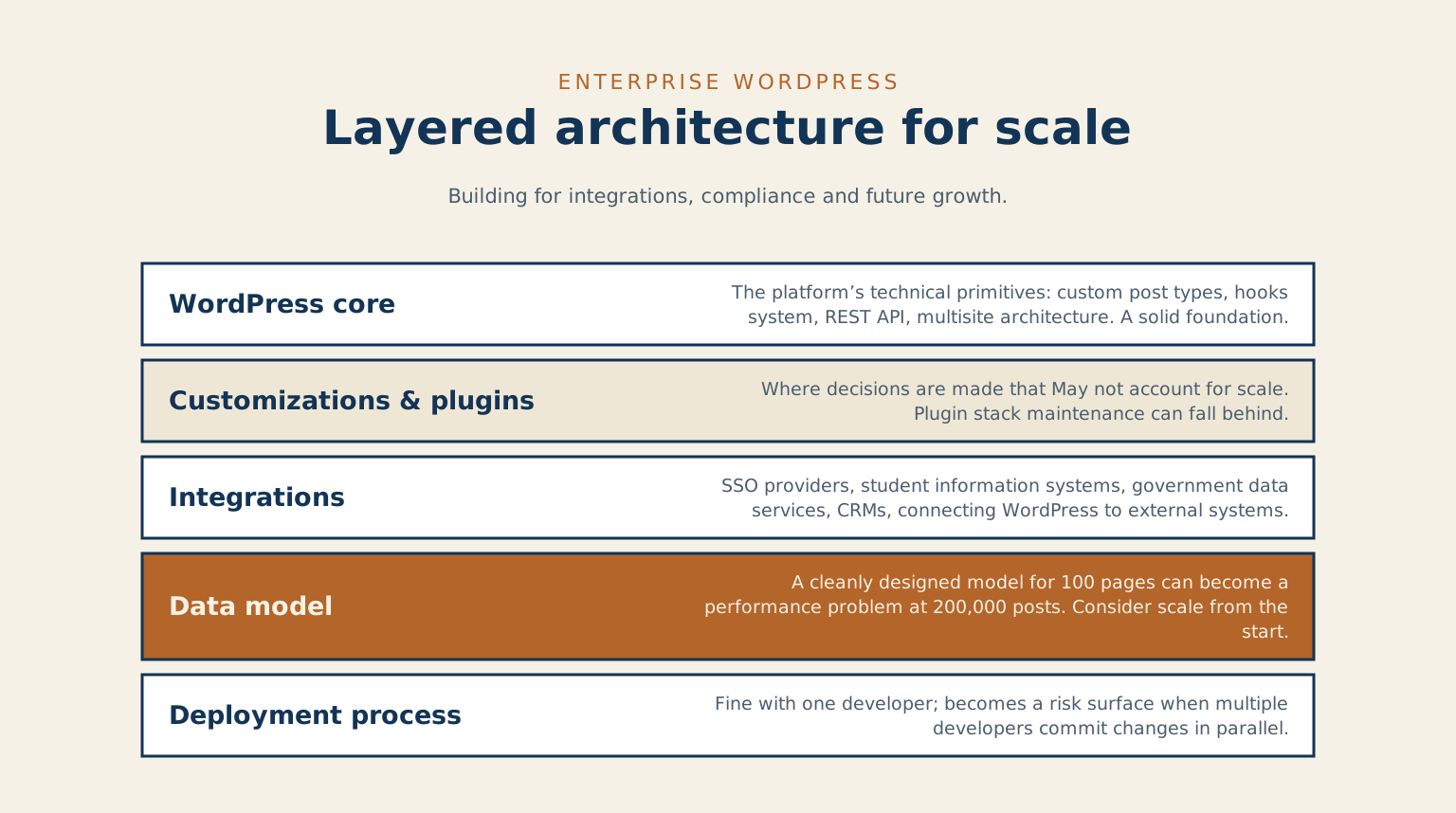
WordPress developers who work primarily on smaller projects often know the platform’s technical primitives well: custom post types, the hooks system, the REST API, multisite architecture. That knowledge is a foundation. Enterprise architecture experience is a different thing built on top of it.
The clearest way to explain the difference is through commercial plumbing. Residential and hotel plumbing are built from the same materials and follow the same pressure principles. What’s different is how the hotel’s plumbing is designed from the first drawing: isolation valves on floor risers so a single pipe failure doesn’t close the building, access panels behind every fixture so maintenance doesn’t require demolition, pressure regulation specific to each floor. The contractor working on the hotel isn’t doing anything exotic. They’re just making different decisions from the start, because the consequences of a single failure compound differently in a 200-room building than in a four-bedroom house.
Enterprise WordPress is the same calculation. A data model that works cleanly for a 100-page marketing site becomes a performance problem at 200,000 posts. An authentication plugin that handled a 50-person intranet creates a compliance gap at 5,000 users. A deployment process that was fine when one developer was committing changes directly to the live site becomes a risk surface when four developers are working in parallel. All of these are architecture decisions that didn’t account for scale.
The work I take on
Most of the engagements I take on fall into a few categories.
- Integrations between WordPress and systems it wasn’t originally built to talk to: SSO providers, student information systems, government data services, custom CRMs, and learning management platforms.
- Technical reviews of existing WordPress builds that have become slow, fragile, or expensive to maintain, when the organization needs to decide whether to repair or rebuild before committing more budget.
- Pre-build consultation for organizations planning a significant WordPress investment: a technical read on a proposed spec before budget is committed, from someone who can identify what’s missing in the architecture.
I work where WordPress is infrastructure, not a marketing asset. Content systems for editorial teams of twenty, intranets with tiered access control, course-delivery platforms where uptime isn’t optional.
This work is platform-agnostic in one important way: if a technical review shows that an organization’s requirements have grown past what WordPress can handle cost-effectively, I’ll say so. I’d rather deliver that read at the start than after the budget is spent.
Where I have done this
I have built exactly this before. The BlackBerry WordPress VIP blog estate was a multi-site publishing operation with tiered editorial access across several brands. Sleep Country’s store locator ran headless against an existing ASP.NET back end, because the right answer was to integrate with what they already had rather than replace it. Tim Hortons’ Roll Up the Rim was a national promotion where a wrong call on load would have been public within the hour. Different sectors, one discipline: decide for scale at the first drawing.
What to check before you commission the build
If you’re evaluating an enterprise WordPress project, a few things are worth examining before money changes hands.
The data model. Does the proposal describe how content will be structured at volume, or does it go straight to template design and plugin selection? A development team that hasn’t thought carefully about the data model before they start building will redesign it later, under pressure, at higher cost. Volume here means real numbers: if the system will hold 50,000 posts, 200,000 users, or content in multiple languages, the data model needs to be designed for that from the start, not retrofitted when performance degrades.
The deployment process. Is there a staging environment, version control, and a documented path from development to production? A project built without those disciplines treats maintenance as an afterthought. That choice usually shows up in the maintenance budget within eighteen months, when a straightforward plugin update becomes a risk event because nobody knows what it connects to.
The integration architecture. If the proposal handles all external system integration through off-the-shelf plugins with no custom middleware layer, check whether those plugins are actively maintained and whether their authentication models are compatible with your organization’s security requirements. Many aren’t, at enterprise scale. The gap doesn’t show up in a demo environment. It shows up when the organization tries to enforce MFA or rotate credentials across a production user base of several thousand accounts. I’ve written more about how WordPress authentication choices create compliance problems later if that’s the specific problem you’re looking at.
If any of this describes a project you’re currently scoping or trying to diagnose, my WordPress development work covers the full scope, from high availability to security hardening. The contact page goes directly to me if you’d rather start with a specific question.
Common questions
What counts as enterprise WordPress? For me it’s less about how big the site is and more about what breaks when it goes down. If a failed deploy means a newsroom can’t publish for an afternoon, or a payroll office can’t run its cycle, you’re doing enterprise work whether or not you’d use the word. Traffic numbers matter, but the real marker is how many people and systems depend on the site behaving, and how expensive it gets when it doesn’t.
How much does an enterprise WordPress project cost? Honestly, I can’t give you a figure from a web page, and I’d be a little suspicious of anyone who could. The cost is driven by the things underneath: how many systems you need to integrate with, how clean your existing data is, how many developers touch the code, and how much of the risk lives in parts nobody has documented. A focused integration is a very different number from a platform rebuild. The discovery call is where “it depends” becomes an actual range for your situation, and it’s the fastest way for both of us to find out whether the work is even worth doing.
Can WordPress really handle enterprise scale? Yes, and it already does, quietly, on sites you use every week. People doubt it because they’ve seen a WordPress site fall over, but the thing that failed was usually a decision made early, not the platform itself. Give it a sound data model, a deployment process, and caching that matches the traffic, and it holds up fine. Hand it a design that assumed a thousand posts and then feed it half a million, and it struggles, the same way any tool would.
Should we repair or rebuild our existing build? Repair, if the foundation is sound and you’re fixing specific failures. Rebuild, if you’re spending more each quarter working around the architecture than you would replacing it. The test I use is simple: can I explain why the current build behaves the way it does, or does every change come with a surprise? A build you can reason about is usually worth repairing. One where nobody can predict the blast radius of a small change is telling you something. I’ll look at what you have before I recommend either, because rebuilding a system that just needed three fixes is an expensive way to feel better.
Is WordPress ever the wrong choice at enterprise scale? Yes. If what you’re really building is a web application with WordPress bolted on the front, or your team already lives in a stack that has no business touching PHP, forcing WordPress into that shape costs more than it saves. Same goes if the compliance regime you answer to effectively rules out the plugin model. I’d rather tell you that on the call than three months into a build. I like WordPress and I’ve spent years with it, but I’m not in the business of selling you the wrong tool because it’s the one I know best.
Tell me about your project
The fastest way to a straight answer. Tell me what you need and I will reply within a business day, honestly, even when the answer is that I am not the right fit.
Prefer to talk? Call 647-641-0643
Share your project details
Use this form for project scope, technical SEO support, onsite training requests, or a focused next-step conversation.