
If a post-secondary institution’s course registration system goes down on enrollment day, the calls don’t go to IT. They go to the registrar, then to the VP Academic, then to the president’s office. Downtime at the wrong moment becomes a reputational event that travels up the org chart, not just a ticket in a queue.
I get asked fairly often to help organizations set up WordPress so it stays up. The short answer is yes, but getting there takes specific architectural decisions, and most conversations about high availability WordPress hosting start at the wrong layer.
What high availability actually means
A lot of hosting providers use high availability to describe what’s really fast recovery: if your server goes down, they provision a new one in a few minutes. That’s better than nothing. But if your site is offline for four minutes at peak traffic, the downtime already happened. Fast recovery and true availability aren’t the same thing.
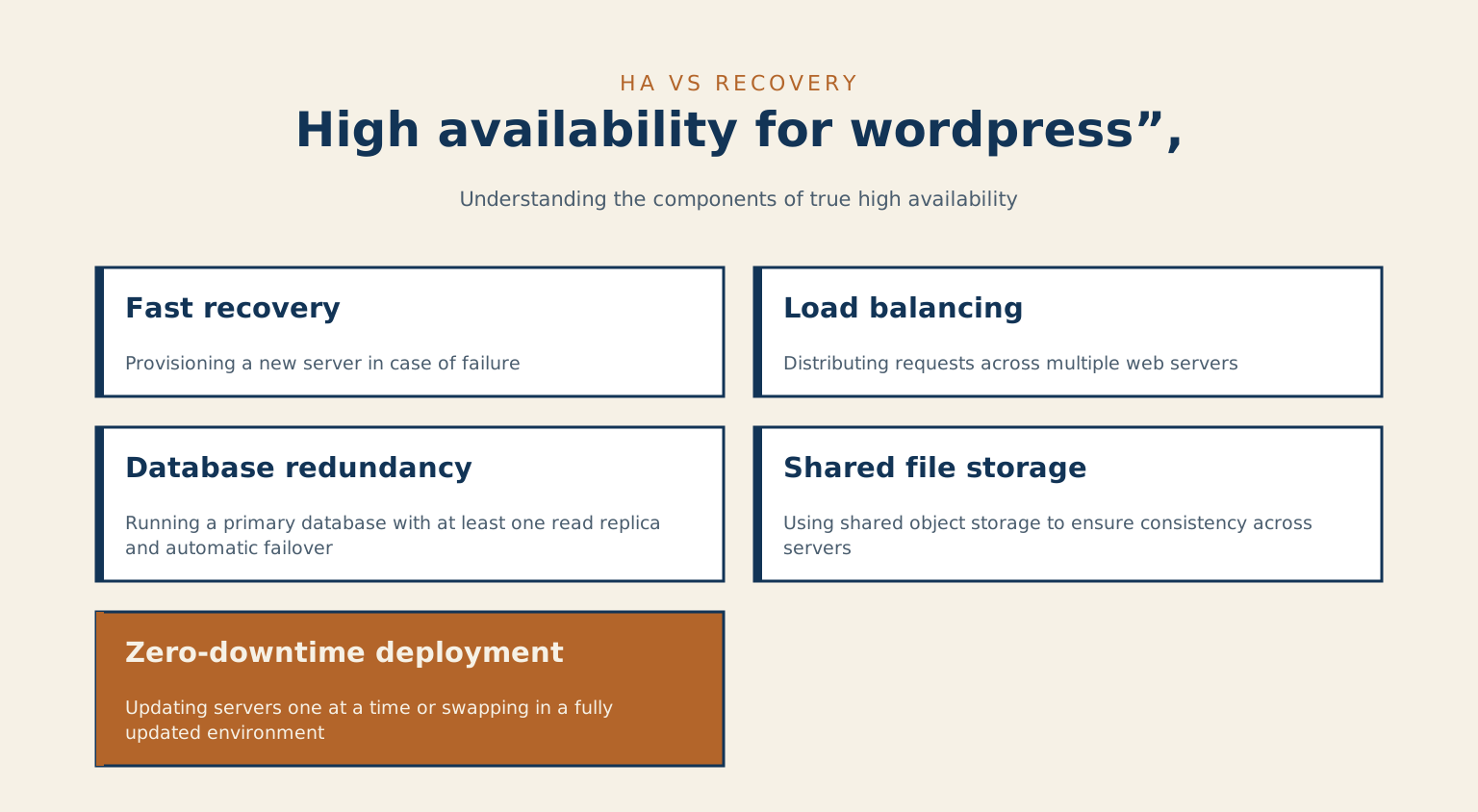
True high availability means designing a system so that any single component can fail without the site going down at all. The visitor never sees the failure.
The analogy I use: think about a grocery store with two checkout lanes open. If one cashier steps away, shoppers redirect to the other lane without anyone leaving. But now imagine both lanes run their price lookups through a single shared terminal. If that terminal goes down, both lanes close, no matter how many cashiers you have. High availability means making sure every dependency in the chain has its own redundant path. Adding a second server doesn’t accomplish that if it shares all the same failure points as the first.
The four pieces that make it real
Load balancing across multiple application servers. Traffic arrives at a load balancer, which distributes requests across two or more web servers running identical copies of the application. If one server fails a health check, the load balancer stops sending it traffic and visitors route to the healthy servers automatically, with no intervention needed.
Database redundancy. WordPress needs a database to serve almost any request, which makes a single database server a single point of failure. A properly configured setup runs a primary database with at least one read replica and automatic failover, so the application keeps operating if the primary goes offline.
Shared file storage. This is the piece most multi-server WordPress setups get wrong. WordPress stores media uploads on the local filesystem. In a setup with two web servers, a file uploaded while a request hits server A doesn’t exist on server B, and requests that land on server B return broken images. The fix is shared object storage, commonly Amazon S3 or a compatible alternative, served through a CDN (a content delivery network) so every server in the pool reads from the same source. Without it, two web servers just produce inconsistency twice as fast, and that only looks like more servers.
Zero-downtime deployment. Pushing an update to a single server while it’s serving traffic can create a brief window where application code and the database schema are out of sync. A rolling deploy or a blue/green strategy lets you update servers one at a time, or swap in a fully updated environment, so visitors never see an error state during a routine update.
Where WordPress specifically makes this harder
WordPress was written for a single-server environment. That made sense historically, and most sites never outgrow it. But in a multi-server setup, a few of those original assumptions surface as real problems, and they’re the places a high-availability build breaks in practice.
File storage is the most common one, and it’s the shared-storage problem above seen from the WordPress side: uploads written to one server’s local disk simply aren’t there when the next request lands on a different server. It has to be a deliberate architectural step, configured before the second server goes live. Bolting it on after the broken images start is the hard way to do it.
WP-Cron is the next issue. WordPress’s built-in scheduler runs when a page request comes in. On a single server, that’s manageable. Across multiple application servers, each server triggers the same scheduled tasks independently, which produces duplicate email sends, redundant data imports, and in some cases integrity problems. The standard fix is to disable WP-Cron and replace it with a system cron running on one designated machine.
Plugins are the third variable, and the one that needs the most case-by-case evaluation. Plugins that write cache files to local disk or store session data in flat files behave unexpectedly when a second server enters the picture, and so do plugins that assume they’re the only running instance. The failure often looks like intermittent weirdness rather than an outage, which makes it harder to trace. Assessing plugin compatibility with a distributed architecture is planning work. You do it before you scale out, because debugging it after the fact is far more expensive.
What to ask when you are evaluating a high-availability WordPress proposal
Any hosting arrangement for a site that needs to stay up should be able to answer these questions clearly. Vague answers usually describe fast recovery rather than genuine redundancy.
- Where are media files stored, and can every application server reach them independently?
- What triggers a database failover, and how long does it take?
- What does the deployment process look like, and is there any window where the site is in a mixed state?
- What does the health check cover, and what happens when a server fails one?
These aren’t trick questions. If the setup is genuinely redundant, the answers are straightforward. If they’re vague, that tells you something about the setup too.
Whether you need it at all
High availability costs more to build and more to run, so the honest question isn’t whether it’s good. It’s whether the cost of downtime justifies the cost of the architecture. A site that serves two hundred visitors a day for a small local business doesn’t need a five-nines stack (the 99.999 percent uptime tier). A university student portal, a government intake form, or a news outlet that can hit national traffic at any hour is a different calculation. If you’re trying to work out which one you are, I wrote a longer piece on how to tell whether high availability is insurance or an upsell, and a companion one on what it means for schools and post-secondary institutions specifically.
Setting up high availability WordPress is part of the high-end WordPress work I do for media organizations, post-secondary institutions, and government bodies across Canada, and part of the broader enterprise WordPress work I take on. If you’re responsible for a site where downtime has real consequences and you want to understand what’s at risk in your current setup, tell me what you’re running and I’ll give you a straight read.
Tell me about your project
The fastest way to a straight answer. Tell me what you need and I will reply within a business day, honestly, even when the answer is that I am not the right fit.
Prefer to talk? Call 647-641-0643
Share your project details
Use this form for project scope, technical SEO support, onsite training requests, or a focused next-step conversation.