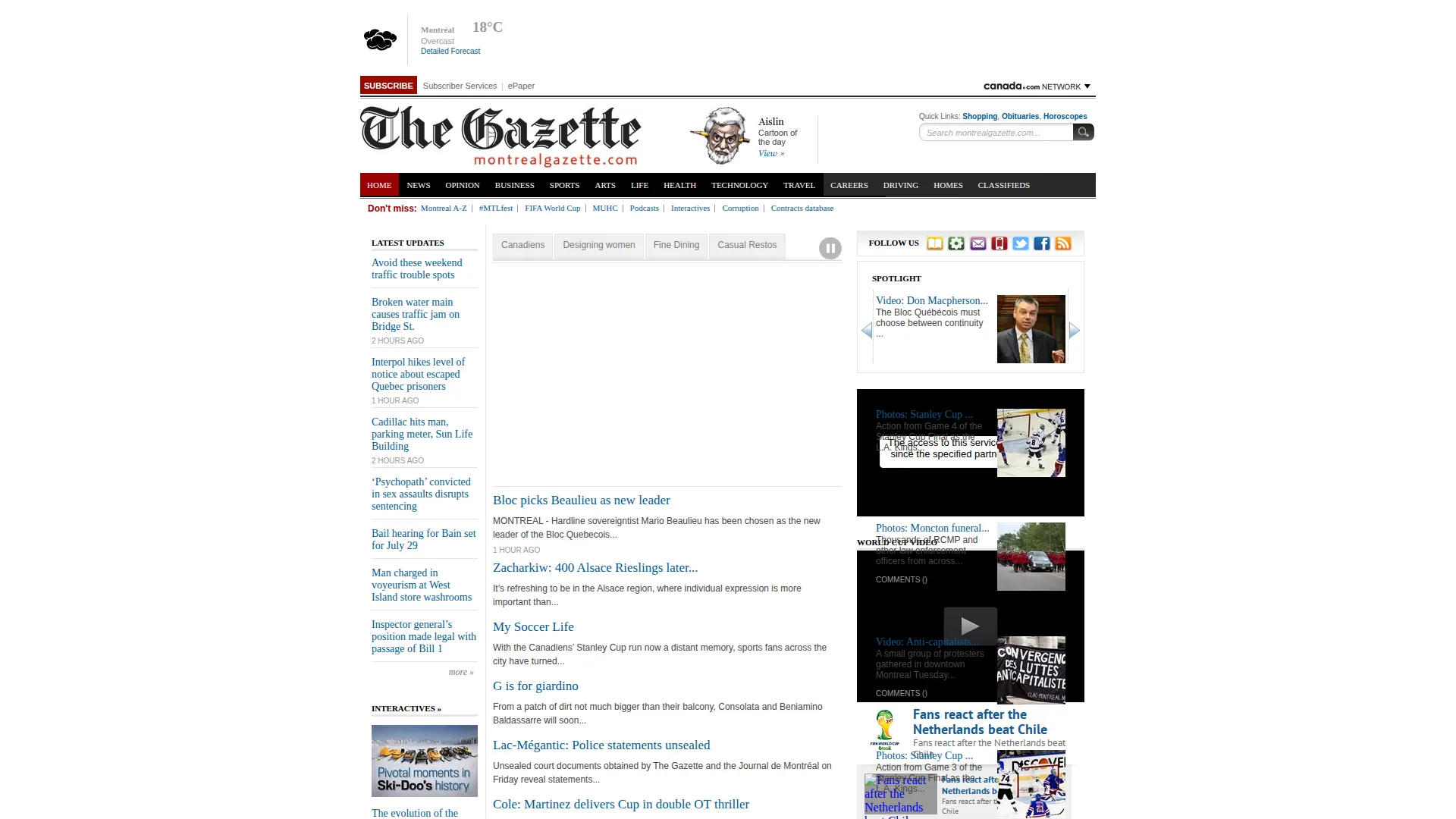
The Montreal Gazette has been published continuously since 1778, older than the United States, older than Canada, the oldest daily newspaper in Canada by a comfortable margin. It is also the English-language daily in a French-language city, which makes the WordPress® platform engineering problem a different shape than it is anywhere else in the Postmedia network. Publishing an English daily in Montreal is a different SEO and content-discovery problem than publishing one anywhere else in the country, and the architecture had to take that seriously rather than treating English as the default and French as a translation overlay.
Bilingual discovery as a first-class concern
The Gazette’s reader searches in both languages, often in the same session. Neighbourhood names, politicians, institutions, streets, cultural venues, public agencies, every one has a French canonical form and an English working form, and readers move freely between them depending on what they are searching for and which language is more naturally indexed for that entity. A Plateau resident searching for coverage of their borough council might enter “Plateau-Mont-Royal” or “Plateau” or even the abbreviated English form, and the paper’s content-discovery infrastructure had to surface the right articles for all three.

The theme engineering had to let an English-language template live comfortably in a search environment that is bilingual whether the publisher likes it or not. That meant being deliberate about a few things the rest of the Postmedia network did not have to think about as carefully: language metadata in the head, taxonomy slug decisions for place names, the way headlines and meta descriptions referenced bilingual proper nouns, internal linking that handled the same entity referenced under two names depending on the writer, and Open Graph tags that produced correct previews when shared into either-language social contexts.
The child theme as the right place for it
The Gazette ran as its own child theme on the shared Postmedia parent that carried the eleven properties of the network. The parent held infrastructure and performance budget across every paper. The Gazette’s child held the bilingual considerations as first-class concerns instead of bolt-ons. That is a real engineering choice: bilingual-by-mandate handling could have lived in a network-wide content type or a settings layer, but doing it that way would have forced ten other papers to carry tooling they did not need, and would have made the Gazette’s bilingual decisions answerable to network-wide editorial defaults that did not understand the Montreal market.
None of it is exotic engineering. All of it compounds. The bilingual-discovery thinking from this build is one I still apply to any publisher operating across language lines, including federal-government clients where the Official Languages Act puts the same structural problem on the table for an entirely different reason. The 2011-2012 Postmedia move onto WordPress VIP was the engagement where the architectural principles for this kind of work got fully codified.
- The work: Montreal Gazette child theme on the shared Postmedia parent; bilingual SEO, taxonomy, and internal-linking discipline for English publishing in a French city
- Architecture: Shared parent with the Postmedia network; bilingual handling held in the Gazette child
- Client: Postmedia Network Inc. (Montreal Gazette)
- Period: 2011-2012
This work was part of the broader Postmedia WordPress VIP migration: one parent theme, eleven distinct child themes across Canada’s major daily newspapers. The full architectural story, including the parent-child seam and the platform decisions that made the network work, is in the Postmedia WordPress VIP migration case study.