
Last week EDUCAUSE published its Top 10 IT issues for 2027, and the item at the top is phrased as a question rather than a system to build: determining where Artificial intelligence (AI) adds real value (reported by Campus Technology, 1 October).
EDUCAUSE’s annual conference was running in Denver while that landed, and there Mark McCormack, its senior director of research and insights, put it plainly: “AI is everywhere. Most of us are using it. Many of us use it frequently, but adopting new technology simply because it’s there isn’t good enough. It has to serve a purpose” (reported by Inside Higher Ed on 5 October).
EDUCAUSE is honest about what the ranking means: it signals urgency more than consensus. And the same report carries the detail I keep chewing on, that scores of colleges have invested in AI-powered learning tools despite what it calls nearly nonexistent independent research showing their widespread efficacy. Money first, evidence later, question last.
Right question, four years late. So I went looking at who’d been asked.
Key takeaways
- EDUCAUSE’s 2027 Top 10 IT issues puts “determining where AI adds real value” at number one.
- The list rests on 882 survey responses and contributors EDUCAUSE publishes by category. Not one of those categories is a teaching role.
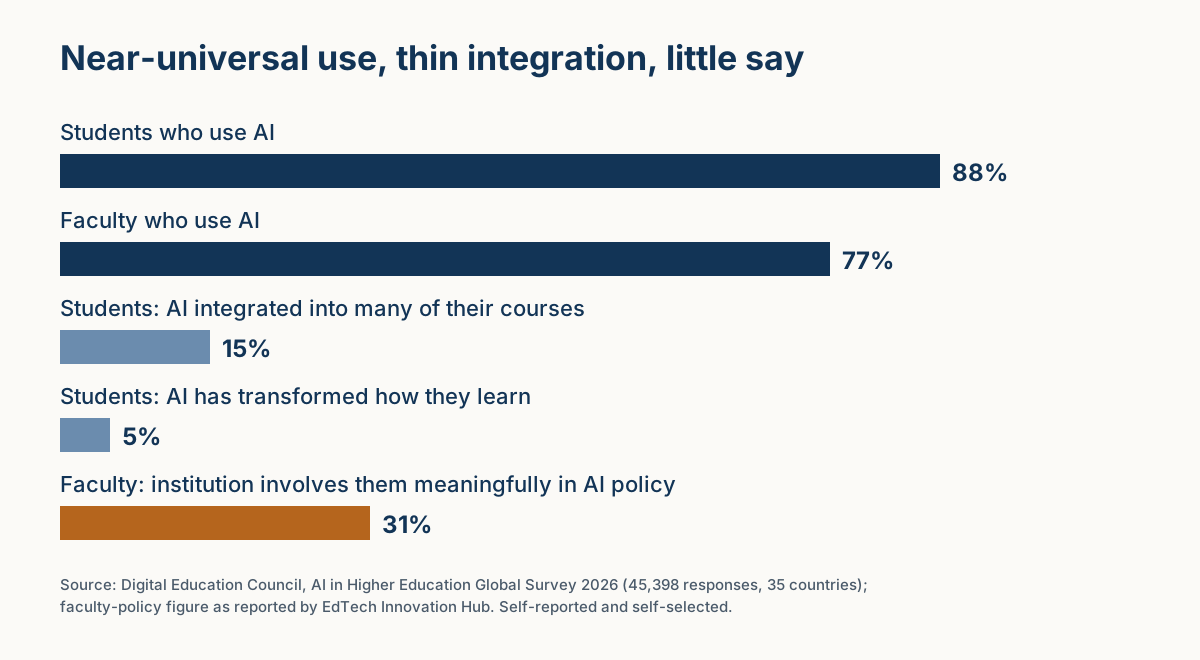
- In the Digital Education Council’s 2026 survey, 88 percent of students use AI, but only 5 percent say it has transformed how they learn.
The roster
The Top 10 comes out of interviews with institutional leaders and a ratings survey: 882 complete responses, fielded 15 May to 1 June this year (EDUCAUSE’s own discussion guide sets out the method, and it’s worth two minutes of your time).
EDUCAUSE describes its contributors by category: 24 senior technology and data leaders, which it gives as CIOs, CISOs and others, plus 20 institutional leaders, presidents, provosts and CFOs, across the United States, the United Kingdom, Ireland and Belgium. Not one of those categories is a teaching role.
Now the caveat, which I’d rather hand you than have you find. The full named list sits on a page I couldn’t open, so I’m going on the categories EDUCAUSE published, and “and others” is doing unknown work in there. The breakdown of the 882 isn’t published either, and EDUCAUSE’s community includes plenty of people who sit close to teaching. If a good share of those 882 were instructional designers, my complaint gets a lot weaker and I’d want to hear about it. So keep it narrow: the published categories contain no teaching role, and who else was in the room, the published material doesn’t say.
EDUCAUSE is a technology-leadership association, not a faculty body, and asking its own community is the job it exists to do. My quarrel is with where the list lands. This is the sector’s flagship priority document, and the question it just elevated to number one is a teaching question wearing an IT badge.
Here’s the strongest reply, the one a CIO would make and the one I had to sit with. Of course this is our question. Nobody uses any tool in any course until somebody’s settled licensing, accessibility, data protection, equity of access and who answers the phone at 11pm when it breaks. Those decide whether a tool is usable at all, and without them your week-six observation never happens. Good argument. Mostly right.
It comes apart on the word “value”. Every item in that list tells you whether a tool can be deployed. None of them tells you whether it helped anyone learn.
Two different questions, and only one of them got elevated.
Value turns up, or doesn’t, in one course, on one assignment, in week six when half of them have stopped reading. It’s the difference between the building inspector signing off on the wiring and somebody standing in the room working out whether there’s enough light to read by. Both jobs are real. Only one happens in the room.
The number underneath it
Put the Top 10 beside the Digital Education Council’s AI in Higher Education Global Survey 2026, which took 45,398 responses across 35 countries (reported 9 July). Summer, so treat it as backdrop. It’s self-reported and self-selected too, so read it as a signal rather than a census: people who answer AI surveys have views about AI.
Eighty-eight percent of students use AI; 77 percent of faculty do, up sixteen points. Everyone knew that.
Then the part fewer people quote. Only 15 percent of students say AI is integrated into many of their courses. Five percent say it has transformed how they learn, and another 28 percent say it enhances their understanding (Digital Education Council, 2026). Those measure different things and I don’t want to blur them: course integration is a fact about design, and the other two are students reporting on their own learning, which is about the least reliable thing anyone can report on. Near-universal use. Transformation almost nowhere.
And the number I keep coming back to: 31 percent of faculty agree their institution involves them meaningfully in shaping AI policy (EdTech Innovation Hub’s reporting of the survey, 9 July carries this figure and the regional ones below).
So the sector’s top priority for 2027 is where AI adds value in teaching, and fewer than a third of the faculty surveyed agree they’re meaningfully in the conversation that decides it.
Which makes one more number read differently
In the United States and Canada, faculty intent to use AI in teaching fell this year, from 76 percent to 67 percent. It is the only region where it went down.
The reading I hear most often is that North American academics are dragging their feet. A second one is less flattering to the tools: intent fell because faculty used them and were underwhelmed. A year of hands-on experience turns enthusiasm into a shrug reliably enough, and if that’s what happened, it’s evidence about the products rather than the people.
My own read is a third. Hand someone a tool, give them no say in the policy governing it, and set it against this: in the US and Canada, 38 percent of students report that no assessment they take allows, encourages or requires AI at all. Then watch what happens to faculty enthusiasm. That looks to me like a reasonable response to being handed something and never being asked. Two weak joints in that, so you have both. The 31 percent is global while the intent drop is US and Canada only, and nobody published a North American involvement figure to set beside it. And the 38 percent is students describing their own assessments, not faculty describing what they were told, so I’m inferring across two groups of people who were asked different questions. Take it as a read.
What the question looks like when a teacher asks it
Here’s the part I can do something about, and I’ll be straight about it: the three below are mine, not EDUCAUSE’s and not the Council’s, and nobody has tested these wordings. Edit them to fit your subject. They shrink “where does AI add real value” until one person can answer it about one tool in one course.
- What would I stop doing if this worked? If the answer’s nothing, the tool is adding activity. Real value shows up as something leaving your week.
- Which student skill am I trading away? Every tool trades one skill for another, and I mean theirs here, yours second. Name the one you’re willing to lose before term starts, say it out loud to someone, and you’ll spot it going a lot earlier than you would otherwise.
- What would I see in week six? Name one observable thing a student does differently. If you can’t describe it now, you won’t recognise it later, and you’ll end up reporting adoption numbers.
Asking them costs nothing and needs nobody’s approval. Acting on the answers is another matter, and I won’t be glib: changing an assessment goes through a committee, dropping a tool mid-term has a cost, and an instructional designer may have no authority over the course at all. What the three buy you is something specific to look for, and that’s what you’ll want in your pocket when the conversation comes round to you.
One question I’d like answered, and I don’t have a good answer myself. If you teach, were you asked anything before your institution set its AI policy? Not a town hall nobody went to. Asked, in a way that changed something. I suspect it varies far more by institution than by country, and I’d like to know whether I’m right.
Next edition: AI feedback on student writing. It is the most common classroom use of all of this and one of the least examined.
These editions run alongside Learning to Learn With AI, a longer series working the same ground in order.
How this was made. Full disclosure, and I mean it as a courtesy, not a confession. AI tools help me research, check my claims, tidy my grammar, and stay on top of far more reading than one person can. The thinking and the judgment are mine, I edit every word into my own voice by hand, and then I put my name on it. Telling you that is the whole point of keeping it human.
Common questions
What is the top issue on the EDUCAUSE 2027 Top 10? “Determining where AI adds real value” is number one, phrased as a question instead of a system to build. EDUCAUSE says the ranking signals urgency more than consensus.
Who decides the EDUCAUSE Top 10 IT issues? The 2027 list comes from interviews with institutional leaders and a ratings survey of 882 complete responses, fielded 15 May to 1 June 2026. The contributor categories EDUCAUSE publishes are technology and data leaders and senior institutional leaders. None is a teaching role.
References
- Kelly, R. (2026, October 1). AI leads 2027 Educause Top 10. Campus Technology. https://campustechnology.com/articles/2026/10/01/ai-leads-2027-educause-top-10.aspx
- EDUCAUSE. (2026). 2027 EDUCAUSE Top 10: AI discussion guide [Primary document]. https://www.educause.edu/-/media/files/multimedia/2026/educause2027top10aidiscussionguidetxt.txt (Source for the methodology and the contributor categories.)
- Palmer, K. (2026, October 5). Technology officers navigating “age of perpetual change”. Inside Higher Ed. https://www.insidehighered.com/news/tech-innovation/artificial-intelligence/2026/10/05/higher-ed-tech-officers-navigating-age
- Digital Education Council. (2026). AI in Higher Education Global Survey 2026. https://www.digitaleducationcouncil.com/resource-library-items/ai-in-higher-education-global-survey-2026 (Self-reported and self-selected. The survey’s own publication date is not stated on the resource page; 9 July is the date of the reporting below.)
- Thompson, E. (2026, July 9). AI in higher education survey 2026: student AI use hits 88%, faculty lag. EdTech Innovation Hub. https://www.edtechinnovationhub.com/news/q6zw9wco2mttajdbd1jyeonjnpiovu (Source for the US/Canada intent figures and the faculty-policy figure.)