
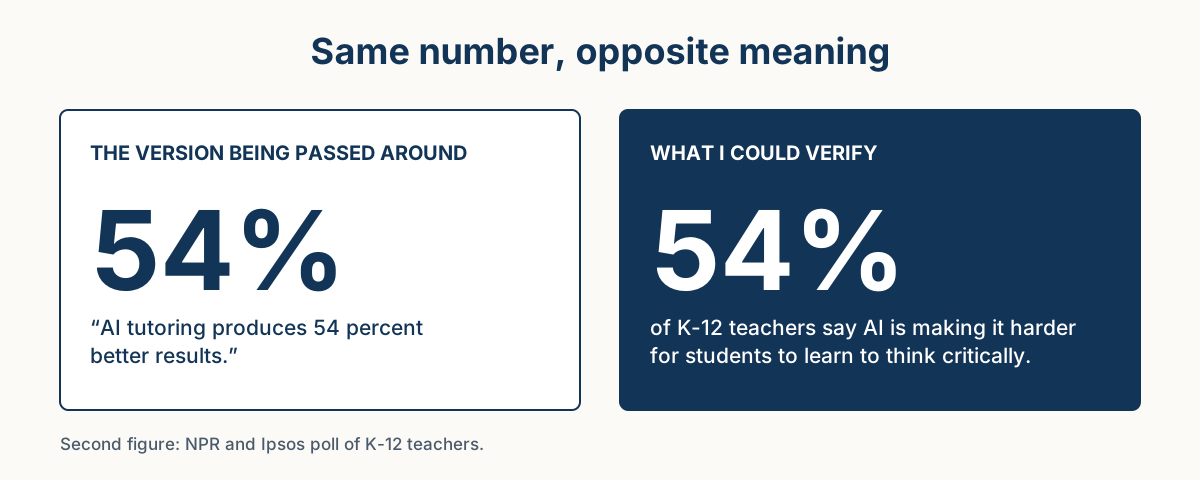
This week I almost opened with a number. I kept seeing it: Artificial intelligence (AI) tutoring produces 54 percent better results. It was everywhere, tidy and quotable, exactly the kind of stat you forward without reading past.
So I checked it. The 54 percent I could actually put my hands on said close to the opposite. In an NPR and Ipsos poll, 54 percent of K-12 teachers said AI is making it harder for students to learn to think critically. Same number, pointed the other way. I had been about to lead with the hopeful version, because it was the one that flattered the tool.
That is the whole reason this newsletter exists, so it is a fitting place to start.
Here is what I actually trust from the week. The World Economic Forum warned that learners are beginning to treat whatever the machine says as settled fact, which is a quiet and expensive habit. GIS Reports made the harder point: when a tool finishes the assignment for you, it also removes the part where you were supposed to get smarter. And 59 percent of teachers in that same poll said the technology is eroding the trust between them and their students.
None of that is an argument against AI. I have spent thirty years building with new tools, and a few of them studying how people actually learn, and I am not here to tell you to put it down. The tool was never the danger; the cost comes from using it with nobody’s judgment left in the loop. The learners who come out ahead are the ones who still do the checking, and the teachers who come out ahead are the ones who make the checking the lesson.
The tool was never the danger; the cost comes from using it with nobody’s judgment left in the loop.
It is the line I will hold every week: learning and working with AI, without handing over the part that was yours to keep.
Key takeaways
- A quotable stat claiming AI tutoring gives 54 percent better results was all over my feed, and I couldn’t trace it. The 54 percent I could trace came from an NPR and Ipsos poll: 54 percent of K-12 teachers said AI is making it harder for students to learn to think critically.
- In the same poll, 59 percent of teachers said the technology is eroding trust between them and their students.
- The tool was never the danger. The cost comes from using it with nobody’s judgment left in the loop.
Worth your attention
The market is already paying for judgment. Two workforce reports landed this week pointing the same way. JLL found most senior leaders expect AI to reinvent roles rather than cut them, and PwC’s jobs barometer describes a labour market splitting into two paths, with the human skills on the better one. Read together, they say the premium is moving to people who use AI and still bring something it cannot. That is not a comfort blanket. It is a to-do list.
Adoption is outrunning the support. Microsoft’s new AI in Education report leads with how fast schools are adopting. The line I would sit with is the one beside it: demand for help using the tools well is climbing just as fast. The software is in the door. What schools are asking for now is someone to show them how to use it without the learning draining out.
The rules are being written after the tools arrived. FutureEd is tracking 77 AI-in-education bills across 27 states, and districts like Columbus are adopting their own policies ahead of state mandates. Watch one thing as these land: whether a policy requires a human to check the work, or only says who is allowed to use the machine. Only one of those protects the learning.
One line before you go
If this is the kind of read you want on a Thursday, subscribe, and bring a skeptic. The deeper version of this thinking, the part that goes past the week’s headlines, is in my series Learning to Learn With AI.
See you next week. Keep the human in it.
How this was made. Full disclosure, and I mean it as a courtesy, not a confession. AI tools help me research, check my claims, tidy my grammar, and stay on top of far more reading than one person can. The thinking and the judgment are mine, I edit every word into my own voice by hand, and then I put my name on it. Telling you that is the whole point of keeping it human.
References
- NPR / Ipsos teacher poll, WEF and GIS Reports findings, via The Latest Findings in AI and Learning, July 2026, Filament Games: https://www.filamentgames.com/blog/the-latest-findings-in-ai-and-learning—july-2026
- JLL, AI redesigns jobs, not cuts them: https://www.jll.com/en-us/newsroom/ai-redesigns-jobs-not-cuts-them
- PwC 2026 Global AI Jobs Barometer: https://www.pwc.com/gx/en/news-room/press-releases/2026/pwc-2026-ai-jobs-barometer.html
- Microsoft AI in Education Report (2026): https://news.microsoft.com/source/2026/06/24/microsofts-new-ai-in-education-report-highlights-widespread-adoption-and-increasing-demand-for-support/
- FutureEd 2026 State AI in Education Bills tracker: https://www.future-ed.org/legislative-tracker-2026-state-ai-in-education-bills/