
A few months ago I trained a small Artificial intelligence (AI) editor on my own writing. Years of my own words, my own habits, tuned until it could catch the machine-made sentences I work to keep out of my drafts. The first essay I fed it, it flagged as very likely AI. Eight tells. The thing is, the essay was mine. I had written every word of it at my kitchen table, on a Sunday, with a coffee going cold beside me.
The machine was not broken. It had learned my voice so well that it mistook me for a very good forgery of me. A human editor read the same piece and found three real tells worth fixing, which is a different and more useful number. But the robot was sure. Eight, it said. Very likely AI. (The essay, for what it is worth, was about automated answers that sound certain. I could not have written a better joke on purpose.)
Key takeaways
- You can’t detect honesty in a sentence, because intent was never in the sentence. That is why a better AI detector can’t win back trust.
- The same edit serves honesty and hiding. Removing an AI tell to sound like yourself is voice. Removing it so nobody thinks to ask is hiding. The difference is disclosure.
- Write one line saying what the AI did. If that line makes you wince, you were hiding.
I keep coming back to that afternoon, because it is the whole detection problem sitting in one chair.
That is why a better AI detector can't win back trust.
Here is what set me off this week. Nature ran an editorial with a title I have not stopped thinking about: Use AI, but don’t mask it (28 July 2026). Alongside it, a news piece about a tool called Academic Humanizer, released on 20 June 2026 by a machine-learning researcher at the University of Minnesota named Jie Ding. You paste it into an AI system and it strips out the constructions readers have learned to associate with machines. Em dashes. The “not just this, but that” pivot. The alarm in that coverage was plain: a tool like that can erase the signs that a paper or a grant was AI-assisted, right when journals and funders are trying to keep track.
I want to be upfront that this is one editorial and one tool. I am reading a trend off a handful of data points, so take the next part as my read, not as settled fact.
But here is the part that stopped me cold. I do the exact thing that tool does. By hand. Every single day.
I strip em dashes out of AI-assisted drafts. I hunt down the “not just X, but Y” pivot and I kill it. There is not a single em dash in this newsletter, and I put none of them there on purpose, which is a joke I am not allowed to complete properly and I am going to leave sitting right here anyway.
Ding built a tool that does my Sunday-afternoon editing for me. Same keystrokes. Same targets. If you put my hand-edit and the tool’s output side by side, you could not tell them apart, and neither could my little robot, and neither could Turnitin or GPTZero or any of the humanizer-bypass services now advertising ninety-nine-point-nine percent undetectable modes to nervous students.
So if the edit is identical, what on earth is the difference between what I do and what I am worried about?
The difference lives somewhere other than the writing. It has to, because the writing is the same. I remove those tells to sound more like myself. The worry is someone removing them to sound like no one at all, to sand off the fingerprint entirely so nobody thinks to ask whether a machine helped.
Same move, opposite intent. And you cannot read intent off a sentence. That is the thing detection keeps trying to do and will always fail at, because a detector reads text, and intent was never in the text.
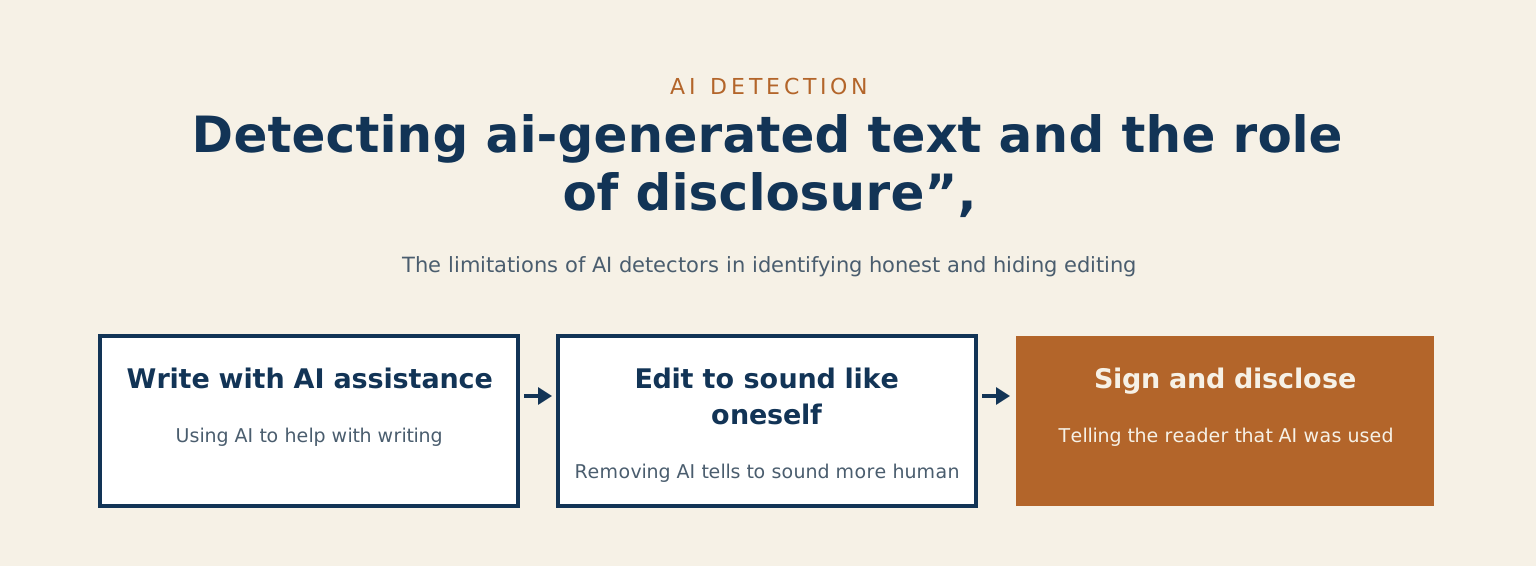
Which means the honest version of me and the hiding version of me part company at exactly one place, and it is not on the page. It is whether I tell you. I strip the em dashes out of it. Then I sign my name, and I say plainly that a machine helped me draft this and I edited it into my own voice. The concealer strips the same em dashes so that nobody thinks to ask, and the prose comes out a tie. The disclosure line is the whole game.
There is also a fairness problem underneath the accuracy problem, and it is worse than the accuracy one. A Stanford group ran seven detectors over essays by non-native English writers and found more than half of TOEFL essays flagged as AI-generated, while essays by US eighth-graders came back near-perfectly clean (Liang et al., Patterns, 2023). The mechanism is grimly simple: a smaller working vocabulary looks like a machine to a tool that measures predictability. So the people most likely to be accused are the people least able to argue back, which The Markup documented happening to international students two years ago.
This is why the detection arms race is a war we chose badly. The moment you make detection the contest, you guarantee the anti-detection industry, and it is already here and it is already winning, because adding human-looking noise back into text is easier than reliably spotting its absence. You will lose that race. And while you are losing it, you are aiming the whole apparatus at the wrong target. You are trying to catch students and scholars, when the thing actually being eaten away is trust, and trust is not a detection problem. It is a disclosure problem.
A detector reads text. Intent was never in the text.
Think about what a clean “human” score actually buys an institution. It buys the feeling of integrity, which is a different thing from integrity, the same way a humanizer buys a student the feeling of authorship. Both are a comfortable stand-in for the real thing. This newsletter runs on the belief that the feeling of a thing and the thing itself are not the same in learning, and it turns out the same crack runs right through here too.
Here is the same choice laid out plainly, because I think seeing the two columns side by side settles it faster than another paragraph from me.
| Changing it to sound like me | Changing it to sound like no one | |
|---|---|---|
| The edit | Strip the em dashes and the “not just X, but Y” pivot | Strip the same em dashes and the same pivot |
| What a detector reads | The same text; it cannot tell the two apart | The same text; it cannot tell the two apart |
| Intent | To sound more like myself | To sand off the fingerprint, so nobody thinks to ask whether a machine helped |
| The disclosure line | Written plainly, with my name signed under it | Absent |
| The wince test | Writing the line feels completely fine | Writing the line makes you wince |
So here is what I would hand the dean, the editor, or the L&D lead losing sleep over this. Stop shopping for a better detector. Ask one question instead, and make it cheap to answer honestly.
The question, for the person doing the writing: am I changing this to sound more like me, or to sound like no one at all? Then, whatever the answer, write one line saying what the machine did. If that disclosure line makes the edit feel completely fine, it was voice, and you are in the clear. If writing that line makes you wince, you already knew you were hiding. The wince is the test. It has been more accurate for me than any detector I have run, including the one that called me a robot.
The question for the person running the institution is a different one, because you cannot audit anyone’s wince. The one lever actually within reach is to make disclosure cost nothing. Build the thing so that a student or a colleague who writes “I used AI to draft this and edited it into my own words” pays no penalty for the honesty, none, so that saying it is the easy path and hiding it is the strange one. I know that is not a small ask inside a committee, a collective agreement, an integrity process that already exists, and a registrar who was not consulted. I have designed that culture on paper and never once had to move it through the machinery you live in. I also know the deeper trap, that inside an integrity process written before any of this existed, an honest disclosure can become the exhibit against the person who made it, and no single dean can wave that away by wanting to. But it is a more winnable fight than the arms race, because it is the only one where the finish line is trust instead of a score.
My robot was right about one thing, in the end. My writing is full of tells, and it always will be, because a voice is only a pile of habits somebody learned to recognize. So I keep editing them, and I keep signing my name underneath, so you always know whose habits they are.
How this was made. Full disclosure, and I mean it as a courtesy, not a confession. AI tools help me research, check my claims, tidy my grammar, and stay on top of far more reading than one person can. The thinking and the judgment are mine, I edit every word into my own voice by hand, and then I put my name on it. Telling you that is the whole point of keeping it human.
These editions run alongside Learning to Learn With AI, a longer series working the same ground in order.
Common questions
Can an AI detector flag writing a human wrote? Yes. I trained a small AI editor on years of my own writing, and the first essay I fed it, one I had written every word of myself, came back flagged as very likely AI, with eight tells. Detectors read patterns in prose, and human writers produce those patterns too.
What is an AI humanizer? A tool that rewrites AI-generated text to remove the patterns detectors look for, so it reads as human. It makes the same kind of edit an honest writer makes to sound like themselves. What separates the two is whether the use is disclosed.
Will a better AI detector restore trust in academic writing? I don’t think so. Intent isn’t in the sentence, so no detector can read it, and the tools built to beat detection improve as fast as detection does. Making disclosure cost nothing is the move that builds trust.
References
- Nature. (2026, July 28). Use AI, but don’t mask it [Editorial]. https://www.nature.com/articles/d41586-026-02347-1
- Nature. (2026). ‘Humanizer’ tool can erase signs of AI-written text. https://www.nature.com/articles/d41586-026-02105-3
- The Register. (2026, July 8). Tool promises to make lazy academics’ AI-written papers sound more human. https://www.theregister.com/ai-and-ml/2026/07/08/tool-promises-to-make-lazy-academics-ai-written-papers-sound-more-human/5268460
- Ding, J. University of Minnesota, Data Science Initiative [Faculty profile]. https://cse.umn.edu/dsi/jie-ding
- Liang, W., Yuksekgonul, M., Mao, Y., Wu, E., & Zou, J. (2023). GPT detectors are biased against non-native English writers. Patterns, 4(7). https://www.sciencedirect.com/science/article/pii/S2666389923001307
- The Markup. (2023, August 14). AI detection tools falsely accuse international students of cheating. https://themarkup.org/machine-learning/2023/08/14/ai-detection-tools-falsely-accuse-international-students-of-cheating
- Committee on Publication Ethics. Authorship and AI tools [Position statement]. https://publicationethics.org/guidance/cope-position/authorship-and-ai-tools
- Ross, C. I disclose every use of AI [Stance]. https://thisismyurl.com/stances/i-disclose-every-use-of-ai/