
I started the week planning to make my work sharper, and I ended it having been corrected four times by software I built to correct other people. The machine was the adult in the room. I was the one being sent back to check my facts, and every single time the machine had the facts and I had the confidence.
Five tracks this week, and they all rhyme. Each one is a small thing I was sure about, and a boring automated check that calmly proved me wrong before a reader ever saw it. I did not enjoy this. I am also not going to pretend it did not save me.
The brand gate that caught me miscounting my own career
I was rewriting my services page, tightening the language, feeling pretty good about it. My brand review gate, the automated thing that reads everything before it goes live, refused to pass it. Twice.
A piece of software I built to catch loose claims found the loosest one in the building, and the loosest one in the building was me.
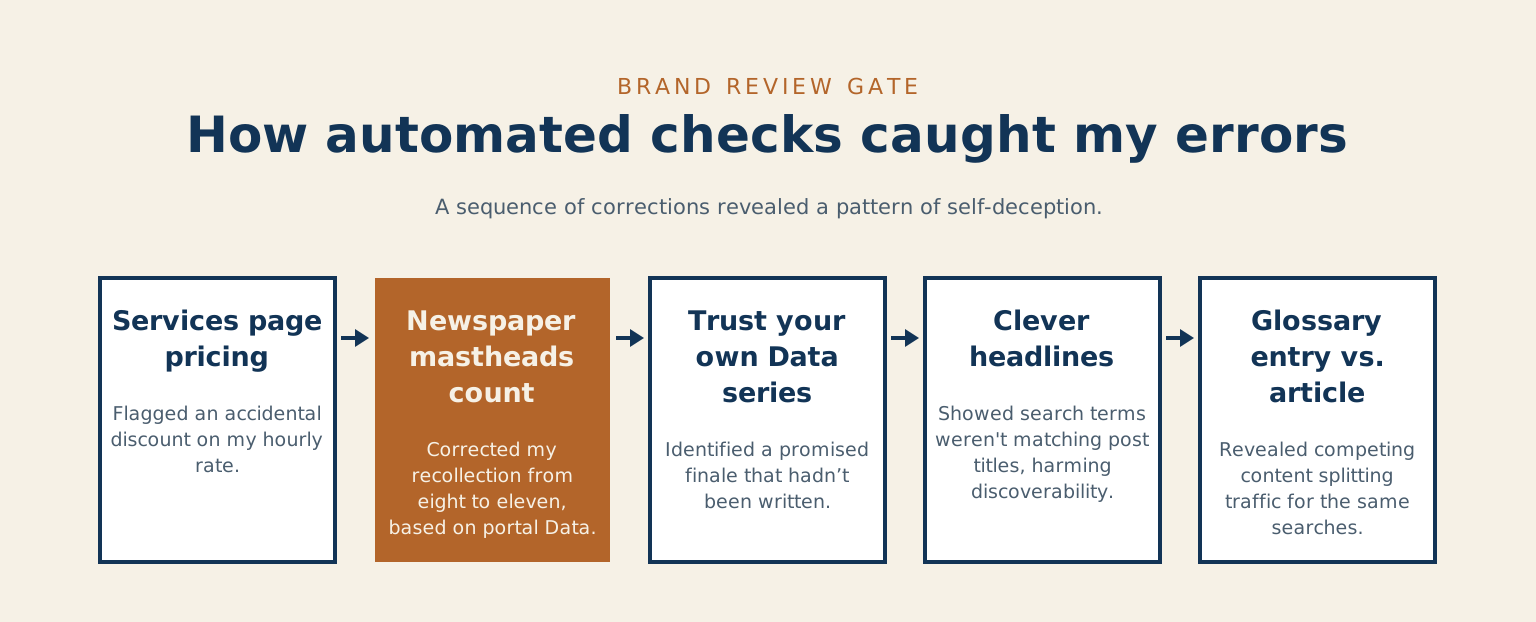
Once for a pricing rule I had phrased in a way that quietly undercut my own hourly rate, which is a generous way of saying I had written myself a discount I never meant to offer. Fair enough. I fixed that and sent it back.
The other refusal is the one that stung. I had written that I ran eight newspaper mastheads during my time on the big Postmedia portal. The gate flagged the number, and it was right and I was wrong. I ran eleven newspaper mastheads on the Canada.com WordPress VIP portal from 2011 to 2013, not eight. My own tool fact-checked my résumé against me and won. I have said the eight version out loud, to real people, more than once. A piece of software I built to catch loose claims found the loosest one in the building, and the loosest one in the building was me.
A four-part series with a finale I hadn’t written
This one is worse, because it had already gone out the door before I noticed.
Part one of a new series called Trust Your Own Data was sitting on the schedule. It is about the ways your own comfortable numbers can mislead you, a topic I apparently have some fresh standing to write about. Part one ends by telling readers that if they only read one piece in the whole series, it should be the last one.
The last one did not exist. Neither did parts two or three. A content-gap review, another patient automated check, pointed this out with no drama at all: you have promised readers a finale you have not written. So there I was, having built a whole series around not trusting your own comfortable numbers, having never once glanced at my own calendar. I spent a good chunk of the week writing the missing three, which is the correct order to have done things in, roughly a week late. Part one, on why happy customers tell you what you want to hear, is live if you want to start where I did.
Clever headlines that hid from the people searching for them
By this point I had accepted my role for the week, so I went through a batch of posts I was a bit proud of and started undoing my own cleverness on purpose.
I had given them titles like “It sounds sure. Check anyway.” Lovely little line. I still like it. The problem is that nobody types “it sounds sure” into a search box at eleven at night, when an Artificial intelligence (AI) tool has just handed them something that looks confident and they need to know whether to believe it. So “It sounds sure. Check anyway.” became “How to check AI output before you trust it.” Same post underneath. One version wins a small award in my head, the other version actually gets found.
A clever name over the door is worth nothing if it is not the name people are looking up. It is the difference between calling your shop “The Cutting Edge” and calling it “Fort Erie Barber” when the whole town is just searching for a haircut. Google’s own guidance on title links is polite about this, but the short version is that a title is a signpost first and a nice piece of writing second.
While I was in there I found something that made me laugh out loud. One of my own glossary entries was competing with one of my own articles for the same search. Two things I wrote, splitting the traffic between them, quietly cancelling each other out. I had built my own competition, and then sat there wondering why neither result was doing better.
The page where I overstated my own record
I spent a good part of the week rebuilding the page that lists what I have actually done. It used to say I was a core contributor with a line of plugins published on WordPress.org. That sounds fine right up until someone tries to check it, so I wrote something that checks it: a script that asks WordPress.org and GitHub directly whether each claim is real, and refuses to publish anything it cannot confirm.
Its first act was to catch me. The page said twenty-one plugins published on WordPress.org. The directory credits me on five. Twenty-one is the number I have built and released, which is true, but it was sitting one clause away from the words “WordPress.org standards”, where any reasonable reader would take it to mean the directory. Nobody was ever going to check that line. I know, because I never had.
What the script did confirm turned out to be better than the loose version I had been telling. One commit in WordPress core with my name first in the credit line, and eighteen merged pull requests into other people’s projects, from Automattic to 10up to Pressbooks. Those are on the public record now, each one linked to the commit that proves it, because a claim you can click beats a claim you have to take on faith.
The plugin that needed three rounds of being told no
Here is the week’s good news, and it is also a correction story, which by now will not surprise you. Thisismyurl Dashboard Notice Control has been accepted to the WordPress.org plugin directory.
It took three rounds with the review team to get there. The final round alone raised four issues. Two were real and I fixed them. One was a stale automated check pointed at a slug that had already changed. One was a false positive I had to answer with a full list of every symbol the plugin defines, which is a strange afternoon.
Along the way, testing a rename, I found an activation fatal I had shipped myself: the plugin checked a user capability before WordPress had loaded the function that answers it, so every page load died. Command-line activation hides that particular bug, because it loads plugins late enough for the check to pass. A real browser does not. I also fixed a settings checkbox that displayed one thing and saved the opposite when a constant pinned it, which is exactly the sort of quiet dishonesty I would flag on a client site without hesitating.
I was irritated at round two. By round three I was grateful, because the version that got accepted is meaningfully better than the one I sent in July, and almost none of that difference was my idea. That listing goes live once the first commit builds. Nothing about the plugin changes in the meantime, including the honest warning on its page about who should not install it.
The honest lesson, worn lightly, is that I spend a lot of energy being clever and the boring, unglamorous checks keep saving me from it. The résumé line nobody would have caught, the finale I forgot to write, a pair of my own pages that had somehow started fighting each other over one reader, and a plugin count on my own credentials page that was true about the wrong thing. Every one of them was found by something patient and unimpressed, running quietly while I admired my own prose. That patient, unimpressed look at the gap between what you claim and what is actually true is more or less the whole job when I run an audit for someone else.
It is a great deal easier to point that microscope at another person’s site than at your own résumé, as this week kept reminding me. Last week’s notes, on a site that kept telling small lies, are in the previous Behind the Scenes. A few weeks before that, an AI agent that un-fixed its own bug fix taught the same lesson from the automation side: verify the output before you keep it.