Most teams that have started using Artificial intelligence (AI) tools cannot tell you which model ran on a specific output, what it cost, or whether anyone reviewed the result before it went anywhere. The accountability layer that every other piece of business technology has: who approved it, what it cost, what it said before editing, does not exist for most AI workflows. I built AIOS to have that layer for my own work.
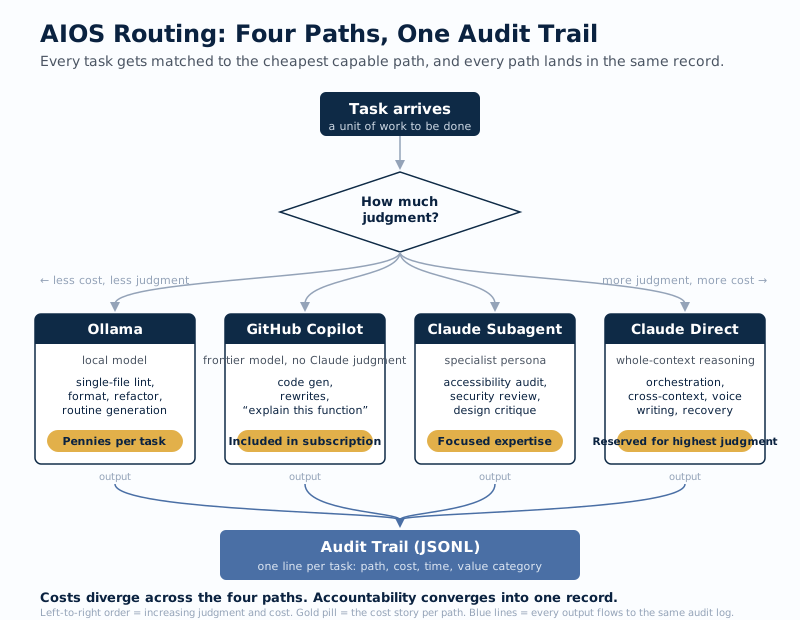
It is not a product you can buy. It is my own operating system: the thing that decides which model does which task, keeps a specialist on every job, checks the work before it carries my name, and logs every step so I can tell you exactly what was done, by what, and what it cost. I built it because I needed AI work to be answerable, and most of the time it isn’t.
What AIOS is
AIOS is the system I use to run AI inside my own practice. The name is plain shorthand for an AI operations system, and that is genuinely all it is: the operations layer that sits between a piece of work coming in and that work going out with my name on it.
Picture a small, well-run studio. There is someone at the front deciding which job goes to which person. There are specialists who each do one thing well and politely decline the things outside their lane. There is an editor who reads everything before it leaves the building. And there is a ledger by the door where every job gets written down: who touched it, how long it took, what it cost. AIOS is that studio, except the specialists are software, the front desk is a set of routing rules, and the ledger is a log I can hand to a client.
The part that matters for you is what it is not. It is not a chatbot I paste things into and hope. It is not one large model doing everything. And it is not a black box. Every decision it makes traces back to a written rule I can show you, and every task it runs leaves a record I can read.
Why I built it
I started using AI tools the way most people did: open a window, ask for something, get something back, decide whether to trust it. That works for a clever first draft. It falls apart the moment you are doing professional work that someone is paying senior rates for, because you cannot account for any of it after the fact. You cannot say which model wrote which line. You cannot say what it cost. You cannot prove a human reviewed it. You are asking a client to trust output that has no paper trail.
I have a stance, on every engagement, that I disclose any use of AI before the work ships. You cannot honestly disclose what you cannot reconstruct. So the audit trail was not a feature I added later for marketing. It was the reason the system exists at all. If I was going to use AI in client work, I needed to be able to show my work, the same way I would expect any tradesperson in my home to show me what they did and what they charged for it.
AIOS is what “show your work” looks like when some of the work is done by a machine.
How it is shaped
People hear “trained” and think of feeding data into a model until it behaves. That is not what happened here, and I want to be precise about it. The models AIOS uses are the same ones anyone can use. What makes the system behave like me is not the models. It is that every rule inside it was built from the documents that describe how I already work.
I have a set of operating pillars I hold to in all my work, and a set of professional stances about how the work gets done. AIOS was assembled from those. A few of them are built into the system so directly that you can point at the code and see them.
Safe by default. A human is always the router and always the final judgment. The system never sends finished work out the door on its own. I decide what gets done, AIOS does the parts it is suited for, and I sign off on what carries my name. The safe path is the default path, not a setting I have to remember to turn on.
Archaeological records. Everything is logged. Every task records which model did it, what kind of work it was, what it cost, and how it turned out. I keep those records the way a good builder keeps the permits and the receipts: not because anyone has asked yet, but because the day someone asks, the honest answer should already be written down.
Artisanal quality. Before a piece of work passes as finished, a quality gate reviews it against the same standard I would apply by hand. Writing gets checked by an editorial reviewer. A page gets checked for accessibility. Code gets checked for whether the next developer can actually read it. The gate can send work back. That refusal is the point.
Integrity over polish. The system is built to tell me when it is not confident, rather than to produce a confident-sounding answer that happens to be wrong. I would rather it stop and ask than guess well.
The professional stances show up the same way. Because I disclose AI use, the audit trail exists. Because I treat accessibility as a precondition and not a final-week scramble, there is a reviewer whose entire job is to catch accessibility failures before they ship. Because I believe every engagement should leave the client able to carry on without me, AIOS is something I can hand over and explain, not a trick I keep to myself. The system is honest and accountable because I am asking it to be honest and accountable on my behalf, and I built it from the documents that say what that means.
How I use it on a normal day
A task comes in. Say it is a client site that needs a content audit, a plugin that needs hardening before release, and a blog post that needs drafting and review.
The first thing AIOS does is decide where each piece of work should go, by cost and by what the work actually needs. This is the part the person watching the budget cares about, so let me be direct about it. The routine work goes to the cheap path. Formatting, linting, a straightforward rewrite, pulling a file into shape: that goes to a local model running on my own machine, which costs pennies.
Code generation that needs a capable model but not my specific judgment can go to GitHub Copilot, a seat I already pay a flat rate for. Only the work that genuinely needs senior reasoning, the strategy, the voice, the calls that carry real consequence, reaches the expensive model. The instinct most people have is to send everything to the best, most expensive tool. That is the equivalent of taking a taxi to check the mailbox. AIOS sends the taxi only where the taxi is worth it.
Then a specialist does the focused work. I have more than fifty agent personas, each scoped to one real role. There is an editor. There is an accessibility reviewer. There is a designer. There is a WordPress expert. For publishing operations, those personas include editorial roles scoped to newsroom workflows, the same context that underlies the publishing infrastructure service. Each one is given a narrow job and is built to decline work that is not its job, which keeps the quality high and the lanes clean.
Then a quality gate reads it. Nothing carries my name until something has checked it against the bar I would hold it to.
And every one of those steps lands in the log. At the end of it, I can tell a client something most people in this work cannot: this task would have taken me roughly this many minutes by hand, here is what it actually cost to run, and here is the kind of judgment that went into it. That is not a sales line. It is arithmetic, and the receipts are in the log.
What this means for you, and where the honesty ends
I want to be careful not to oversell this. AIOS does not replace me, and it is not magic. A human is the router and the final call, every time. The AI involvement is disclosed, never hidden. And the whole thing is built to be auditable precisely because AI work, left alone, is not.
What it means for you is simpler than the machinery behind it. If you bring me work, you are not getting a consultant who experiments with AI on your dime and waves away the question of how. You are getting someone who solved the accountability problem for his own practice first. I can show you the paper trail, and I can tell you what the work cost down to the task. The governance question that makes a lot of organizations nervous about AI, the “how do we know what it did and whether we can stand behind it” question, is one I had to answer for myself before I would put it near anyone’s project.
I answered it. The answer is sitting in the log.
If you need AI work you can actually account for, that is the service this page is really about.
I offer AI operations as a service, built on the same system and the same standards I have described here. If you are weighing how to use AI in your organization without losing the thread of what it did and what it cost, read the AI Operations service page, or book a discovery call and tell me what you are trying to do. No pitch, no pressure: just an honest conversation about whether this is the right fit for the work in front of you.
What AIOS is not: it is not a licensed product, not available for purchase, and I do not consult on deploying it elsewhere as a software system. What I do offer is AI operations infrastructure work, designing and implementing a routing, governance, and audit layer inside your existing tools and models. If you are looking for an off-the-shelf AI operations platform to license, that is outside what I do.