Your guests choose you weeks before they arrive, from a kitchen table three provinces away with eleven tabs open. Win that moment and the season mostly looks after itself. It comes down to hours that are right, a booking path that works under a thumb, answers a tired reader can find without hunting, and a page that loads before they give up.
I drive up to meet clients across Niagara, and after launch monthly care is there if you want it.
Building on the web since 1996, in WordPress since 2007 · accessibility built in from the first commit, AODA and WCAG 2.2 AA · WordCamp speaker at 18+ events · Fort Erie, Ontario
If your Niagara-on-the-Lake business runs on a season, a calendar and a booking, this page is for you. Inns and bed and breakfasts in Old Town, wineries and tasting rooms out along the Niagara Parkway and York Road, Queen Street shops and restaurants, and the businesses in Virgil, St. Davids, Queenston and Glendale who serve them all year. I work out of Fort Erie, which is forty-five minutes down the Parkway, close enough that I come to you and far enough that I have to earn the drive. Here is how I work as a website designer here, and what I would look at on your site first.
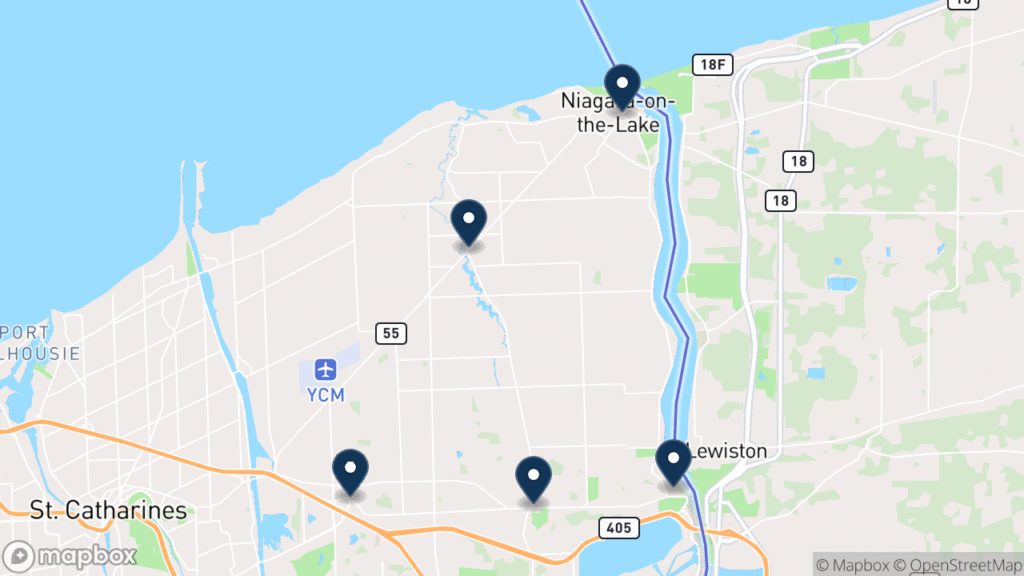 Map of Niagara-on-the-Lake with its villages marked: Niagara-on-the-Lake, Virgil, St. Davids, Queenston, and Glendale. Christopher Ross builds and supports websites for businesses here, from Fort Erie in the Niagara region.
What your guests decided before they got here
The Chamber of Commerce on Queen Street, serving this town for more than sixty years, calls tourism the key business driver for the area outright. Take them at their word and it changes what a website is for. Your visitor is planning from somewhere else, often from another country, usually weeks ahead, and by the time they walk past your door the decision is already made.
That planning window is the whole opportunity. Somebody building a weekend around the Shaw Festival calendar, a winery tour or an anniversary is comparing you against four other places in a browser tab at home. The site that answers the practical questions gets the booking, and it is usually beating a prettier one to it.
A good share of that audience is over sixty and reading on a phone in bright sun, or on a tablet at the kitchen table with the glasses on. So contrast, type size and one big obvious button are commercial decisions here well before they are compliance ones. I build to AODA and WCAG 2.2 AA from the first commit, which in this town mostly means your best-spending guests can actually read the page.
Five things that move bookings in Niagara-on-the-Lake
- Put the practical facts on the page as text. Opening dates, seasonal hours, whether you take walk-ins, how far you are from Queen Street, where people park, and how the space works for somebody with a walker. These are the questions asked before a booking, and plain sentences are what search engines quote back, and increasingly what the Artificial intelligence (AI) answer tools read out loud.
- Give the shoulder season its own page. April and November guests are after something quieter, cheaper and slower than the July crowd, and almost every site in town is written for July. There is real demand sitting in those months waiting for somebody to speak to it.
- Own the booking path. A short, obvious, phone-friendly way to book direct is usually worth more than a redesign, and it keeps the guest relationship, the email address and the review history with you. The big platforms genuinely earn their keep on reach, and they work best as one door among several rather than the only door.
- Write for somebody who has never been here. Plain English, prices in Canadian dollars said out loud, and a line about how far you are from Toronto and the airport. Your reader may be in Ohio or Osaka, doing currency and driving math while they read.
- Fill in your Google Business Profile properly. Real photos, current hours, the holiday closures filled in, and the questions answered. For a small visitor-facing business here it does more than most of what gets sold as marketing, it is free, and it takes an afternoon. Do that one this week whether or not you ever call me.
Where your guests find you first
In a town where tourism is the economy, being properly listed with these is worth more than any amount of clever marketing, and none of them pay me anything to say so.
- Niagara-on-the-Lake Chamber of Commerce (opens in a new tab). For a visitor-facing business here this is the first call I would make, ahead of everything else on this list.
- Town of Niagara-on-the-Lake, business resources (opens in a new tab). The municipal side: economic development contacts, permits and the practical questions that come before a website.
- The Shaw Festival (opens in a new tab). Plan your content year around the Shaw season and you will always have something current to say, and something to be found for.
- Greater Niagara Chamber of Commerce (opens in a new tab). The regional chamber, useful once you sell beyond the visitor economy.
Who this is for
- Inns, bed and breakfasts and small hospitality operators who want the direct booking to be theirs rather than a standing commission on every guest.
- Wineries, tasting rooms and tour operators whose visitor plans weeks ahead and wants availability, logistics and accessibility settled before they commit.
- Queen Street retail and restaurants competing against good neighbours, where the difference gets made in the details rather than the design.
- Anybody in Virgil, St. Davids, Queenston or Glendale serving both the visitor trade and the people who live here year round, which is two audiences and usually one overworked website.
Two honest notes on fit. This work pays for itself when you want the direct path to be yours, so if you are happy running every booking through a platform and intend to keep it that way, you will get more out of a good photographer than out of me. And the calendar is real: four weeks from first call to launch is the floor, so if your season opens in a fortnight, ring me anyway and we will find the repair that gets you through it and plan the build for the quiet months.
How a project actually runs
The twenty-minute call is free, and quite often it ends with me telling you that a repair will do. The fix is usually smaller than you are bracing for. Plenty of sites in this town are already decent and the trouble is one path that gave up somewhere in the middle.
If it turns out to be a build, we spend an hour or two on discovery, and for a visitor-facing business most of that hour goes on the booking path, the season, and who your guest is before they arrive. Then discovery, architecture, build and launch, with your real words in place from the first phase, because a page designed around filler text keeps the shape of filler text long after the words change. You watch it go up on a private staging link rather than signing off a mockup. Four to ten weeks is usual, and it is normally your own photos and copy that set the date.
Thirty-day defect warranty on every build. The domain, the hosting and every login stay in your name, so if you and I part ways afterwards everything keeps running. In a town where a good many operators have been locked into somebody’s platform once already, that is worth saying out loud.
What I check first, and it costs you nothing
Before we even talk I will book a room, a table or a tour on your own site, from my phone, and go all the way to the confirmation screen. On a laptop everything looks fine, which is exactly how a break in the middle of that path survives a whole season. If yours works end to end I will tell you so, and you will have had a free audit out of me.
The second thing I look at is who ends up holding the guest relationship. Every reservation, review and email address that lands inside somebody else’s platform is an audience you are renting rather than one you own, and renting is fine right up until the rent changes.
Most of the time what is costing you bookings is one form or one page of stale hours. Honestly, I would rather tell you that and lose the bigger job, because the referral from an owner I was straight with is worth more to me than the rebuild was. You should ask the same straight answer of whoever you hire.
Common questions
How much does website design cost in Niagara-on-the-Lake?
Most local builds start around $2,500 CAD and the common engagement runs higher, depending on how many pages you need and how much of the writing falls to me. You can get yourself a range in about two minutes with the project scope estimator, and a real number after the twenty-minute call. Either way you get a fixed price in writing before any work starts.
My site looks fine. Is a rebuild worth it?
Often the honest answer is that a repair will do, and I will say so. In this town a lot of sites look good and stumble on something specific: the booking path breaks on a phone, the seasonal hours went stale back in March, or the contrast washes out for an older guest reading in sunlight. Each of those is an afternoon or two of engineering, and it is usually the cheaper honest answer.
Are you a local web designer, or are you in Toronto?
Local. I am in Fort Erie, which is a forty-five minute run up the Parkway, and I would far rather sit across a table from you than do the whole thing over email. If you have been quoted by a Toronto shop, the difference you will feel is that I can come and stand in your lobby and watch a guest try to book. The nearest published example of this kind of work is the three Ridgeway shops case study, which is the same job at the same scale for the same sort of owner.
Can you handle bookings, availability and a second language?
Yes, and each of those gets decided at the architecture stage rather than added as a plugin at the end. Properly bilingual means the French pages are part of the structure from the start, and a real availability system means your calendar is the source of truth rather than an email landing in an inbox somebody has to remember to check.
Will I be locked in to you afterwards?
The domain, the hosting account and every login are in your name from the first day. WordPress is open source, so any developer in Niagara can pick it up after me. That is deliberate. I would rather you stayed because the work was good.
When should I start if I want it live for the season?
Count back four to ten weeks from your opening, then add a couple more for gathering photos and writing the words. For a May opening that means a call in January or February. If you are reading this in April with a season bearing down on you, ring anyway and we will find the repair that carries you through to the autumn.
Web design in Niagara-on-the-Lake is mostly a hospitality problem wearing a technology hat. Twenty minutes on the phone will tell us which one you have, and that part is free.
Just over the line from here I also build in St. Catharines and Niagara Falls, and out along the bench in Lincoln. For the whole region, there is a wider view of the Niagara practice.
Tell me about your project
The fastest way to a straight answer. Tell me what you need and I will reply within a business day, honestly, even when the answer is that I am not the right fit.
Prefer to talk? Call 647-641-0643
Share your project details
Use this form for project scope, technical SEO support, onsite training requests, or a focused next-step conversation.