Lincoln is one town on the map and three different markets on the ground. A website built for “Lincoln” in the generic serves a business in none of them, because the customer in Beamsville, the visitor headed to Jordan, and the trade buyer calling Vineland are three different people with three different questions.
I meet clients in person across Niagara, and after launch monthly care covers the updates, backups and monitoring if you want it.
Building on the web since 1996, in WordPress since 2007 · accessibility built in from the first commit, AODA and WCAG 2.2 AA · WordCamp speaker at 18+ events · Fort Erie, Ontario
If you run a business in Beamsville, Jordan, or Vineland, this page is for you. I grew up next door in Grimsby, right on the same Bench beside Beamsville, so this stretch of the escarpment and the wine country is home ground for me and not a market I had to go study. I am based in Fort Erie now, about an hour down the QEW, but I know this end of Niagara the way you know a place you learned to drive in. Here is how I work.
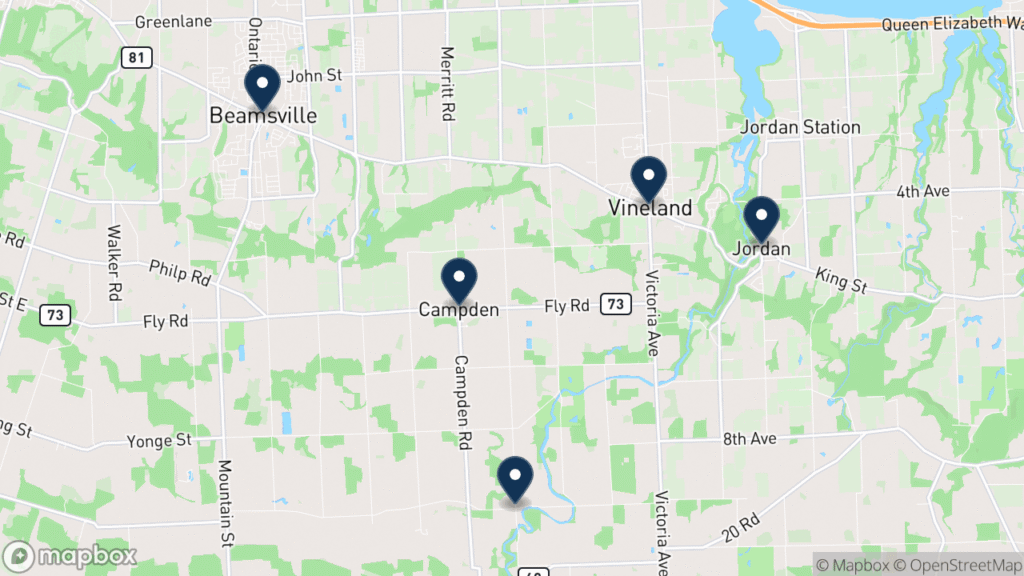 Map of Lincoln, Ontario, with its villages marked: Beamsville, Jordan, Vineland, Campden, and Tintern. Christopher Ross builds and supports websites for businesses across the township, from Fort Erie in the Niagara region.
Lincoln is one town and three markets
The Town of Lincoln sits between Lake Ontario and the Niagara Escarpment at the west end of the region. It was stitched together from a handful of older communities, and the three that matter for most businesses are Beamsville, which is the town seat and the largest, along with Vineland and Jordan. There are smaller places too, Jordan Station, Campden, Tintern, Rockway, but those three carry the weight. This is agricultural country: more than fifty wineries, tender fruit orchards, and a craft-beverage scene of wineries, breweries, and distilleries that pulls people up from the city. The Beamsville Bench and the Twenty Valley are the wine sub-regions here, and Ball’s Falls and the Bruce Trail are close enough that a good part of your customers arrive with a whole day already planned.
Here is the part that catches people out. Because it is all one municipality, the easy thing is to build one “Lincoln” website and call it done. But the job a website does in Beamsville is not the job it does in Jordan, and neither one is the job it does in Vineland. A barbershop on the main street, a boutique inn that lives on bookings, and a grower who sells to both wholesale buyers and weekend visitors need three different sites. Same town, three jobs. Let me walk through each one.
Beamsville: the main street
Beamsville is Lincoln’s commercial town centre and its municipal seat. It has an old-fashioned downtown of century-old brick buildings full of everyday businesses: a barbershop, a bakery, dress shops, a print shop, restaurants, banks, and trades. Orchards and vineyards ring the whole thing, and the Beamsville Bench wine appellation is named right for it. But the businesses I am talking about here mostly serve people who already live nearby.
The website job in Beamsville is everyday findability. Someone needs a plumber, wants to know if the bakery is open on a Monday, or is checking whether the print shop can do a rush job before Friday. They are not planning a trip. They are settling a small question, usually on a phone, usually in a hurry. The site that wins is the one that answers that question in plain words without making them dig.
This is the closest of the three to the situation I see in Welland and Port Colborne: a real base of working businesses, low digital competition, and a lot of sites that were built years ago and never touched since. If your Beamsville business has current hours that are wrong online, or a services list that stops halfway, or a site that was fine in 2015 and has quietly aged out, that is a small fix with a big payoff. Nobody in your trade has raced ahead of you online. There is still open ground here.
Jordan: the village a visitor plans a day around
Jordan Village is a different animal. It is a small, historic, tourist village: heritage streets lined with preserved buildings that hold independent boutiques, galleries, artisan studios, and antique shops. The anchors are the Cave Spring Vineyard tasting room in Jordan, the Inn on the Twenty with its restaurant and spa, Jordan Harbour, and the Twenty Valley wineries all around. It sits about an hour and fifteen minutes from Toronto, which is the number that tells you everything about the customer.
The visitor to Jordan plans the trip from home, before they leave. They decide the night before, or a week before, whether the inn has a room, whether the tasting room takes walk-ins, whether the shop they saw online is open on the Sunday they are coming. By the time they are standing on your street, the decision is already made. That means your website is doing its most important work while your customer is fifty or a hundred kilometres away, on a couch, comparing you against three other options.
So the site here is a booking-and-logistics tool, not a brochure. It is the same job a Niagara-on-the-Lake hospitality business has, just at a smaller scale. I build toward direct bookings the business actually owns, rather than a permanent cut handed to a booking platform on every reservation forever. I put shoulder-season and seasonal hours on the page honestly, so nobody drives out in March to a locked door. And it has to be readable on a phone, in bright sunlight, by an older visitor who is squinting at the screen in a parking lot. That last part is not a nice-to-have in Jordan. It is most of your traffic.
Vineland: the growers and the research town
Vineland is agricultural first: tender-fruit farms, greenhouses, and wineries, including Vineland Estates. It is also home to the Vineland Research and Innovation Centre, an independent not-for-profit horticultural research campus out in Vineland Station on Victoria Avenue. That research anchor tells you the town has a serious growing and trade economy underneath the scenery.
The website job in Vineland is different again, and it is the trickiest of the three, because a Vineland business often has two audiences on one site. There is the wholesale or trade buyer: a retailer sourcing fruit, a distributor, an agri-supplier, someone who needs specifications, volumes, certifications, and a reason to trust you with a purchase order. And then there is the farm-gate or agritourism side, the weekend visitor who just wants to know your hours, your address, and whether you have peaches yet.
Those two people want opposite things from the same homepage. The trade buyer wants credibility and detail and does not care about your photo of the barn cat. The visitor wants the barn cat, the hours, and a map, and will bounce off a spec sheet. The real problem is serving both without one muddling the other. The way through is to give each audience its own clear path from the first screen, so the buyer lands in the trade section and the visitor lands at the farm gate, and neither has to wade through the other’s page to get there. Get that split right and one site does two jobs cleanly. Get it wrong and it does neither.
How a Lincoln business gets found
A few things hold true across all three communities, whichever one you are in.
- Name your community, not just “Lincoln.” People search for Beamsville, Jordan, and Vineland by name far more than they search the municipality, and putting the right name in plain text on the page is how both search engines and the newer Artificial intelligence (AI) answer tools learn where you actually are.
- Serve the resident, the visitor, and the trade buyer differently. A page written for a neighbour who needs your hours reads nothing like a page written for a visitor planning a day trip or a buyer checking your credentials. Decide who yours is for before you write a word of it.
- Use the wine-route and trail context on purpose. A lot of your customers are already moving through Twenty Valley or along the Bruce Trail with a day mapped out. If your page tells them where you sit in that day, you catch traffic that is already headed your way.
- Answer the pre-visit question in plain text. “Are you open Sunday,” “do you take walk-ins,” “do you sell wholesale,” “where do I park.” Write the answer in words a search engine or an AI assistant can lift and repeat, and you get found by the exact person asking.
Who to know in Lincoln
I get nothing from listing these. No referral fee, no arrangement, no favour owed. They are just the organisations worth knowing if you run a business in Lincoln, and a good site is one that sits inside its community instead of floating above it.
- Lincoln Chamber of Commerce (opens in a new tab), based in Beamsville on Beam Street and serving all three communities since 1985.
- Downtown Bench Beamsville BIA (opens in a new tab), the downtown Beamsville business improvement area, with a name that plays on the Beamsville Bench.
- Vineland Research and Innovation Centre (opens in a new tab), the horticultural research anchor out in Vineland Station.
- Jordan Village (opens in a new tab), the tourism listing for the village through Visit Niagara.
- Town of Lincoln (opens in a new tab), the municipality, for economic development and permits.
- Greater Niagara Chamber of Commerce (opens in a new tab), the regional chamber for the wider area.
Who this is for
- A Beamsville main-street or trades business whose site was built years ago and never touched, and who wants to be easy to find and easy to reach.
- A Jordan inn, shop, gallery, or winery that wants direct bookings it owns instead of paying a platform a cut on every reservation.
- A Vineland grower or greenhouse that sells to trade buyers and also runs a farm-gate side, and needs one site to serve both without confusing either.
How a build works
It starts with a free twenty-minute call. No pitch, no pressure. You tell me about the business and which community it lives in, and I tell you honestly whether I can help and what it would take. If we go ahead, I start with discovery: I learn what your customers actually ask, who they are, and what the site has to do before I design anything.
The build runs in four phases: discovery, architecture, build, and launch. You see real copy on a private staging link along the way, not a mockup full of filler text, so you are reacting to the actual thing before it goes live. Most builds take four to ten weeks depending on size. Every site comes with a thirty-day defect warranty after launch, so if something breaks that we built, I fix it. And you own everything: the domain, the hosting, the logins. When we are done, nothing about your site needs me to keep running. You are not renting it back from me.
Three questions worth asking any developer
Who owns the hosting and the domain? This matters because it decides whether you actually own your website. If the developer holds the domain and the hosting login in their name, you are renting your own business from them, and you find out the hard way the day you want to leave. The answer should always be that you own both.
Who updates the seasonal hours or the booking path, and how hard is it? In Jordan and Vineland especially, your hours and your availability change with the season, and the wrong hours online cost you real visits. If changing the hours line means emailing the developer and waiting, that is a problem. You should be able to update the things that change often, yourself, in a couple of minutes.
What would you refuse to build? A developer who will build anything you ask has no opinion about what works, and you are paying for the opinion as much as the pixels. I will refuse to bury your hours three clicks deep, and I will refuse to hand your bookings to a platform that takes a cut forever when you could own them. Ask, and listen for whether the answer is about you or about them.
Common questions
How much does a website cost in Lincoln?
Most local builds start at $2,500 CAD. It is a fixed price agreed against a written scope before the work begins, so the number does not move once you have said yes to it. What changes the figure is how many pages you need and how much of the writing and photography you already have. You get a real number after a twenty-minute call.
Should my site say Lincoln, or my community?
Both, but lead with your community. People search Beamsville, Jordan, and Vineland by name far more than they search the town of Lincoln, so those names need to be on the page in plain words. Then I add Lincoln and Niagara around them, so you get found by someone searching the specific village and by someone searching the wider area. You do not have to choose. You just have to put the name people actually type first.
Do you actually know all three communities?
Honestly, yes, and I will tell you which parts I know best. I grew up next door in Grimsby, right on the Bench beside Beamsville, so the main-street side of Beamsville and the wine country between here and there is genuinely home ground. Jordan and Vineland I know well as a Niagara person who has spent years around them, though I will lean on you for the inside knowledge of your own trade and your own customer. What I will not do is pretend a village is interchangeable with the one next to it. That is the whole reason this page has three sections instead of one.
Tell me about your project
The fastest way to a straight answer. Tell me what you need and I will reply within a business day, honestly, even when the answer is that I am not the right fit.
Prefer to talk? Call 647-641-0643
Share your project details
Use this form for project scope, technical SEO support, onsite training requests, or a focused next-step conversation.