The Niagara Falls web design market defaults to tourism aesthetics. If your business serves year-round clients, not summer tourists, your site needs to say something different.
I meet clients in person across Niagara, and after launch monthly care covers the updates, backups and monitoring if you want it.
Building on the web since 1996, in WordPress since 2007 · accessibility built in from the first commit, AODA and WCAG 2.2 AA · WordCamp speaker at 18+ events · Fort Erie, Ontario
If your Niagara Falls business serves the people who live and work here year-round, not just the summer crowd, and your website doesn’t reflect that, this is for you. What follows is for the professional practices, trades, and service businesses whose customers are searching in February, not only in July.
Niagara Falls has a split economy. The tourist economy is real, enormous, and well-served by web designers who know how to make hotel booking flows and attraction pages. The professional economy: law firms, medical practices, engineering and consulting firms, insurance brokers, the OLG-adjacent gaming sector, is underserved by precisely that same market, because the aesthetic and structural requirements of a professional services site are completely different from a tourism site.
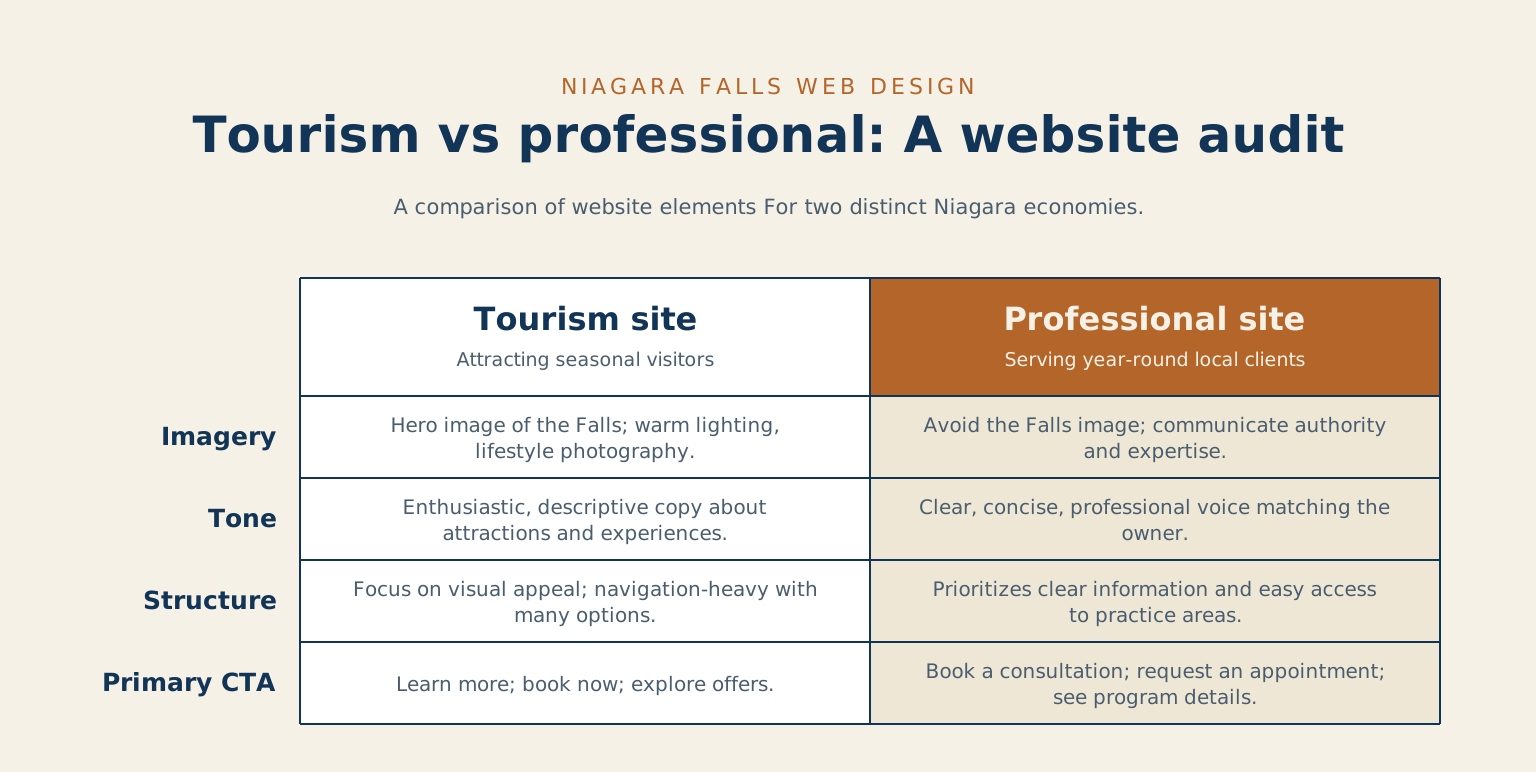
A personal injury law firm in Niagara Falls doesn’t want a hero image of the falls. It doesn’t want warm lighting and lifestyle photography. It wants a site that communicates authority, earns trust within thirty seconds of the first visit, and routes a potential client to the right practice area without requiring them to read a navigation menu. That’s a different design brief than a tourism site, and it requires someone who understands the distinction, not just the WordPress template market.
Niagara College nearby also produces a category of site requirement that’s particular to this market: continuing education, workforce training, and professional development programs that need to be findable by working adults searching for upskilling options during evenings and weekends. The design requirements for those sites: clear program outcomes, real cost information, obvious application paths, are nothing like tourism.
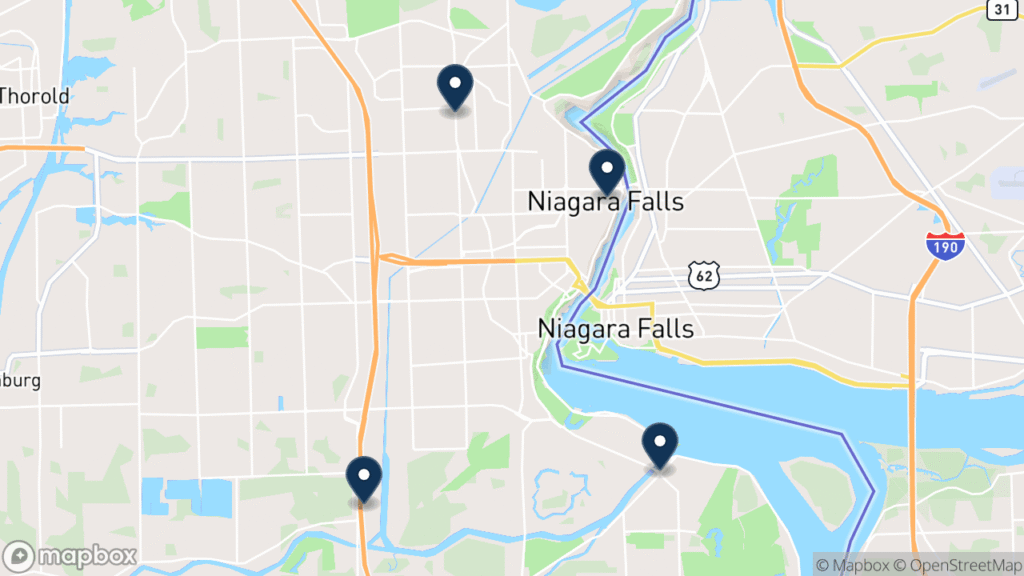 Map of Niagara Falls with its communities marked: Niagara Falls, Chippawa, Stamford, and Montrose. Christopher Ross builds and supports websites for businesses here, from Fort Erie in the Niagara region.
Six things every site I build does
- Clear first-impression headline. A visitor who lands on the homepage knows within three seconds what you do, who you serve, and why that matters to them. Not the city’s tourist pitch; your professional value proposition.
- Real trust signals. Actual credentials, specific client context, real results, not stock photos of generic professionals or the waterfall everyone already knows is there.
- Obvious primary CTA. One action per page, visible above the fold on every device, repeated at logical points below. For a law firm it’s “Book a consultation.” For a medical practice it’s “Request an appointment.” For a training program it’s “See program details.” It’s never “Learn more.”
- Voice that matches the owner. The copy sounds like the professional running the business, like the person running the business rather than like a brochure.
- Mobile-first. Tested on real devices. Working adults searching for professional services in Niagara Falls are searching on their phones.
- Loads under 3 seconds. Measured against real-user conditions, not a Lighthouse lab score on a corporate fibre connection.
A seasonal operation with staff, equipment, and a real off-season is a different business from a booking funnel. If you run a marina, a campground, a charter or a winery, this page is for you: you’ve staff, equipment and an off-season, and none of that’s a booking funnel.
Getting found in Niagara Falls
No business here has quite the search problem a Niagara Falls business has: the name of your city belongs to a waterfall, and to a second city in another country.
- Tourism volume drowns local intent. Search almost anything alongside Niagara Falls and you’re up against hotels, attractions and tour operators spending real money on those words. That auction belongs to them, and you can happily leave it to them. The searches that matter to you’re longer, quieter, and almost nobody bothers with them.
- A share of the results are in New York. Niagara Falls, Ontario and Niagara Falls, New York share a name, and search engines split the difference constantly. State the province plainly in your pages, your listing and your markup, or you end up shown to people who would need a passport to reach you.
- Neighbourhood beats city. Lundy’s Lane, Fallsview, Chippawa and the Montrose business area behave like separate markets with separate customers. Naming the one you actually serve does more work than another paragraph about Niagara Falls.
If your clients are here all year rather than for a weekend, the whole job is to look like a local business to a local searcher, and to stop competing for words that were never going to pay you back.
Who this is for
- Niagara Falls professional services firms: legal, medical, financial, insurance, consulting, whose current site reads like a tourism property and isn’t attracting the right clients.
- Healthcare organizations and clinical practices that need a site structured around patient trust, service clarity, and intake flow, not aesthetic.
- OLG-adjacent and gaming sector businesses that serve a year-round professional and corporate client base and need positioning that reflects that.
- Training and workforce development programs that need a site designed for working adult learners: clear outcomes, real costs, obvious application paths.
What working together actually looks like
You won’t disappear into a project portal and wonder what is happening for six weeks. Here is the whole shape of it from your side of the table.
It starts with the free 20-minute call. You tell me what the current site isn’t doing and what the business needs from it. I tell you, honestly, whether I’m the right fit, and if I’m not, I’ll usually point you to someone who is.
If we go ahead, the first real step is a discovery conversation, an hour or two, about what you do, who you serve, and what a visitor should do next. Everything after that’s built from that conversation. You watch the site come together on a private staging link while it’s being built, so you react to real pages instead of approving a mockup and hoping. Most owner-operator builds run four to ten weeks from that first conversation to launch: what usually moves the date is how much copy and how many photos you’ve ready, not the build itself.
Your time commitment is real but small: the discovery conversation, a round or two of feedback on staging, and the material only you can provide. I handle the rest. When it launches, the first thirty days are mine to watch closely; that’s when the small things surface, and they get fixed without a new invoice.
What to ask anyone before you hire them to build your site
Whether you hire me or not, three questions will tell you most of what you need to know about whoever builds your next site.
First: who owns it when we are done? The honest answer is you: the domain, the hosting, the content, all of it in your name. You want the site to keep working whatever happens between you and whoever built it.
Second: can another developer take this over? A site built on standard WordPress can be handed to any competent developer if life happens to the one who built it. That’s worth confirming early, while it’s still an easy question.
Third: what happens after launch? A website isn’t a painting you hang and walk away from. Plugins update, browsers change, security matters. Find out whether the person who builds it will still be there, and what that costs, before the first thing breaks.
You do not have to hire local to get good answers to these. But you should get good answers.
Who to know in Niagara Falls
I make nothing from sending you to any of these, and none of them know I’m writing this. I list them because if you run a business in Niagara Falls, these are the doors worth knowing about, whether you ever hire me or not.
- Niagara Falls Chamber of Commerce (opens in a new tab), the local chamber and part of the South Niagara Chambers group. A good first stop for meeting other owners who are in the same year-round economy you’re.
- City of Niagara Falls business improvement areas (opens in a new tab), the city’s business side. Niagara Falls has five BIAs, so if your storefront sits inside one, that’s who to talk to.
- City of Niagara Falls (opens in a new tab), the municipality itself, for economic development questions and permits.
- Greater Niagara Chamber of Commerce (opens in a new tab), the regional chamber, which is the one I point people to when they sell beyond the city and into the rest of Niagara.
Common questions
How much does a website cost in Niagara Falls?
Most local builds start at $2,500 CAD. It’s a fixed price agreed against a written scope before the work begins, so the number doesn’t move once you’ve said yes to it. What changes the figure is how many pages you need and how much of the writing and photography you already have. You get a real number after a twenty-minute call.
Should my Niagara Falls website use a photo of the Falls?
If your customers are year-round locals or professional clients, usually no. A big Falls photo across the top tells a visitor you’re in the tourism business, which quietly works against a law firm, a clinic, or an insurance office. The image at the top of your site should signal what you actually do, so someone who lands there knows in a second that they’re in the right place.
Do you build tourism or hotel booking websites?
No, and I would rather say that plainly than take the work. Tourism and hotel booking is a different specialty with a different search strategy, built around visitors who will never live here. I build for the professional and year-round local economy, the offices and practices and training programs that serve the same people all year, and that’s where I’m actually good.
Tell me about your project
The fastest way to a straight answer. Tell me what you need and I will reply within a business day, honestly, even when the answer is that I am not the right fit.
Prefer to talk? Call 647-641-0643
Share your project details
Use this form for project scope, technical SEO support, onsite training requests, or a focused next-step conversation.