
I grew up in Grimsby and I’ve built websites for a living since 1996. If you’re looking for a web designer here, the most useful thing I can tell you is that Grimsby is harder to be found in than a town this size should be, and that the reason is fixable.
I meet clients in person across Niagara, and after launch monthly care covers the updates, backups and monitoring if you want it.
Building on the web since 1996, in WordPress since 2007 · accessibility built in from the first commit, AODA and WCAG 2.2 AA · WordCamp speaker at 18+ events · Fort Erie, Ontario
Most of the Grimsby work I take on starts the same way. The site looks fine, and it’s invisible to half the people who would have hired you. I watched this town spread out below me from up on the Mountain, and I work from Fort Erie now, an hour down the QEW, so Grimsby is the one town on my map I never had to learn. Here is how I work.
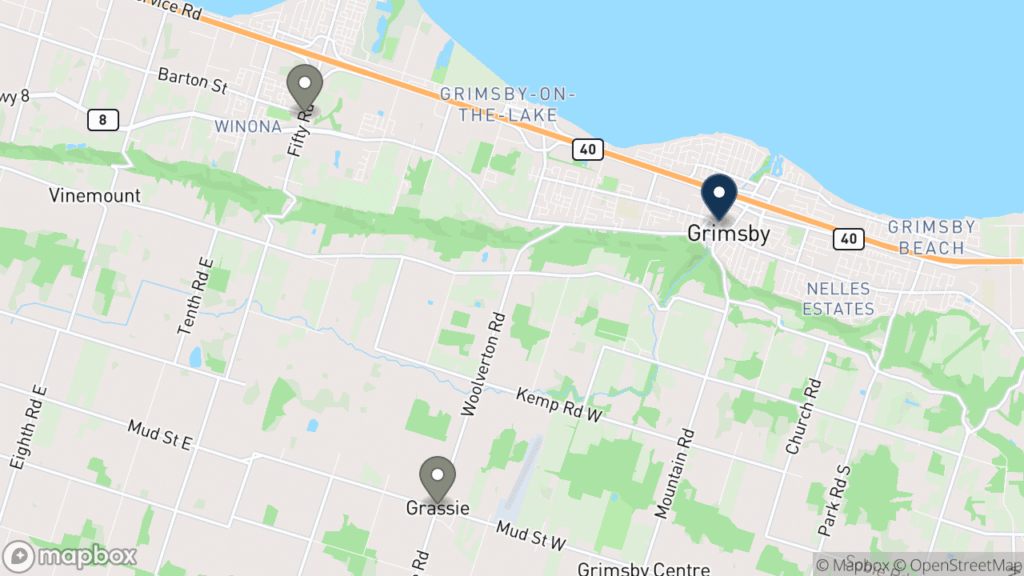 Map of Grimsby, with the town centre marked. Grassie and Fifty Road are marked in a lighter tone, just outside the town. Christopher Ross builds and supports websites for businesses here, from Fort Erie in the Niagara region.
What makes Grimsby a harder town to be found in
Grimsby is a surprisingly narrow town. It runs east to west as a long ribbon pressed between Lake Ontario and the Escarpment, and it’s the first Niagara town a driver from the Greater Toronto Area reaches and the last one they leave. That shape matters more than it sounds like it should. Somebody coming down the QEW is alongside Grimsby for several minutes and passes more than one interchange for it, which is ample time to decide to stop in a beautiful place, if the town has given them a reason to. A large share of the working population commutes out of town and shops back into it on weekends, so your customer is frequently researching at nine at night from somewhere else, deciding whether Saturday is worth the drive.
Grimsby is a big-city town and a rural one at the same time. One foot is in the urban pull of Hamilton and Burlington a short drive west, and the other borders the farms of Smithville over the escarpment and the Beamsville fruit land east along the Bench. Not many places sit in both worlds at once, and your customers come from both of them.
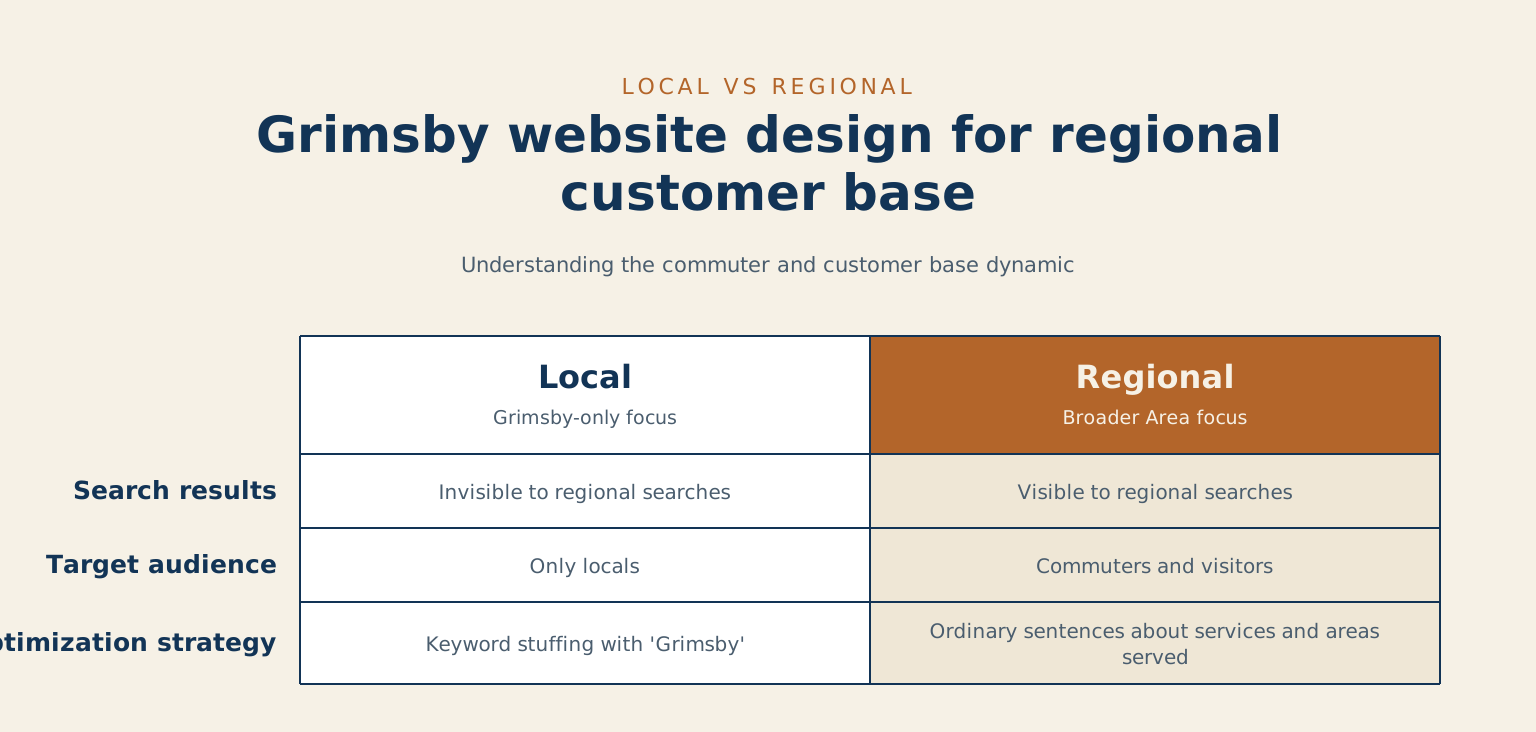
Grimsby is also proudly its own town while sitting inside the pull of three much larger metro markets: Hamilton immediately west, the Greater Toronto Area up the QEW, and St. Catharines to the east. That’s an advantage for the businesses here and a problem in search results, and it’s the same fact twice. Somebody looking for a plumber in town gets a contest, and the other entrants are Hamilton and Burlington firms that Google is confident will make the drive. Appending “in Grimsby” to everything on the page is the standard advice, and here it’s not enough on its own. The page has to be legible to somebody who has not worked out which municipality you’re in and doesn’t much care.
Then there are the people who come for the place itself. The Painted Ladies at Grimsby Beach, the restored Pumphouse at Forty Mile Creek Park, the point where the Bruce Trail meets the Waterfront Trail, and the Bench wineries just up the road all bring people who planned the trip before they left home. They’re not searching for you by name. They’re searching for a reason to stop, and the businesses that get found are the ones whose site answers a question a visitor actually has before arriving.
How a regional customer finds you
- Get the regional signal right before the local one. A Grimsby business that ranks only for “in Grimsby” phrasing is invisible to the Burlington search that would’ve converted. That means saying plainly, in ordinary sentences, which communities you serve and how far you travel, and it means a service page per real service rather than one page listing everything.
- Write for the drive. Your customer is deciding whether to spend forty minutes each way, so say how long you’re open after they would arrive, whether parking near you is realistic on a Saturday, and whether it’s worth combining with the wineries or the trail while they’re out. Nobody local needs that. Everybody driving in does.
- Answer the pre-visit question in writing. Whether you’re open on a holiday Monday, whether the patio is dog friendly, whether somebody can reach you the same day. Those are the real searches, and the site that answers them in plain text is the one a search engine repeats back to a driver still deciding whether to come.
Where a Grimsby business gets known
No arrangement, no referral fee, nothing in it for me. These are just where a Grimsby business gets found and gets known locally, and being listed and active in them does more for a small business than most of what gets sold as marketing.
- Grimsby & District Chamber of Commerce (opens in a new tab). A volunteer organisation of local business and professional people. Membership gets you a directory listing and, more usefully, the room.
- Downtown Grimsby BIA (opens in a new tab). If your storefront is in the downtown core, between roughly Kerman and Robinson below the Mountain, you’re almost certainly inside the boundary and already paying into it. Confirm it with them, then use what you’re funding.
- Town of Grimsby, business associations (opens in a new tab). The municipal starting point, including the downtown revitalisation work the Town runs jointly with the BIA, the Region and the Chamber.
- Greater Niagara Chamber of Commerce (opens in a new tab). The regional chamber. Worth it when your customers are spread across Niagara rather than concentrated in one town.
Three markets in one town
Grimsby is really three markets sharing one town name, and they want different things from a website. Most of the sites I see here are built well for one of them and say nothing at all to the other two.
- Visitors and day trippers. This customer decides before leaving home, which means your website does its work days before anybody arrives. Grimsby has more reasons to stop than most towns its size: the Painted Ladies at Grimsby Beach, the restored Pumphouse at Forty Mile Creek Park, the point where the Bruce Trail meets the Waterfront Trail, the Bench wineries up the escarpment, and a calendar that runs all summer. Music in the Park at Coronation Park on Thursday evenings, Movies in the Park on August Fridays, Canada Day at the Grimsby Museum, the Casa Shoreline Social down at Casablanca Waterfront Park. The Grimsby Author Series (opens in a new tab) has been bringing Canadian writers to the Carnegie Building since 2002 and draws an audience from well beyond town twice a year. The opportunity is a page for each real reason somebody comes, with your hours written against the event weekend instead of in general.
- Trades and professional services. This is where the contest is hardest, because you’re up against a Hamilton firm with a bigger budget and a listing Google already believes will make the drive. What wins the work is the sentence almost nobody writes down: which communities you serve and how far you travel. A Grimsby electrician who works Beamsville, Smithville, Winona and Stoney Creek, and says so plainly on a page for each service, gets found for searches the “in Grimsby” version of that page never reaches.
- Main Street retail and hospitality. Your weekend customer is driving in and deciding on the way, and the Thursday farmers market at the Peach King Centre brings a steadier local crowd through the season. Answer the practical question before anybody asks it: how late you stay open once somebody has driven in, and what market day does to your hours. The Downtown Grimsby BIA is already promoting the core, and a site that agrees with what it says about market days and event weekends gets carried along by it.
What building this actually involves
The first question I’ll ask is where your customers live, because on a regional build that answer decides the structure of the whole site. If half your work comes from Burlington and Stoney Creek, that’s not a footer stuffed with place names. It’s a decision about how many pages you’ve and what each one is for.
It starts with a free twenty-minute call. You describe what the site isn’t doing; I tell you straight whether I’m the right fit for it, and when I’m not I’ll point you toward somebody better suited. If we go further, we spend an hour or two on discovery: what you sell, who buys it, and which municipalities you genuinely want work from.
From there it’s four phases, discovery, architecture, build and launch, with your own words on the page from the beginning rather than placeholder text. It goes up on a private staging link while it’s being built, so you’re reacting to real pages instead of approving a picture of one. Four to ten weeks is typical for an owner-operator site, and the thing that moves the date is how ready your copy and images are.
Thirty-day defect warranty on everything, and you own all of it: the logins, the domain, the hosting in your name. There’s no arrangement where the site stops working if you stop paying me.
What to ask before you hire anybody, me included
Ask to see a site they built that earns work outside its own town. Regional reach is the specific thing you’re buying here, and it’s easy to claim and hard to fake, so ask for the example rather than the assurance.
Ask who holds the domain and the hosting once the final invoice is paid. If the answer is anything other than you, you’re renting a website rather than owning one.
Ask what they would refuse to build for you. Anybody who says yes to every idea in a first meeting will also say yes to the ones that waste your budget. You don’t have to hire locally to get honest answers to these, and you should ask them of whoever you choose.
Common questions
How much does a website cost in Grimsby?
Most local builds start at $2,500 CAD. It is a fixed price agreed against a written scope before the work begins, so the number does not move once you have said yes to it. What changes the figure is how many pages you need and how much of the writing and photography you already have. You get a real number after a twenty-minute call.
How do I choose a web designer in Grimsby?
Ask them which Grimsby customers they think you’re missing, and see whether the answer is about the town or about their package. Somebody who knows the market here will already have a view on whether your buyers are on Main Street, driving in from Burlington, or planning a weekend around the wineries. If they can’t tell those apart before quoting, they’re selling you a template with your town’s name on it.
Do you only work with Grimsby businesses?
No. I work from Fort Erie across Niagara and well beyond it, and a good deal of my work is nowhere near here. Grimsby has its own page because I know the town, not because I only take jobs in it.
Should my site target Grimsby or the wider region?
Both, and the order matters. Say clearly where you’re, then say just as clearly which communities you serve and how far you’ll travel. Businesses here lose more work to being unfindable in Burlington than to being insufficiently Grimsby.
How well do you actually know Grimsby?
I grew up here, watching the town grow from up on the Mountain before I ever built a website, and I’ve been building them since 1996 and working in WordPress since 2007. I’m in Fort Erie now, an hour down the QEW, but Grimsby isn’t a market I had to study. That doesn’t mean I’ll assume what your customers want today. It means I start a step ahead of a builder meeting the town for the first time.
Tell me about your project
The fastest way to a straight answer. Tell me what you need and I will reply within a business day, honestly, even when the answer is that I am not the right fit.
Prefer to talk? Call 647-641-0643
Share your project details
Use this form for project scope, technical SEO support, onsite training requests, or a focused next-step conversation.