
A training day built around your team’s actual work, not a slide deck pulled from a template library and adapted overnight.
Curriculum developer and instructor at the M.L. Campbell Training Centre, Sherwin-Williams’ international training facility · has taught WordPress at Sheridan College and York University · MA candidate in Learning and Technology, Royal Roads University · Fort Erie, Ontario
Book a training discovery call See full service details
The discovery call produces a written training brief for your team. Yours to keep, whether or not you book delivery.
What happens when training does not stick
The training happened. The facilitator was engaging. The participants said it was useful. By the following Wednesday, nobody had changed how they worked. The deck is in a shared drive somewhere. That is not a training problem, it is an instructional-design problem. Generic content, delivered to a generic audience, produces generic retention.
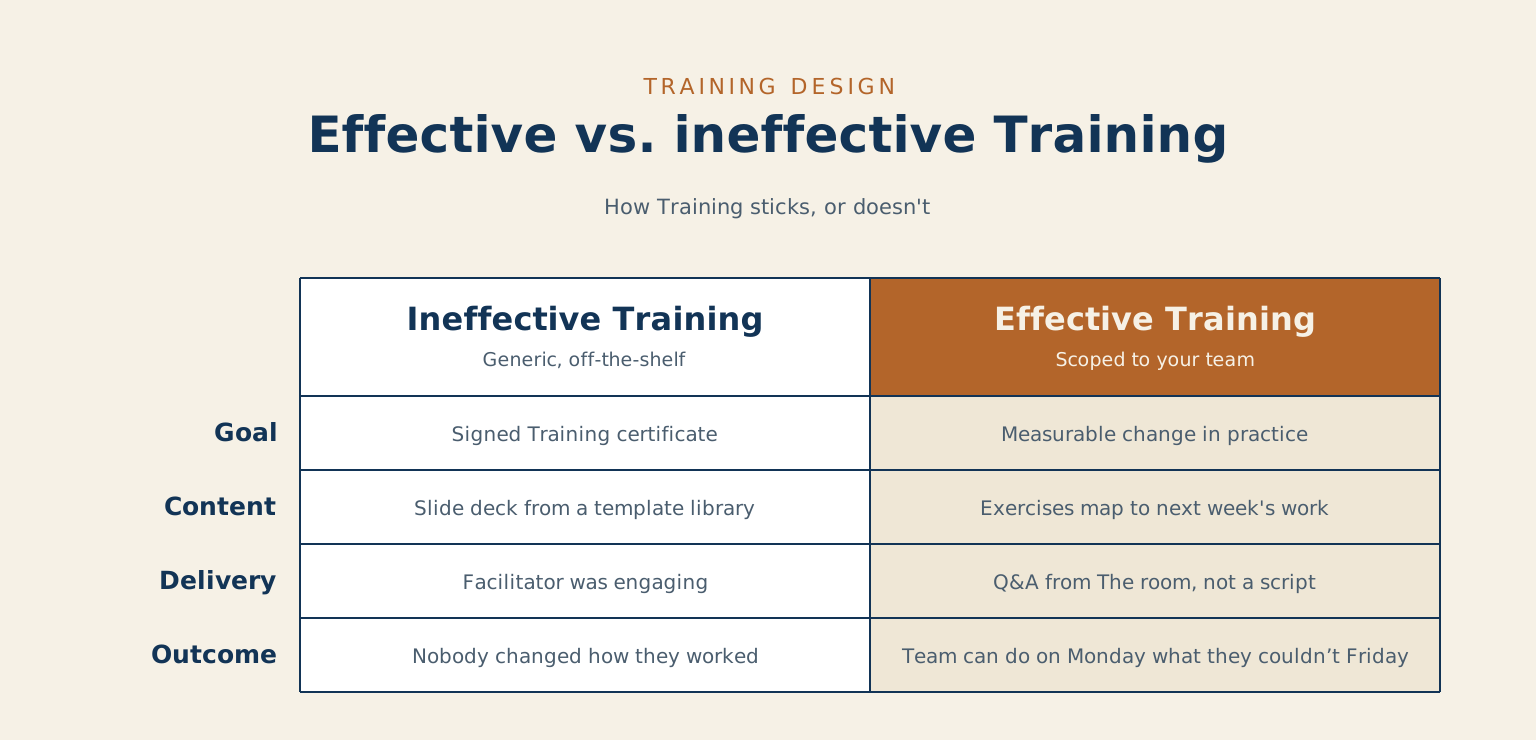
The sessions here are built around your team’s actual roles, tools, and workflows. The exercises map to work they will do next week. The Q&A is pulled from the room, not from a script. The goal is what your team can do on Monday morning that they could not do on Friday.
What I deliver
- WordPress and content management: Scoped to your install, your theme, and your editorial governance rules. Authors, editors, admins, and developers each get material that maps to their actual role.
- LMS and learning platform operations: For teams administering or building on LearnDash, Sensei, LifterLMS, or Moodle, user management, course setup, reporting, and governance.
- Microsoft Office suite: Excel, Word, Outlook, and PowerPoint, structured courses from foundations to advanced data and presentation work. Available as catalogue delivery or scoped to your team’s version, templates, and workflows.
- Instructional design and L&D methods: For teams building internal training capacity. How to structure a session, how to write assessments that measure the right thing, how to close the gap between “trained” and “doing it.”
- Custom curriculum: For organizations with proprietary processes, tools, or workflows that off-the-shelf training does not reach. Built around the roles, and delivered to the team before anyone in the organization reviews a generic course outline.
Who this is for
- ✅ Teams of 3–12 where the training must be applied to your team’s actual tools and workflows, not a generic walkthrough of the platform in its default state.
- ✅ Organizations onboarding a cohort to a platform they have deployed and need trained on consistently.
- ✅ L&D leads who want a practitioner in the room, Lead instructor at the M.L. Campbell Training Centre, an MA Candidate in Learning & Technology, and a track record of programs that scaled.
This is live, instructor-led delivery for a team working through something together, so it suits a group rather than a solo learner with a video library. It is built to change what people do on the Monday afterwards, which is a different goal from issuing a certificate. If a plan is really serving the certificate, I will say so on the discovery call, because the two need different designs.
Investment
The day rate covers up to 10 participants, including pre-session site review, custom session design, live delivery, recording, take-home reference document, and 30 days of email Q&A after the session.
- Private team delivery: Niagara-region travel included. Beyond Niagara, travel and accommodation billed at cost with a written estimate.
- Public cohort: Open-enrollment seats sold per-event on the training events calendar.
- In-person Niagara: An on-site workshop in Fort Erie or the Niagara region, for organizations within driving distance who want the room together.
- Curriculum development: For organizations building internal training capacity that needs designed assets, not just facilitated delivery.
The discovery call confirms scope, format, and timeline before any commitment. See the canonical Training & Enablement service page for the full engagement shape and the WordPress training catalogue.
Common questions
How many people should be in a session?
Eight to twelve is the sweet spot for hands-on work. Below eight you are paying for a room you do not need and a one-to-one session would serve you better. Above about sixteen the format changes: I can still teach it, but people stop asking questions, and the questions are where the value is.
Do you train on our systems or on generic software?
Yours. Generic training is why people forget it by Friday. We use your actual site, your actual inbox, your actual spreadsheets, so what someone practises on Tuesday is what sits in front of them on Wednesday. It does mean a little setup with your team beforehand, and it is the single thing that most affects whether the training sticks.
What stops everyone forgetting it in a month?
A job aid they keep, a recording they can go back to, and a follow-up session a few weeks later once real questions have surfaced. Training that ends at the door has a short half-life. The follow-up is where people bring the problems they only discovered by trying.
Tell me about your project
The fastest way to a straight answer. Tell me what you need and I will reply within a business day, honestly, even when the answer is that I am not the right fit.
Prefer to talk? Call 647-641-0643
Share your project details
Use this form for project scope, technical SEO support, onsite training requests, or a focused next-step conversation.