
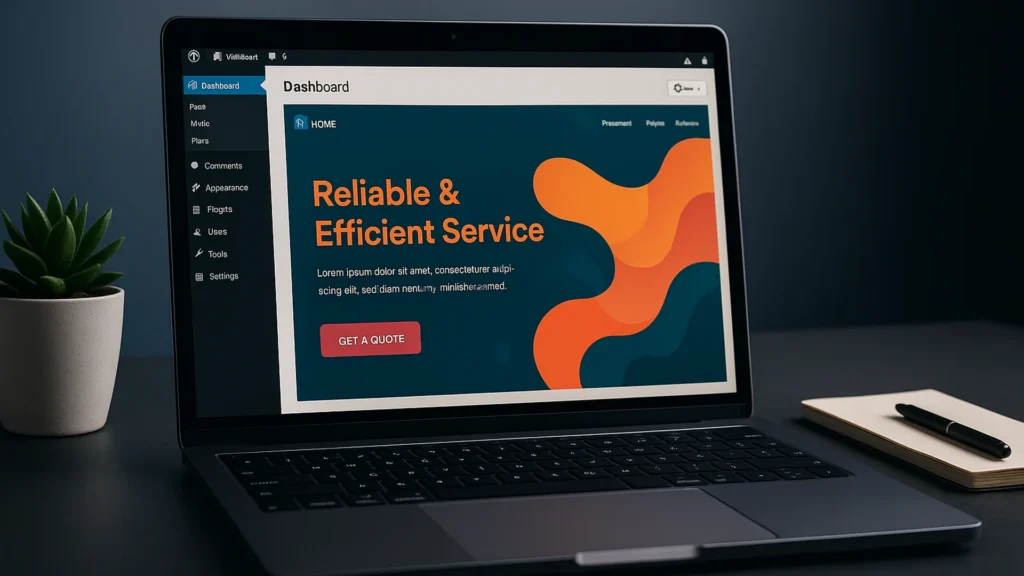
Custom WordPress for editorial teams, training platforms, and applications that have outgrown off-the-shelf — engagements from $14,000 substantial scope to $56,000+ application builds. Nineteen years on WordPress, scoped honestly to the work in front of us.
Recent WordPress work: Sherwin-Williams · M.L. Campbell · Sayerlack · Postmedia network
I’ve been on the open web since 1996, working professionally since 1998, and on WordPress since 2007. The work that earns this kind of engagement splits into three shapes: custom themes built from scratch (or rebuilds of inherited themes that have outgrown a page builder), coordinated customisations across an existing site (template work, integration work, performance work), and full application builds where WordPress is the platform underneath something more substantial — a learning management system, a directory, a member area, a custom industry tool. Each gets scoped and priced honestly against the actual work, not the agency-quote convention of “round it up and add a margin.”
Who this is for
- Fit. Editorial teams, newsrooms, and training platforms on WordPress that need custom workflows, custom block patterns, or a theme rebuild — and who already know that “use a page builder” is the wrong answer.
- Fit. Businesses ready to commission a custom application built on WordPress as the foundation — LMS, directory, marketplace, membership platform, custom workflows.
- Fit. Existing WordPress sites that need substantial functionality the off-the-shelf plugins don’t quite cover, where the integration is non-trivial, or where an existing plugin has been abandoned and needs a clean replacement.
- Fit. Teams that have been told “WordPress can’t do that” and want a second opinion from someone with nineteen years inside the platform.
- Not fit. Single plugin patches, theme tweaks, or under-$14k surgical work — that’s Maintenance and Support. Email me a brief if you’re not sure which side of the line your work is on; I’ll tell you straight.
- Not fit. Brand-new marketing sites starting from zero — Business Website Design covers that path more cleanly, then customisations can be layered on later.
- Not fit. “Fix our broken site” emergencies — that’s a maintenance conversation, not a development conversation.
What I build
- Custom themes. Built from scratch with editorial workflow as a first-class concern. Or a rebuild of an inherited theme that’s slow, fragile, or built on a page builder the team has outgrown.
- Coordinated customisations. Template overrides, hook integrations, third-party API integrations, performance work, schema additions — surgical changes that improve the existing site without forcing a rebuild, scoped as a single coherent engagement rather than a string of tickets.
- Custom plugins. Single-purpose, well-documented, tested against the kind of WordPress your team already runs. Useful when no existing plugin does the job, or when the existing plugin has been abandoned and the migration is bigger than the rebuild.
- Full application builds. WordPress as the backend for something larger: an LMS (the M.L. Campbell Training Centre is the longest-running engagement of this kind I’ve shipped), a directory, a marketplace, a membership platform, a custom dashboard. WordPress as infrastructure, not just a CMS.
Tiers and what each one builds
I bill at $275 an hour. The tier you land on reflects scope; the rate is constant.
| Investment | Hours | What this tier builds |
|---|---|---|
| $14,000–$22,000 | 50–80 | Substantial scope. A custom theme built from scratch, a major integration project, or a coordinated set of customisations across an existing site. Four to eight weeks. |
| $22,000–$56,000 | 80–200 | Application build. A full WordPress-backed application — LMS, directory, marketplace, membership platform — built clean, documented, and handed off with team training. Eight to sixteen weeks. |
| $56,000+ | 200+ | Multi-phase application. Larger or longer engagements — typically a phased application build with a follow-on retainer for iteration. Quoted against a written scope after a sixty-minute scoping conversation. |
What the price covers, regardless of tier
I plan it, build it, and I’m the one you call when something needs attention afterward. The first thirty days post-launch are on me — anything that breaks because of my work, I fix on my time. Code is delivered with documentation written for the people who’ll maintain it, not as a generic “here’s a wiki” handoff.
What I’ve built on WordPress, and who it was for
The longest-running engagement is the M.L. Campbell Training Centre, a WordPress-based learning system running LearnDash with extensive customisations, built for a Sherwin-Williams industrial coatings brand. Attendance grew tenfold over the life of the project; the total annual cost of the platform I built came in below what the previous off-the-shelf system used to bill in a single month.
Earlier in my career I led WordPress development across the Postmedia network of Canadian daily newspapers — the National Post, Financial Post, Vancouver Sun, The Province, Calgary Herald, Edmonton Journal, Ottawa Citizen, Montreal Gazette, Windsor Star, Regina Leader-Post, and canada.com — handling theme development, performance optimisation, plugin maintenance, and editorial workflow at the scale of national news traffic. That experience shapes how I think about template structure, asset budgets, and editorial workflow on every WordPress engagement today.
Most day-to-day client work happens with businesses in the Niagara region of Ontario, but I take engagements remotely across Canada and into the United States.
The plugin discipline I bring to every engagement
Plugin sprawl is the single biggest source of preventable WordPress slowness. The discipline that keeps sites maintainable five years in:
- Every plugin earns its keep. If a plugin runs on every page and adds more than 50ms of overhead, it needs a one-sentence justification — what feature it enables, who depends on it, what would break if it left. Plugins that can’t pass that test come out.
- No page builders for the page templates that matter. Page builders are useful for marketing pages that change weekly. They’re a liability on templates that should be tuned once and left alone. The template gets coded; the editorial blocks fill it.
- One vendor per category. Three SEO plugins fighting over schema output is not a feature; it’s a bug. Same with three caching plugins, three security plugins, three contact-form plugins. Pick one that earns its keep, retire the rest.
- Plugins from the WordPress.org repo first, premium second, custom code third. Repo plugins are vetted, updated, and supported by a community. Premium when the repo doesn’t have the feature. Custom code only when no plugin matches the requirement and the requirement is durable.
- Annual plugin audit. Each year, the plugin list is walked. Anything not updated in 12 months gets investigated; anything abandoned gets replaced. The audit takes half a day and prevents a “the plugin we depended on no longer exists” emergency.