A premium plugin’s price tag is a first-year number doing a five-year job. You pay $79 today, then $79 again next year, and the year after, usually a little more each time. Multiply that across a stack of plugins and a handful of sites, and the quiet renewal line stops being a rounding error and becomes one of the larger numbers in your software budget.
This calculator is for anyone who owns that budget: site owners, agencies, and ops leads deciding whether a stack they can afford to buy is one they can afford to keep. You enter what you run today, and it projects what you will actually have spent once renewals, per-site licensing, and annual price rises are all counted. There is an optional lifetime break-even if you are weighing a one-time deal against paying every year.
Project what a premium plugin stack really costs once you count the renewals, the per-site multipliers, and years of quiet price increases, not just the year-one sticker.
How this is calculated
Most people price year one and stop there. This projects the full running cost across your horizon. Treat the result as a planning estimate, not a quote.
year one = plugins × average price × sites (sites count only under per-site licensing)each renewal = year one × renewal rate, compounding by the annual increase from year three ontotal cost of ownership = year one + every renewal across your horizonper site, per year = total ÷ (sites × years)Enter the standard list price, not a first-year promo. Promos end and renewals bill at full price, so a projection built on the intro price understates the real bill.
The annual increase is a steady average. Real vendors raise prices in uneven jumps, so read the total as a reasonable middle, not a precise forecast.
A lifetime price is modelled as one payment today. It assumes the vendor stays in business, which is the risk the break-even year cannot capture on its own.
Why is the total so much bigger than the sticker price?
The sticker is one year. Licenses renew, and the renewals never stop while you keep the plugin. A stack that looks like a few hundred dollars in year one often crosses several thousand across five years, because you pay most of that price again every year, with a small increase on top.
What is the renewal trap with first-year discounts?
A vendor offers sixty percent off the first year, you anchor on that number, and then every year after you pay full price. The discount was real, but it only touched year one. That is why this tool asks for the standard price, not the promo. Enter what you will pay at renewal, because that is what you will pay for almost the entire life of the plugin.
Per-site or unlimited-site licensing?
If you run one or two sites, per-site pricing is usually fine. Once you run many sites, per-site pricing multiplies fast, and a flat unlimited license often costs less across the whole stack even though its sticker looks higher. Run both scopes through this tool and compare the per site, per year row. That number tells you which one is actually cheaper for your situation.
Are lifetime deals worth it?
Sometimes. If the break-even year lands well inside how long you expect to run the plugin, the math favours lifetime. The catch it cannot see is vendor longevity. A lifetime license is only as long as the company lasts, and plenty of plugin businesses change hands or wind down. Weigh the break-even year against how stable the vendor looks before you pay years of cost up front.
A worked example
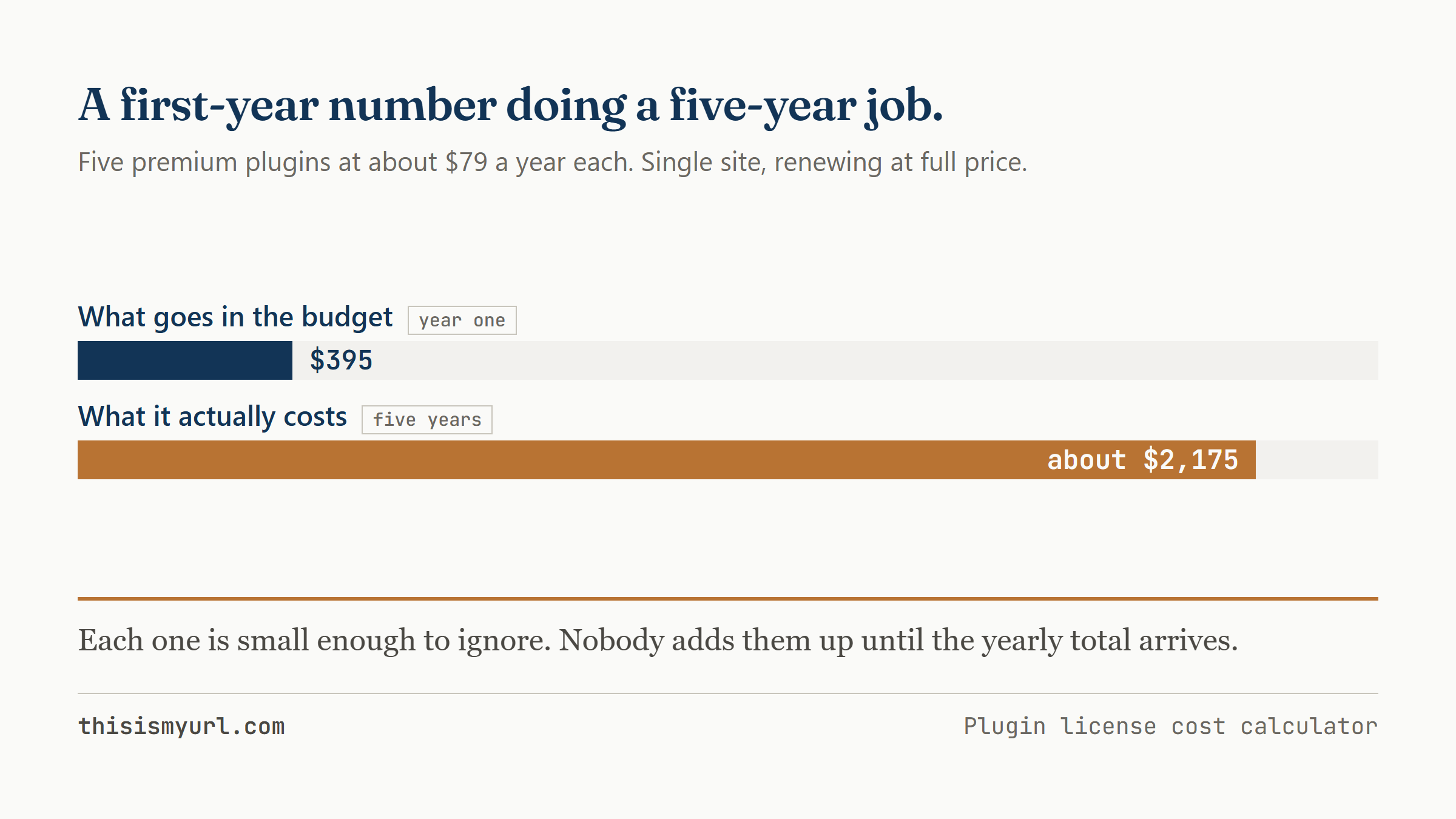
Take a small site running five premium plugins at about $79 a year each. Single site, renewing at full price, with an 8% increase each year. Year one is $395, which is the number most people put in the budget. Five years in, the same five plugins have cost about $2,175. That $395 sticker was really a $2,175 commitment across five years.
It works the way streaming subscriptions do. Each one is small enough to ignore on its own, and nobody adds them up until the yearly total arrives and surprises them. The gap widens fast as the site count grows. Run 20 plugins across 25 sites on per-site licensing and the five-year total climbs into six figures; the same stack on flat, unlimited-site licensing can land near an eighth of that. At that size, the per-site multiplier is the whole decision.
Common mistakes
- Budgeting the promo price. “60% off your first year” is a genuine discount and a genuine trap. The renewal reverts to full price and stays there for as long as you keep the plugin, so the number that belongs in a five-year budget is the standard renewal, not the offer.
- Ignoring the per-site multiplier. A $79 license for one site is rarely $79 for twenty sites. Many vendors price in tiers, and the jump between the single-site tier and the agency tier is where the real cost lives when you run more than a couple of installs.
- Treating a lifetime deal as free money. Lifetime means the vendor’s lifetime, not yours. It can be a fair bet on a plugin from a company you expect to be around, and a poor one on a plugin you cannot afford to have go unmaintained. Weigh the vendor’s staying power before you weigh the discount.
Everything here runs in your browser. Nothing you type is sent anywhere or saved.
I have published 20+ plugins on WordPress.org and maintain client plugin stacks, so I have watched these renewal bills stack up quietly. If you want a second read on what your stack will cost to run, book a short scoping call. Book a scoping call
Leave a reply