When does AI cross the line?
Every knowledge worker has felt the flicker by now. You hand a task to AI, it hands back something good, and a half-second later a small voice asks whether that was allowed. I have felt it too. I have also decided, after a couple of years of using these tools every working day and teaching other people to use them, that the flicker is mostly wrong, and that it is worth being honest about why.
The word that small voice reaches for is steroid: an unfair edge, a shortcut that makes the result count for less. I see AI as an augment instead. Getting genuine value out of it is a skill in its own right, one I have written about separately in a companion piece on treating AI as a conversation rather than a vending machine. And the steroid reaction, when people reach for the word, can be describing something other than a principle. Before I defend that, I owe the other side its strongest version, because there genuinely is one.
A surgeon has to actually know the anatomy under her hands, because the day the tool is unavailable is the day a person is open on the table and she has to be enough on her own.
The short version
- Some AI use really is a shortcut past a skill you were meant to build. That is the honest case, and it is real.
- Check what the steroid label is landing on. If the whole point of the task is the output, the label has nothing to protect.
- Nobody calls the calculator, spellcheck, or a 30-year ghostwriter a steroid, though each does the same thing AI is accused of.
- For me the tool works like glasses. It gives back access to a room that writing has always made harder for me to enter.
- Before you call someone's AI use cheating, name the skill they will lose and say why this tool trips the alarm when the others never did.
Concede the real cases first
There are honest steroid cases, and they are not hard to picture. A surgeon has to actually know the anatomy under her hands, because the day the tool is unavailable is the day a person is open on the table and she has to be enough on her own. A student sitting down to learn how to structure an argument is supposed to walk away able to structure one alone, six months later, with nothing plugged in.
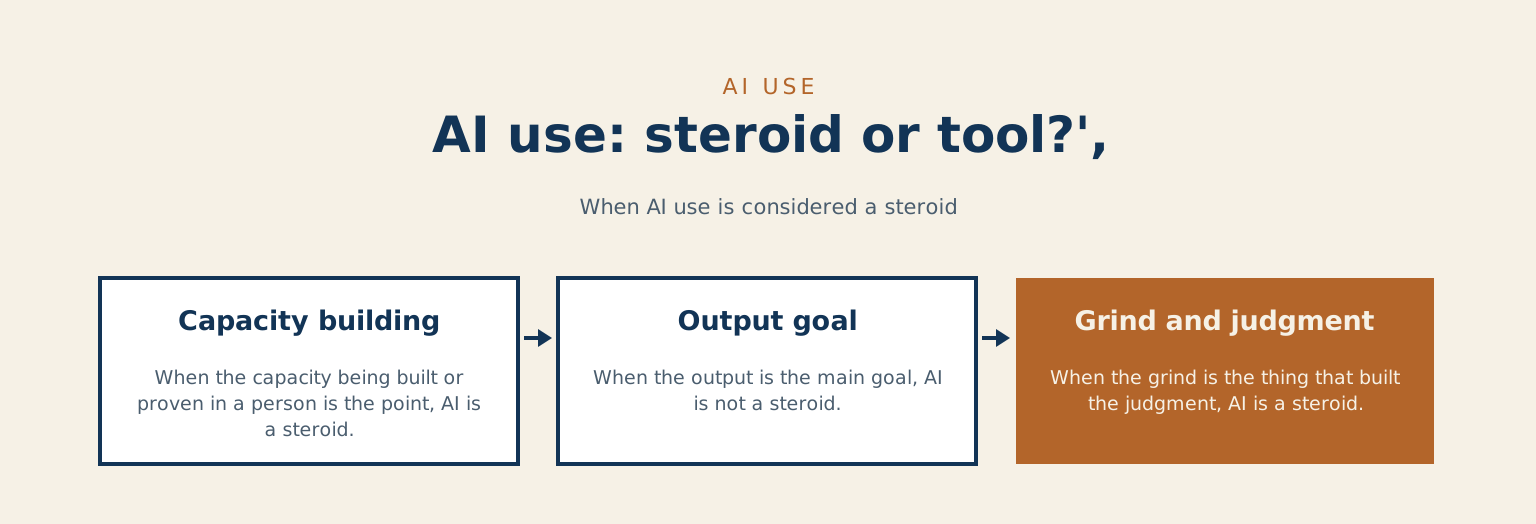
In each of those, the capacity itself is the whole point of the exercise. Hand that capacity to a machine and you have quietly emptied out the exact thing the exercise existed to build. I concede this without hedging, because it is true, and because it is the test that keeps everything after it honest: when the capacity being built or proven in a person is the point, AI is a steroid, and you should keep your hands off it.
What the studies show
The student case has data behind it. In a PNAS study of high school math students, the group that practised with unfettered access to GPT-4 scored 17% worse on the exam than students who never had it, once the tool was taken away. A version built with safeguards largely removed that harm.
Harvard Business School researchers worked with Boston Consulting Group on the other half of that line, in an experiment with 758 knowledge workers. On 18 tasks inside what GPT-4 could do, people using it finished 12.2% more tasks and finished them 25.1% more quickly. On one task outside its reach, they were 19% less likely to get a correct answer.
Watch which tools get the label
Here is where I stop being even-handed. Those honest cases are real, and they are narrower than the way the word gets thrown. It lands well beyond them, on tasks whose whole point is the output: the report that needs to exist, the code that needs to ship. There is a strong objection buried in that, and it deserves its full weight: grinding out those reports by hand is often how judgment quietly accretes.
The junior who writes a hundred of them becomes the senior with taste, even when the point of each single report was only the report. So let me grant it and then run my own test over it. When the grind is the thing that built the judgment, that is a capacity case, and the output-versus-capacity test I just conceded already catches it and tells you to keep your hands off. The objection I am about to name lives in the other grinds, the ones that built a bill and a habit of resentment and now demand the same tribute from the next person anyway.
The tools that never got the label
So watch which tools earn the label and which ones somehow never do. Nobody calls the calculator a steroid. Nobody says it of spellcheck, or of the dictionary, or of the kid who had a private tutor, or the writer with a standing copy editor, or the executive who has quietly used a ghostwriter for 30 years. Every one of those does the precise thing the objection accuses AI of doing. Each hands you a result you could not reliably produce unaided. Each was, for somebody, the difference between keeping up and dropping behind. And the steroid word never comes near them. It is held in reserve for the one tool that showed up after the objector had already paid the price in full, by hand.
That reaction is not a principle. It is a toll.
The person who paid to cross this bridge does not enjoy hearing that the bridge is now free. Their objection carries the exact shape of the toll-booth operator’s: I suffered to get through here, so you should have to suffer too. There is an older, plainer word for it when senior people do it to junior ones. We call it hazing, and we do not usually admire it.
The sharpest example I have
I want to press on this with the sharpest example I own, which is myself. I misspell words constantly. My attention wanders off the page while I am still writing on it, so a thought I had cleanly in my head arrives on the screen in three broken pieces. I have never been tested for anything, so I won’t claim a diagnosis. I have suspected for years that I carry a mild case of dyslexia, and it would explain a great deal. The International Dyslexia Association’s definition is difficulties in word reading and spelling that persist even with instruction that is effective for a person’s peers.
What the tool gives back
For me, AI works like glasses. It catches the spellings I cannot reliably catch, and it holds the thread when my attention drops it and hands that thread back so I can keep going. What it restores is access to a room that writing has always made harder for me to enter. Now try saying the cheating reaction out loud against that. Tell the man who cannot reliably spell that using the tool which spells for him is an unfair edge, a steroid he ought to feel some shame about. The instant the difficulty is real and visible, the objection has nowhere left to hide. It was never about the learner’s honesty. It is about the gatekeeper’s comfort.
United States special-education law already treats this kind of tool as ordinary. In 20 U.S.C. 1401, an assistive technology device is any item used to increase, maintain, or improve the functional capabilities of a child with a disability.
What it does at work
I am not asking for a pass on the strength of any of that, and the argument does not need one. My spelling is the point itself, made visible and held up on purpose. The glasses case simply strips the paint off the objection so you can see the metal underneath, and once you have seen it there you will recognise it in the ordinary cases too. The analyst who turns a day of spreadsheet work into an hour is being handed her afternoon back, to spend on the part of the job that actually wanted her judgement. That is the shape of most of the AI-operations work I do with teams: lifting the expensive, grinding part of a job off a person so their hours land where their judgement actually earns its keep.
The closest measurement is a study of 5,179 customer support agents. With an AI assistant they resolved 14% more issues per hour on average, and 34% more if they were novice or low-skilled workers.
The line I will defend
So here is the line I will stand behind. If you want to call someone’s AI use a steroid, you owe two answers before you reach for the word. First, name the actual skill this person was supposed to own and will now lose. Point to a specific capacity, something you could write on a job description. A general unease that thinking might go soft does not count.
Sport has a version of this test. The World Anti-Doping Agency’s Prohibited List takes in a substance that meets two of three criteria: performance enhancement, a health risk to the athlete, or a violation of the spirit of sport. The people whose job is policing steroids ask for criteria before they use the word.
Second, explain why this tool trips the alarm when the calculator and the ghostwriter never did. Say plainly what makes AI the exception. If you grab for the steroid word, you may not be able to answer either question. The people who can answer are pointing at a real capacity case, the surgeon or the student, and they are having the honest version of this argument, which is a quieter conversation than the one the word starts.
A disclosure
One disclosure, because in a piece this forceful about AI I would be a hypocrite to bury it. I drafted this with the same kind of tool it defends, used as the glasses I described, and then argued with it line by line until every claim in it was one I would put my name to. If that lowers the piece in your eyes, sit for a moment with why. The words are mine. The tool only ever held the thread while I found them.
What you would have to believe
You are free to think I have this wrong, and I would honestly rather you say so out loud than nod along and quietly resent the tool. So here is exactly what you have to believe to get there. You have to hold that AI hollows out some specific capacity that the calculator and the copy editor left perfectly intact, and you have to be able to name that capacity when someone asks you to. If you can name it, come and make the case, because that is the argument worth having and I will take it seriously. If you cannot, then what you are guarding is the price of the toll, and the honest next question is who is served by keeping the booth open.
The last time you felt that flicker, which skill did you think you might lose?
Common questions about the AI cheating objection
Is this saying AI is never a shortcut past real learning? No. When the capacity being built in a person is the point, like the surgeon learning anatomy or the student learning to argue, keep your hands off the tool. That case is real, and it is narrower than the objection makes it sound.
Why compare AI to a calculator or a ghostwriter? Because each one hands you a result you could not reliably produce alone, and nobody calls those cheating. The comparison shows the steroid label is being held in reserve for the one tool that arrived after the objector had already paid the price by hand. Sorting the honest cases from the toll is a lot of what the teaching work I do comes down to.
How do I tell an honest objection from a toll? Ask for two answers. Name the specific skill the person will lose, and explain why this tool trips the alarm when the calculator and the copy editor never did. If neither answer comes, what is being guarded is the price of the toll. If you can name the skill, that is the argument worth having, and I would rather you bring it to me than nod along.
Checked against the WADA Prohibited List page and the text of 20 U.S.C. 1401, on 2026-10-11.
References
- Bastani, H., Bastani, O., Sungu, A., Ge, H., Kabakcı, Ö., and Mariman, R. (2025). Generative AI without guardrails can harm learning: Evidence from high school mathematics. Proceedings of the National Academy of Sciences, 122, e2422633122.
- Dell’Acqua, F., McFowland III, E., Mollick, E., Lifshitz-Assaf, H., Kellogg, K. C., Rajendran, S., Krayer, L., Candelon, F., and Lakhani, K. R. (2023). Navigating the jagged technological frontier: Field experimental evidence of the effects of artificial intelligence on knowledge worker productivity and quality. Harvard Business School Working Paper 24-013.
- Brynjolfsson, E., Li, D., and Raymond, L. R. (2023). Generative AI at work. NBER Working Paper 31161.
- International Dyslexia Association. Definition of dyslexia.
- World Anti-Doping Agency. Prohibited List.
- United States Code, Title 20, section 1401. Definitions (assistive technology device).
Where AI draws its lines: the full series
This is one of five connected pieces working out where AI stops helping and starts standing in for the person. Each one holds up on its own, and together they run a single test into the places the argument actually gets fought.
- When does AI cross the line? The test the whole series runs on. You are reading this one.
- Is using AI cheating? What the answer depends on.
- When banning AI is right, and when it is just gatekeeping.
- Where AI actually goes too far, from someone who defends it.
- Will AI widen the digital divide? Only if we let it.