
I live in Fort Erie, and I work in tech, so I have been following the local data centre conversation closely. There is a lot of worry going around right now, and before anyone picks a side, it helps to separate what is actually happening from what is just circulating.
The short version:
- The Town of Fort Erie has received no formal application and no pre-consultation request for a data centre.
- The alarming power figures come from a developer’s own marketing material, and no public body has reviewed them.
- Ontario’s grid is run by the not-for-profit IESO, and the Transmission System Code has a transmitter require a capital contribution from the load customer for a connection facility built for its needs.
- Water use is a fair question, and so is transparency, since Ontario keeps no public registry of proposed data centre sites.
- This is a request to argue from the facts, whichever side of the question you end up on.
What is actually on the table
Here is the fact at the centre of it. The Town of Fort Erie has confirmed it has received no formal application and no pre-consultation request for a data centre. A developer is marketing a parcel of local land as a possible site, and a company promoting property is a long way from a project being proposed and approved. Any data centre would need municipal zoning approval before a shovel hit the ground, and we are nowhere near that point. The eye-catching figures making the rounds, the ones about tens of thousands of homes’ worth of power, come straight from that developer’s own marketing material. No public body has reviewed a plan, because there is no plan to review yet.
A company promoting property is a long way from a project being approved.
What would have to happen first
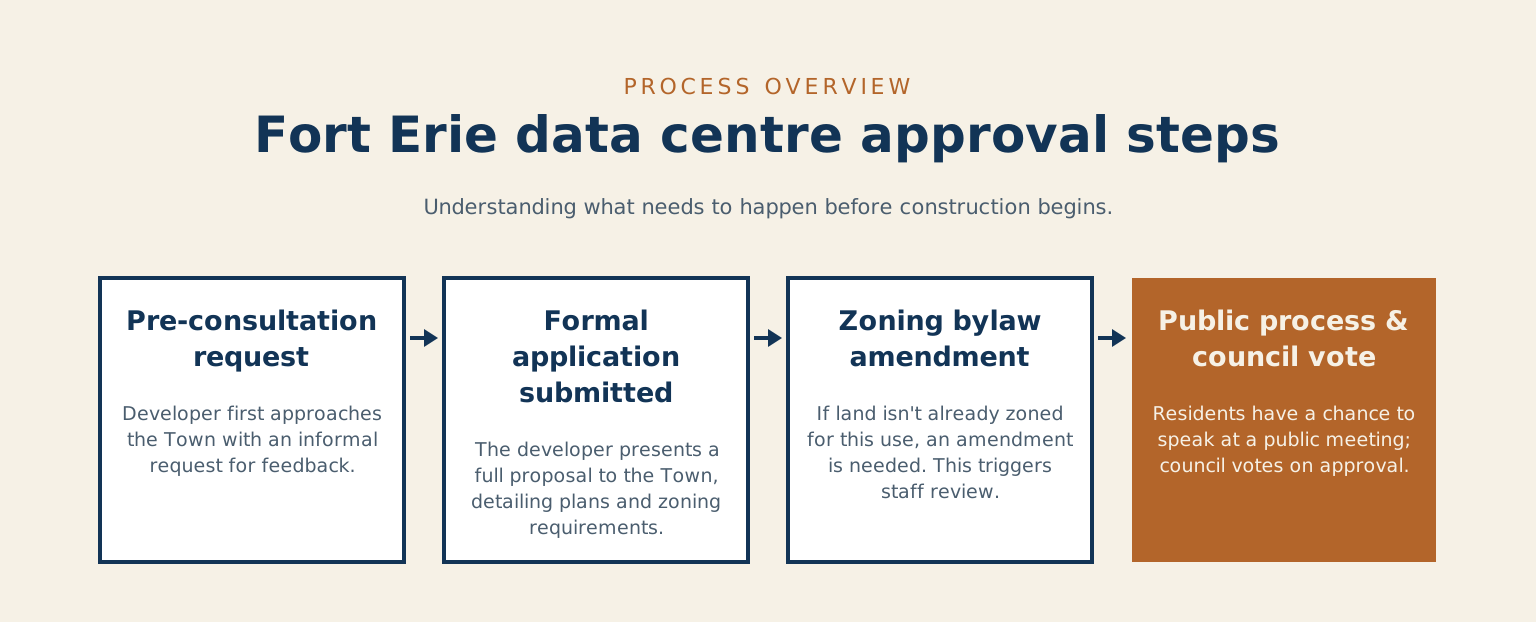
It is worth knowing how this process works, because the steps are public and slow by design. A developer would first bring the Town a pre-consultation request, then a formal application. A data centre on land not already zoned for it would need a zoning bylaw amendment, which triggers staff review and a public process, ending in a council vote that residents can speak to. Ontario’s own citizen’s guide to land use planning says there must be at least one public meeting before a zoning bylaw is passed, and everyone who attends must have a chance to speak. That council decision is the moment residents get a real say, and it happens at a public meeting that goes on the record. None of those steps has started. The land being marketed online is just that, land being marketed, and marketing is the cheapest part of any project.
How Ontario pays for new power, and why it changes the math
The fear is understandable. The headlines that alarmed people here are American, and in the United States they are alarming for good reason. There, regulated monopoly utilities can build the power infrastructure a large data centre needs and spread that cost across everyone’s bill, and communities near data centre hotspots have seen real rate spikes because of it.
Ontario runs on a different model, and that difference is the whole point. Our grid is managed by the IESO, which describes itself as a not-for-profit corporate entity established in the Electricity Act, 1998, with generation procured under contract. The province already has rules about who pays to connect a large new load. Section 6.3.1 of the Ontario Energy Board’s Transmission System Code says that where a load customer is served by transmitter-owned connection facilities, a transmitter shall require a capital contribution from that customer to cover the cost of a connection facility required to meet that customer’s needs. That is a very different setup from a private utility that can overbuild and send your house the bill.
To be fair, the grid question is real. The IESO’s 2025 demand forecast session lists industrial sector and data centre growth as the primary new demand drivers. The scale here also stays small for now. The IESO’s October 2024 forecast release puts data centres at 13% of new electricity demand and 4% of total anticipated Ontario demand in 2035.
The fair questions to ask, on water and on transparency
Fresh water deserves the same calm treatment. Cooling does use water, and how much it uses, where it comes from, and what happens to it afterward are all fair things to ask. Not every data centre cools the same way, which is exactly the sort of detail a real application would have to spell out. Ontario sits a long way from the drought-stressed American Southwest, and local water and wastewater capacity is something you can get real numbers on. Ontario’s Permit to Take Water program says a permit is required if you plan to take 50,000 plus litres of water in a day from the environment. So ask for the numbers.
Transparency is the real gap
The harder problem is that those numbers are not always there to find, and the one real gap here is transparency. That is the part I would push on. Ontario keeps no public registry of proposed data centre sites. That kind of vacuum is exactly where rumour rushes in. Until that changes, the work falls to residents and the Town to ask for specifics in public, and to any future applicant to put real numbers on the table up front, while a decision can still be shaped by them.
None of this is a yes or a no on data centres. It is a request to argue from the facts. If a genuine proposal ever lands here, Fort Erie will be far better served by good questions than by a game of telephone.
If a proposal did land, what is the first number you would want the applicant to publish?
Common questions about the Fort Erie data centre
Has the Town approved a data centre? No. The Town has confirmed it has received no formal application and no pre-consultation request, so there is nothing to approve yet.
Where do the big power numbers come from? From the developer’s own marketing material. No public body has reviewed a plan, because there is no plan to review yet.
What is the real thing to watch? Transparency. Ontario keeps no public registry of proposed data centre sites, so the work falls to residents and the Town to ask for specifics in public. If you want the engineering side of what a hosting provider’s uptime promise covers, what high-availability WordPress actually requires walks through it.
Can I ask you about the tech side of this? Please do. I live here and work in tech, building and looking after WordPress sites, so if you want to talk it through, you can reach me any time.
Checked against the Transmission System Code, the IESO corporate page and the Ontario land use planning guide, the IESO October 2024 forecast release, the IESO 2025 demand forecast presentation and the Permits to take water page, on 2026-10-11.
References
- Citizen’s guide to land use planning: zoning bylaws, Government of Ontario
- About the IESO, Independent Electricity System Operator
- Transmission System Code, Ontario Energy Board, revised March 31, 2025
- Electricity demand in Ontario to grow by 75 per cent by 2050, IESO news release, October 2024
- 2025 Annual Planning Outlook demand forecast presentation, IESO
- Permits to take water, Government of Ontario