A while back an owner called me on a Saturday morning. Her contact form had stopped sending. She only found out because a customer phoned, annoyed, asking why nobody had replied to the message he sent three weeks earlier. Three weeks. Every enquiry in that window had gone nowhere. The form still looked fine on the page. It just quietly did not work, and there was nothing on her screen to tell her.
That is the honest question behind every care plan, so let me put it plainly. Is paying someone every month to look after your WordPress site worth it, or can you leave it alone until something breaks and deal with it then? I have opinions, obviously, but I want to give you a fair answer, because for a small number of sites the answer really is “leave it alone.”
Your website is closer to a car than a brochure
If nobody told you this when the site launched, here it is. A brochure, once printed, stays exactly as printed until the paper yellows, and it’s easy to assume a website behaves the same way once it is launched.
Your WordPress site is closer to a car. It is software, running in public, every hour of every day, and software keeps moving. WordPress ships updates, your plugins and your theme ship updates, and the server underneath gets patched. Meanwhile the people who try to break into websites are working every day too, looking for a known hole in an old version of something.
A car you never service keeps running, which is the trap, right up until the day it does not. And when a neglected car finally lets you down, it picks the hard shoulder, in the rain, on the day you needed to be somewhere. A neglected website works the same way. The decay is invisible for a long time, and then it arrives all at once, at the worst moment.
What goes wrong, and how you hear about it
Let me be specific, because “your site could have problems” is too vague to act on. Here is what happens on a site nobody is watching.
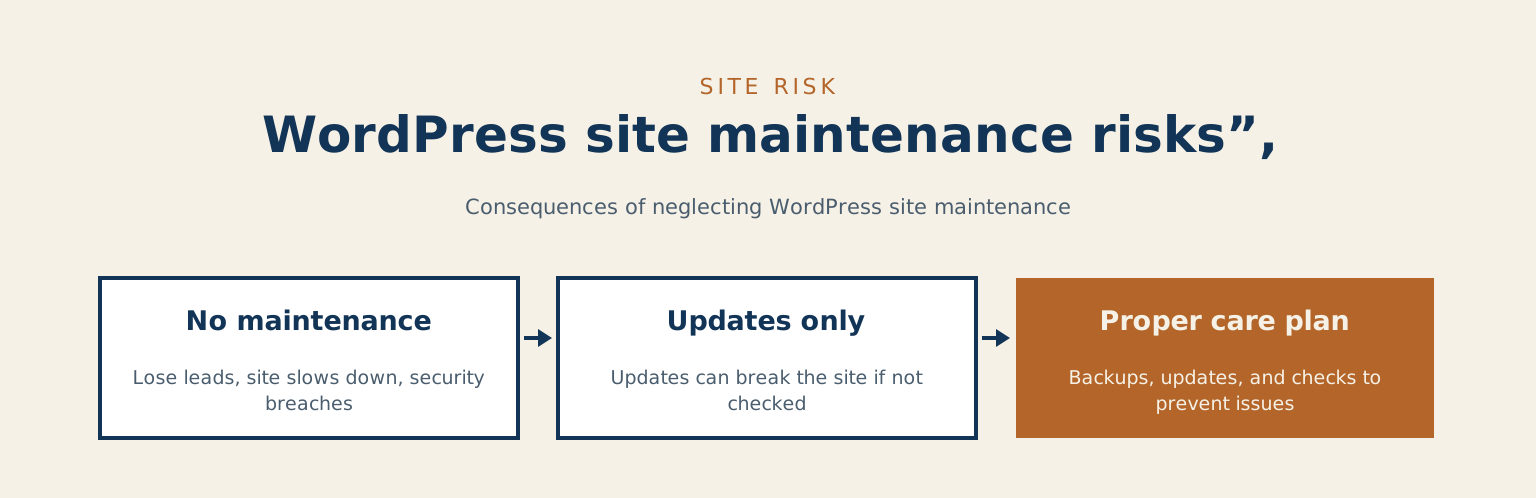
The contact form can stop sending, like the story above, when a plugin or email setting changes underneath it, and you lose leads without ever learning how many. A plugin gets abandoned by its developer, stops getting updates, and slowly turns into an open window. Two plugins that used to get along stop getting along after an update, and the site goes white on a Saturday when you have no one to call. The site slows to a crawl and visitors leave before the page loads. Or an unpatched hole gets the site defaced, or quietly turned into a machine for sending spam in your name.
Notice the common thread. Somebody else may well know before you do. A customer tells you. Google tells you, by dropping you in the results or flagging your site as unsafe. Your host tells you, after they have already suspended the account. The dashboard that was supposed to warn you said nothing, because the thing that failed was the thing that does the warning.
What a real care plan does, versus running the updates and hoping
There is a version of “maintenance” that is mostly theatre. Someone logs in once a month, clicks “update all,” logs out, and sends you an invoice. That barely counts as care, because an update is exactly the moment a site is most likely to break, and nobody checked.
Here is what I mean by looking after a site properly, next to the version that only looks like it.
- Backups: update and hope means taken and never restored; real care means taken, with one restored to prove it works
- Updates: update and hope means click “update all,” log out; real care means applied, then the site is loaded the way a customer would load it, form and checkout included
- Monitoring: update and hope means none, and a customer finds out first; real care means security and uptime alerts reach the person looking after the site
- When it breaks: update and hope means a stranger, starting from scratch; real care means someone who already has the keys and knows how the site is built
The same list, in more detail
Backups that get tested. A backup you have never restored is a guess. I have watched an owner discover on the worst possible day that the backups had silently been failing for months. So the plan is not “we take backups.” It is “we take backups and we prove one restores.”
A backup you have never restored is a guess.
Updates applied, and then checked. After every round of updates I load the site the way a customer would. Does the homepage look right? Does the form send a real message, and does checkout still work if there is one? An update that breaks the form is worse than no update at all if nobody notices for three weeks.
Security and uptime monitoring, so a break-in or an outage reaches me before it reaches your customer. And the quiet part that matters most when things go wrong: a human who already knows your site. When a site goes down at nine on a Saturday, you want to text someone who already has the keys and knows how the thing is built, instead of explaining your whole business to a stranger from scratch.
The math that makes it worth it
The reason a care plan pays for itself is the shape of the risk, far more than any list of features.
The cost of prevention is small and predictable, the same modest amount every month, and you can put it in a budget and forget it. The cost of the other path is large and sudden, and it lands at the worst time. It is a site down during your busiest week, or a hacked site you are paying, in a panic, to have cleaned and rebuilt while you lose sales every hour it stays broken. Or the quietest version, weeks of leads that went nowhere because a form failed and no one was watching.
So you are really buying two things. You are buying down the odds of the expensive, sudden problem, and you are buying a known phone number, a person who picks up and already understands your site, for the day you need one. That second thing is what an owner is relieved to have, right at the moment they need it.
When you probably do not need one
I said I would be fair, so here it is. If you have a tiny site that never changes, a single page with your name, your hours and a phone number, with no forms, no shop, no logins and hardly any traffic, then a full care plan may be more than you need. There is not much to protect and not much to lose. Keep it updated a couple of times a year, keep one good backup somewhere you can find it, and get on with your life.
The honest line is roughly this. The more your site does, and the more it would hurt to lose it for a week, the more a plan earns its keep. A brochure page with nothing on the line can sit there. A site that takes bookings or sells something, or brings you the leads that pay your bills, has already answered the question. Losing it for a few days would genuinely cost you money or customers.
Where to go from here
If you read the list of what goes wrong and felt a small knot, that knot is worth listening to. It may mean your site is doing enough to be worth protecting. For the flip side of this, the slow harm an unmaintained site does to the people still relying on it, here is what you owe the people still running your old code.
If your form stopped sending tonight, who would find out first?
I keep this simple on purpose. If you would rather just talk it through and have me tell you honestly whether you need one, get in touch and we will work it out. No pressure, and if the answer is “you are fine, leave it alone,” I will tell you that too.
References
Checked against the sources listed below, on 2026-10-11.
- Hardening WordPress, WordPress Advanced Administration Handbook
- Upgrading WordPress, WordPress Advanced Administration Handbook
- Save submitted messages with Flamingo, Contact Form 7
- Plugin developer FAQ, WordPress Plugin Handbook
- Security issues report, Google Search Console Help
- Why does speed matter? web.dev