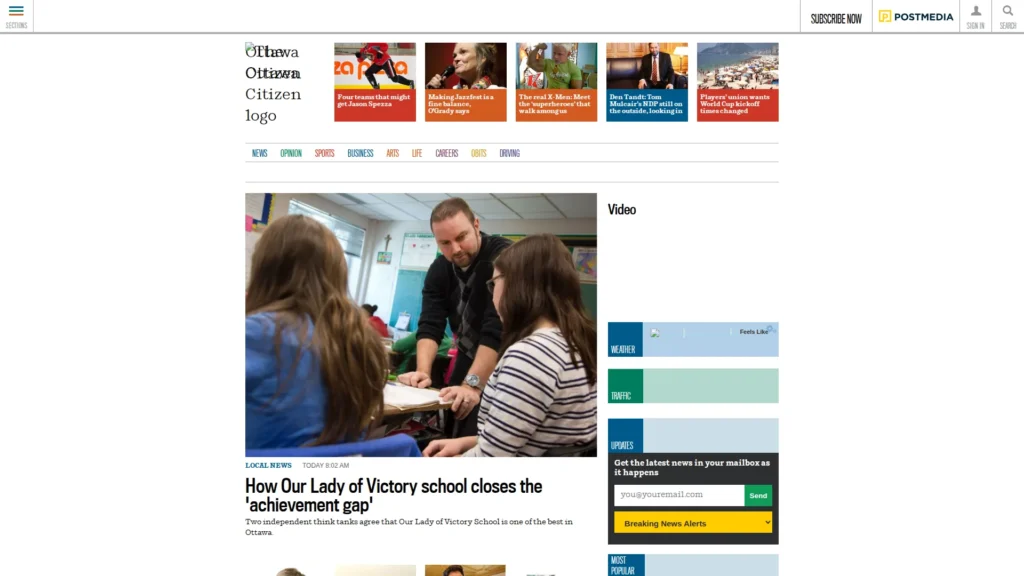
The Ottawa Citizen has been published in the federal capital since 1845, which makes it older than the country it covers. A meaningful slice of its readership works on Parliament Hill — Members of Parliament, ministerial staff, public servants in federal departments a few blocks away, the diplomatic corps, and the policy-shop researchers who turn government documents into briefing notes for the rest of the country. That is a different reader than the one who picks up a regional paper at the corner store. The WordPress® platform decisions on the Citizen had to honour what that reader actually does with a news article.
The reader who checks the references
A federal-policy beat reader is, often professionally, going to follow a link to a tabled document, an Order Paper item, a Standing Committee witness list, or an Auditor General report. If that link is dead, or rewritten, or pointed at a stale URL, the trust hit lands harder than it would on a civic story in a regional market. The Citizen’s article template, link handling, and quoted-material treatment all had to honour the fact that the reader’s next click was statistically likely to be a verification click into a primary source rather than a click into a related-articles widget.
The Citizen ran as its own child theme on the shared Postmedia parent that carried the eleven properties of the network. The parent handled performance and infrastructure across every paper. The Citizen’s child handled the editorial weight that a federal-politics front page demands — section landings for federal politics, public service news, and national-affairs coverage needed real prominence in homepage and navigation logic, and the CMS and theme decisions around quoted material, document links, and inline source attribution carried more weight here than on regional civic pages.
Why platform posture decided the project
The 2011-2012 Postmedia migration onto WordPress VIP gave the Citizen a production-grade platform that mattered specifically because of the readership. Public servants reading a paper on a Monday morning are not going to wait for a slow page to load. They are going to give the link a few seconds and then move to a different source. The Citizen’s article-page performance, search-result preview accuracy, and link permanence all rode on platform decisions made at the parent-theme level, reviewed by Automattic’s enterprise team during the early-2012 VIP onboarding process, and inherited cleanly by the Citizen’s child theme.
The platform migration on this paper is one I still cite when a public-sector or policy-adjacent client asks why the platform choice matters before the design choice does. Readers checking references is the use case that decides it. A paper whose reader will not tolerate a dead link to a tabled document is a paper whose platform decisions have to honour link permanence as a first-class concern. The shared-parent / per-paper-child architecture that carried the rest of the Postmedia network let the Citizen’s child theme treat those concerns with the editorial weight they deserved.
- The work: Ottawa Citizen child theme on the shared Postmedia parent; federal-politics-aware editorial controls, link-permanence discipline, and source-attribution treatment
- Architecture: Shared parent with the National Post and the rest of the Postmedia network
- Client: Postmedia Network Inc. (Ottawa Citizen)
- Period: 2011-2012