Most owners assume a visibility problem means the work isn’t good enough. Usually the work is fine, and the real issue is a posting habit that guarantees you disappear.
It tends to look like this. You post when you remember to. Your Instagram has gaps. Your Google listing hasn’t been touched in six months. Your website still says “hours may vary,” a placeholder from three years ago. These feel like separate problems, but they share one cause: there is no maintenance system behind any of it.

A maintenance system is scheduled work that keeps your presence consistent, and consistent is the word to hold onto. Visibility is built on showing up regularly, and regular beats perfect every time. Most small businesses don’t have anything like that in place, and it has nothing to do with how much they care.
The reason is friction. Every one of those tasks takes time you don’t have. A caption takes twenty minutes to write. Updating business information is tedious enough that it slides to next week, then the week after. Anything that costs time gets pushed down the list until it stops happening at all, and once nothing happens, the visibility goes with it.
What changes that is removing enough friction that the system becomes doable.
Take a salon owner who hates writing captions. She stops posting, and the gap opens. Now she uses Artificial intelligence (AI) to draft the caption in five minutes instead of twenty. Same caption, a third of the effort, and the system holds. She posts every week, people see the new looks and the happy clients, and the visibility comes back because the routine is finally one she can keep.
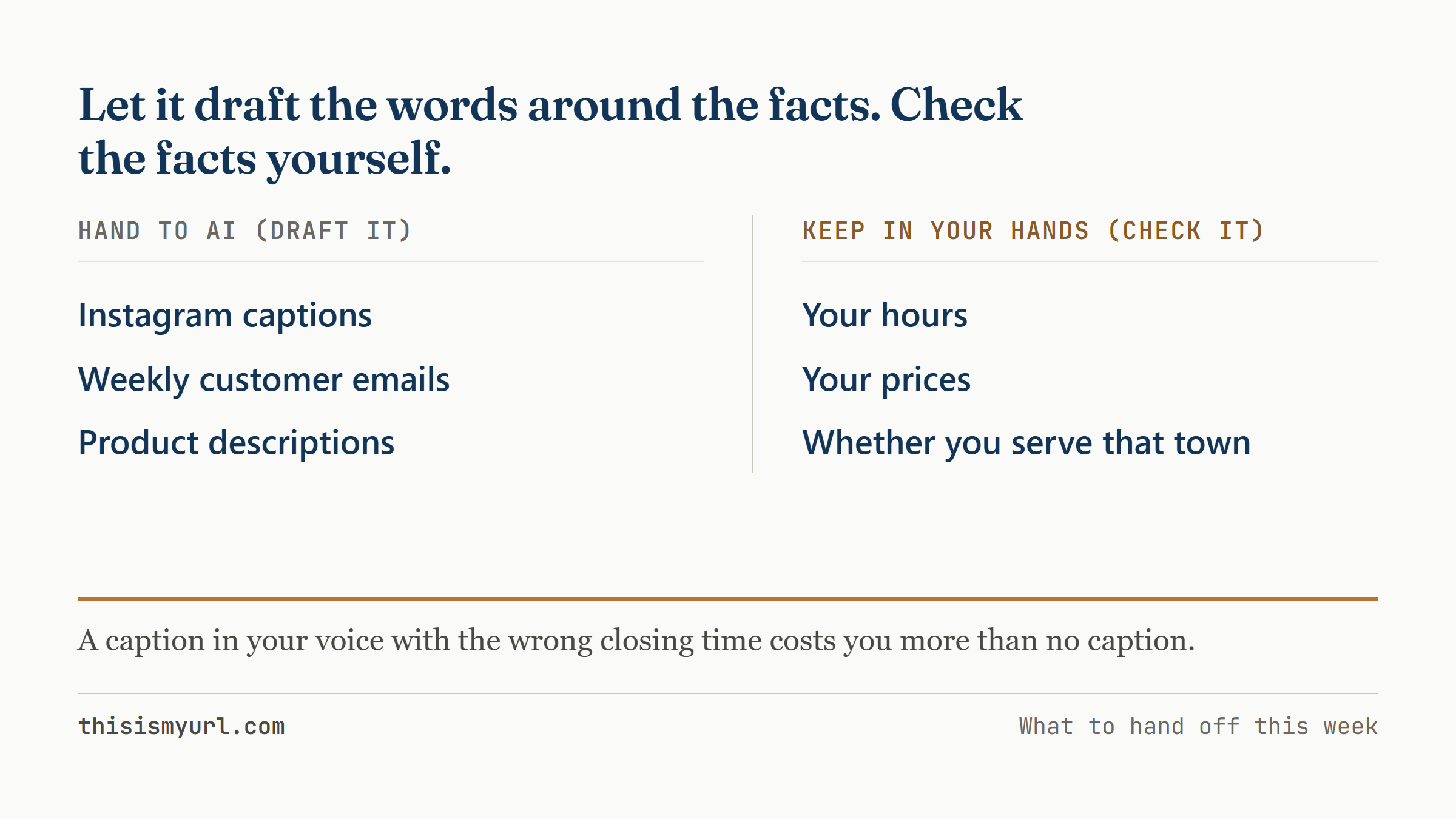
The same move works up and down the street. The plumber’s version is the weekly email to service customers. A retail shop has product descriptions that need refreshing, and a contractor has a gallery full of before-and-after photos with nothing written under them. In each case the AI does the same job: it takes out the friction that was quietly killing the routine.
A business that keeps showing up has usually built a system that survives a real week, and that matters more than talent or budget.
One thing to keep in your own hands: anything a customer could act on, which mostly means your hours and your prices, and whether you actually service that town. Let the tool draft the words around those, then read the draft once and check the facts yourself. A caption in your voice with the wrong closing time costs you more than no caption at all.
So this week, pick the one thing your business neglects because it takes time. The monthly email, the weekly post, the listing update, whichever one it is. Use AI to draft it or speed it up. Do that three times and see if the routine feels sustainable now.
If it does, add the next neglected task a month later, one at a time, until the visibility work runs on rails instead of willpower. And if it doesn’t, the experiment cost you three drafts and an afternoon, which is a lot cheaper than another season of being invisible.