She runs the front desk at a dental office. Two dentists, four people on the admin side, the kind of practice where everyone knows the regulars by name. Last week one of the owners stopped by her desk and asked a simple question: those Artificial intelligence (AI) tools we’re paying for, are they actually worth it? Renewal was coming up. He just wanted to know.
She’d bought two of them about eight months back. One helps with scheduling, one handles the back-and-forth texting with patients about appointments. Together they run $380 a month. The staff use them most days. The front desk feels calmer than it used to. She was ready to renew without a second thought, and honestly she still wants to. But standing there, asked to explain why, she realized she had nothing to hand him. Not a number. Just a feeling that things were smoother.
That’s an uncomfortable spot to be in, and it has nothing to do with the tools being good or bad. The problem is she can’t prove it either way. One of the owners is a numbers person. “It feels smoother” is not going to land with him, and she knows it.
Why she’s stuck
Here’s the part that matters: she didn’t do anything wrong eight months ago. She bought those tools because she had a real problem. The phone rang all day, patients texted at all hours, the front desk was drowning a little. She went looking for help, found two tools that looked like they’d help, and they did. That’s how almost everyone buys this stuff. You feel a pain, you find a thing that fixes the pain.
What she didn’t do, because nobody does, is write down how bad the pain was before. How many minutes scheduling actually took. How many texts the desk was answering by hand on a normal Tuesday. She was solving a problem. Measuring it never crossed her mind. So now, eight months later, there’s no starting line to measure against. You can’t show how far you’ve come if you never marked where you started.
Think of it like getting in shape without ever stepping on a scale. You feel better. Your clothes fit different. But if someone asks how much you’ve lost, you’ve got nothing, because you never weighed yourself on day one. The progress is real. The proof just doesn’t exist, and you can’t go back and create it after the fact.
The fix, even though it’s late
The good news is you don’t need a fancy system, and you don’t need to have done this from the start. You can begin now and have a real answer in about a month.
You only need two numbers for each task the tool is supposed to help with. The first is how long the task takes, one time. The second is how often it happens in a week. That’s it. Time per task, and how many times a week. Measured now, then measured again later, those two numbers give you everything.
So pick the two or three things the tools are meant to help with. For her, that’s scheduling an appointment and answering a patient text. This week, have the person who actually does each one keep a small log. Every time they schedule someone, jot down how long it took. Every day, a rough count of how many patient texts they handled. Do that for five days. That’s your current picture, the real one, with the tools running.
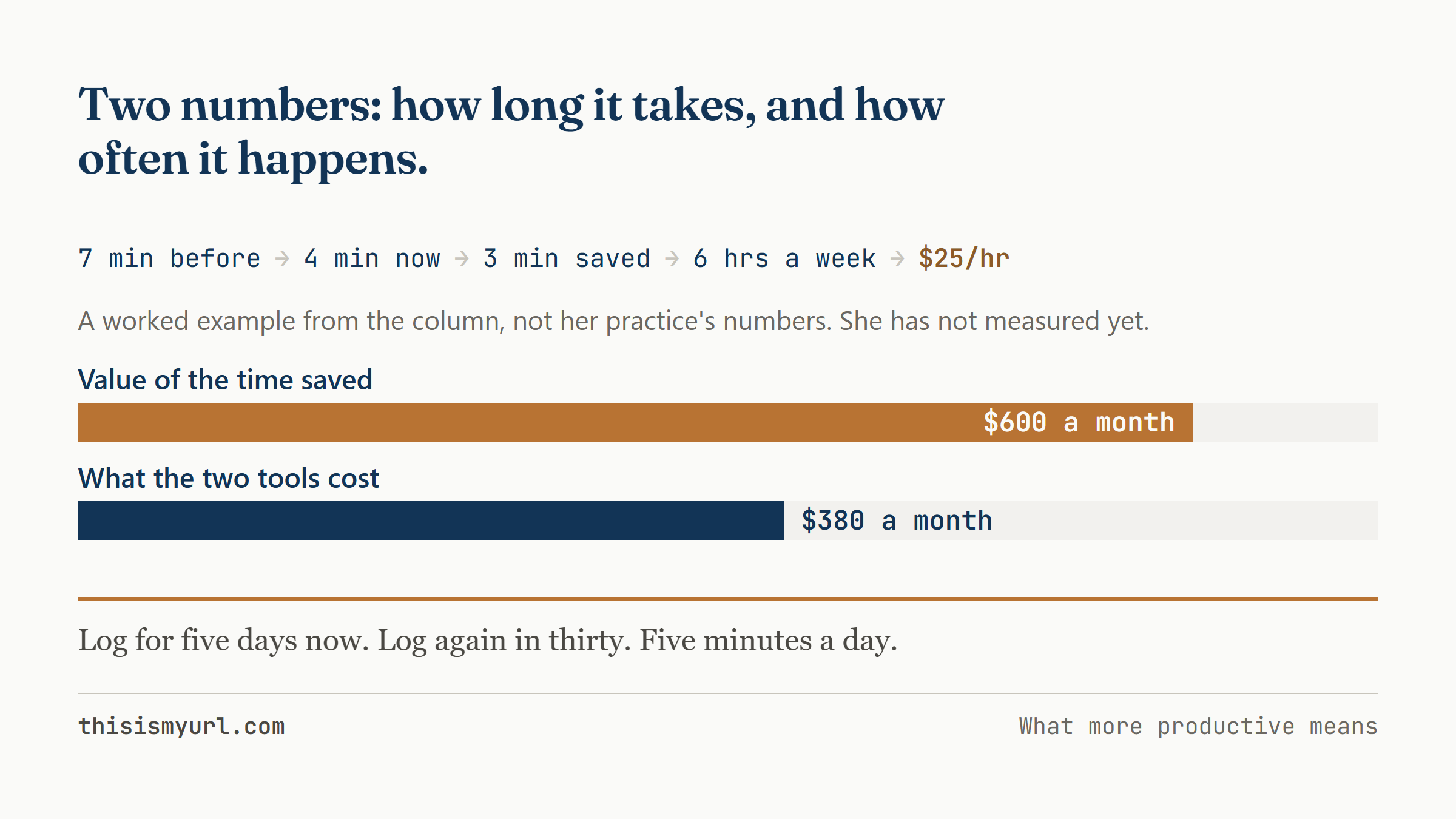
Then compare against what you remember the old days taking, and log it again in thirty days. What you’re after is the difference. If scheduling now takes four minutes instead of seven, that’s three minutes saved, times however many times a day it happens, times five days. Add it up across the week.
Then put a dollar on it. Take the hours you saved and multiply by what you pay the person doing that work. If you save six hours a week and that time costs you $25 an hour, that’s $150 a week, around $600 a month. Set that next to the $380 you’re paying, and now you’re not renewing on a feeling. You’re renewing on a number, and the numbers person at the table has something he can actually chew on.
Setting up the log takes about twenty minutes. Filling it in takes maybe five minutes a day for each person. That’s the whole cost of never being caught flat-footed by that question again.
If you haven’t bought yet
If you’re reading this before you’ve signed up for anything, you have the easy version of the job. Before you buy, have whoever’s going to use the tool spend ten minutes writing down the same two numbers. How long the task takes right now, and how often it comes up in a week. That’s your starting line, and it costs you ten minutes and a sticky note.
Then put a reminder in your phone to measure again in thirty days. When the renewal question comes, and it always comes, the answer will already be sitting in a drawer.
The owner asked her on a Thursday. She doesn’t have his number yet. By the second week of July she will.