Maria keeps the books for six small businesses around town. A flower shop, two restaurants, a hair salon, a guy who does drywall, and a small print shop. She’s good at it, and she’s busy, which is why she signed up for an Artificial intelligence (AI) bookkeeping assistant in the first place. It promised to sort expenses straight from the bank feeds and flag anything that looked off. For someone juggling six sets of books, that’s real help.
She did her homework on the part that felt like homework. She read the pricing page twice, compared the monthly plans, picked the one that fit. The Terms of Service was fourteen pages and she opened it on her phone between two client calls, with a third client already texting. She scrolled, saw a wall of legal text, and clicked Agree. She had work to do. Most of us would have done the same thing.
Three months later an email arrived from the vendor. Friendly tone, big news: they had partnered with a “data intelligence firm.” She almost deleted it. Then she read a little further and her stomach dropped. As part of the standard terms she had agreed to, customer transaction data was being shared with their training partners. Customer transaction data. That was her clients’ money moving in and out of their accounts. The flower shop’s slow January. The restaurant owner who was behind on a supplier.
The phone calls nobody wants to make
She had to call all six clients and tell them what happened. Those aren’t fun calls. “Hi, remember that tool I mentioned? It turns out the company I trusted with your numbers has been sharing them, and I didn’t catch it.” Five of them understood. One did not, and Maria doesn’t blame him. He moved his books somewhere else. She lost a client she had worked with for four years, over fourteen pages she scrolled past in a parking lot.
Maria did nothing reckless. She skipped the terms, which is the single most normal thing a busy person does online. The catch is that a tool wired into your bank feed and your customer list is a different kind of app from the ones we’re used to. With an ordinary app, the terms really are legal boilerplate. With this kind, they describe what the company is allowed to do with the money moving through your clients’ accounts. That’s a different kind of agreement, and it deserves a different kind of attention.
Ten minutes, three things
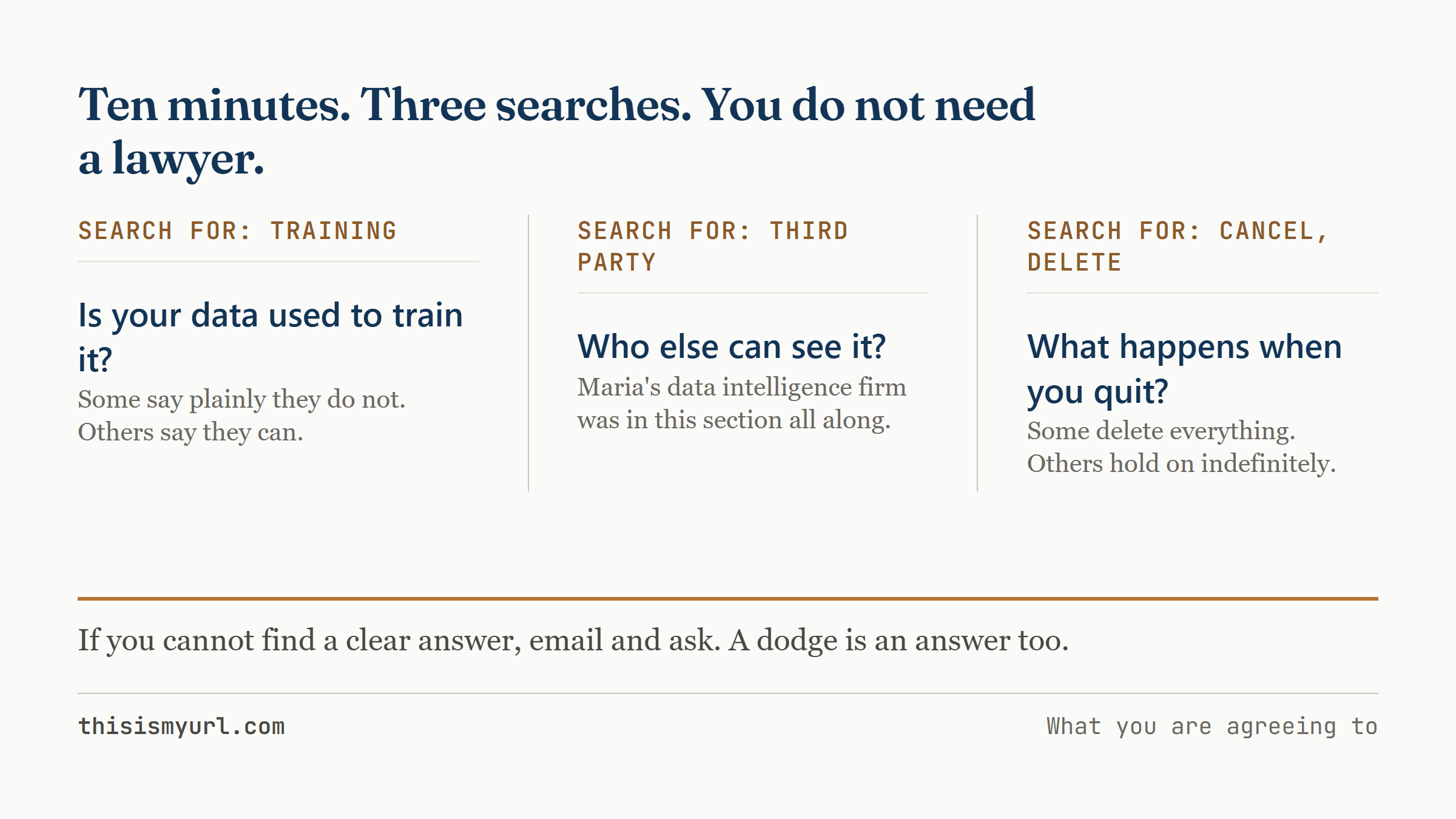
You need three answers, and the terms document will hand them to you if you know what to look for. No lawyer required, and no reading all fourteen pages. On a computer you press Ctrl and F (Command and F on a Mac) to search the page for a word. On a phone, most browsers have a “Find on page” option in the menu. Here’s what to search for.
Start by searching the Terms of Service or Privacy Policy for the word training. You’re looking for whether your data gets used to improve the AI. Some tools say plainly that they do not train on your data. Others say they can. Neither answer is automatically a dealbreaker, but you want to know which one you’re getting before your clients’ numbers are part of it.
Next, search for third party, and try data sharing too. This tells you who else can see your information besides the company you signed up with. Maria’s “data intelligence firm” was sitting right there in this section the whole time. If a tool shares with partners, it will usually say so here.
Last, find the part about cancellation. The question that matters isn’t just how to quit, it’s what happens to your data after you do. Some tools delete everything when you ask. Others hold onto it indefinitely, so leaving the service doesn’t mean your information leaves with you. Search for “cancel,” “delete,” or “retain” and read the few sentences around each.
That’s the whole job. Ten minutes, maybe less once you’ve done it a couple of times. Think of it like reading the label before you buy a jar of pasta sauce. You’re checking three things: what’s in it, where it came from, and whether it’s going to sit well with you. The label is right there on the jar. Most of the time we read it in a few seconds and move on.
If you search for those three words and can’t find a clear answer, that’s useful information by itself. It means you should email the vendor and ask before you connect anything real. “Do you use my data to train your AI, do you share it with anyone, and what happens to it if I cancel?” A company that handles your data responsibly will answer plainly. One that dodges the question has told you something too.
Maria still uses an AI assistant for the books. A different one. The first thing she did before signing up was press Ctrl and F.