Canadian Technology Human Resources Board: bilingual newsletter platform, 2003
The Canadian Technology Human Resources Board, Bureau canadien des ressources humaines en technologie, was a federal sector council during the years the Government of Canada was running the Sector Council Program: industry-led, federally supported bodies that worked on the labour-market questions inside a single sector. For CTHRB-BCRHT, the sector was Canada's technology workforce. The board needed a public-facing site that could carry program information, post updates, and accept newsletter signups from technology professionals and employers across the country. Like every federal body, it had to do all of that in both official languages, not as a translation overlay but as a parallel and equally-weighted English and French presence.
A newsletter signup that had to be its own platform
In 2003, the SaaS newsletter category had not yet become what it is now. MailChimp existed but had not matured into the default answer to "how should we manage a mailing list," and the enterprise listserv tools the board's internal communications team actually used were not the kind of thing a public website could pipe sign-ups directly into. The web layer had to be its own platform.
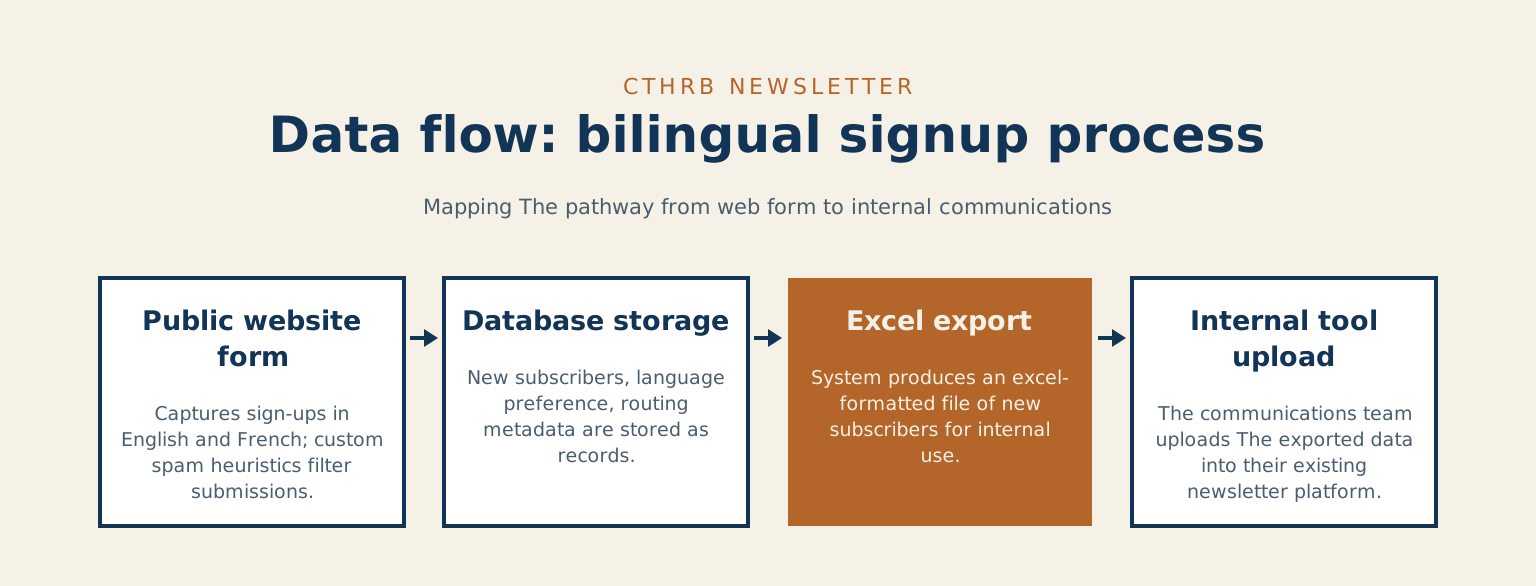
The build settled on PHP and MySQL for the front end: bilingual content trees, parallel English and French sign-up flows, language-preference capture as a first-class field rather than a checkbox afterthought. New sign-ups landed in the database. On a cadence the internal team could control, the system produced an Excel-formatted export with the new subscribers, their language preference, and the routing metadata the communications team needed. The team uploaded the Excel into the newsletter management tool they already ran on the inside, and the loop closed. The web layer captured. The internal tool sent. The format that joined them was the format every team in 2003 already knew how to open.
Spam detection, before that had become a checkbox you turned on
The interesting part of running an open public sign-up form in 2003 was that there was no third-party service to call. Akismet did not exist. reCAPTCHA did not exist. The Bayesian-filter ideas that would become mainstream a few years later were a recent essay from Paul Graham and a still-experimental Apache project. If the form was going to reject the wave of automated junk submissions that hit any open web form, the build itself had to do the rejecting.
So the build did. The system carried its own heuristics: URLs in name fields, sign-ups submitted unrealistically fast after page load, repeated patterns from the same source, payloads whose shape simply did not match what a human filling in a Canadian sector-council newsletter form would write. Submissions that tripped the heuristics were quarantined for human review rather than rejected outright, because false-positives on a federal-body sign-up list have a different cost than false-positives on a personal blog comment. The bilingual dimension compounded the work: spam patterns in English are not the same as spam patterns in French, and a single set of rules tuned for one language would have either let the other language through or thrown out legitimate signups in it.
- Platform: PHP and MySQL front end; bilingual parallel content trees; Excel-formatted export to the internal newsletter management tool
- The build: Bilingual landing-page and information site for a federal sector council; public newsletter sign-up with custom spam heuristics; quarantine-for-review workflow; Excel handoff to internal communications
- Period: 2003
- Client: Canadian Technology Human Resources Board (CTHRB-BCRHT), a federal sector council under the Government of Canada Sector Council Program
Where this pattern transfers
Two patterns from this engagement carry forward to work happening right now. The first is the make-versus-buy problem: every era has a layer where the SaaS market hasn't quite arrived yet, and a practitioner working at the edge of what a buyer needs ends up building inside that gap. The build is rarely permanent (the market catches up), but the build is what serves the buyer in the meantime, and the architectural discipline that goes into it determines how cleanly the eventual handoff to a commercial product will go.
The second is the regulated-bilingual pattern. Any organization operating under the Official Languages Act, or under a parallel multilingual statutory requirement in another jurisdiction, lives with the same discipline this build needed: two languages of intake, two languages of content, two languages of spam, one set of records, and a handoff format that downstream systems can actually read. Building bilingual as a translation overlay does not hold up under audit. Building it as parallel infrastructure does.