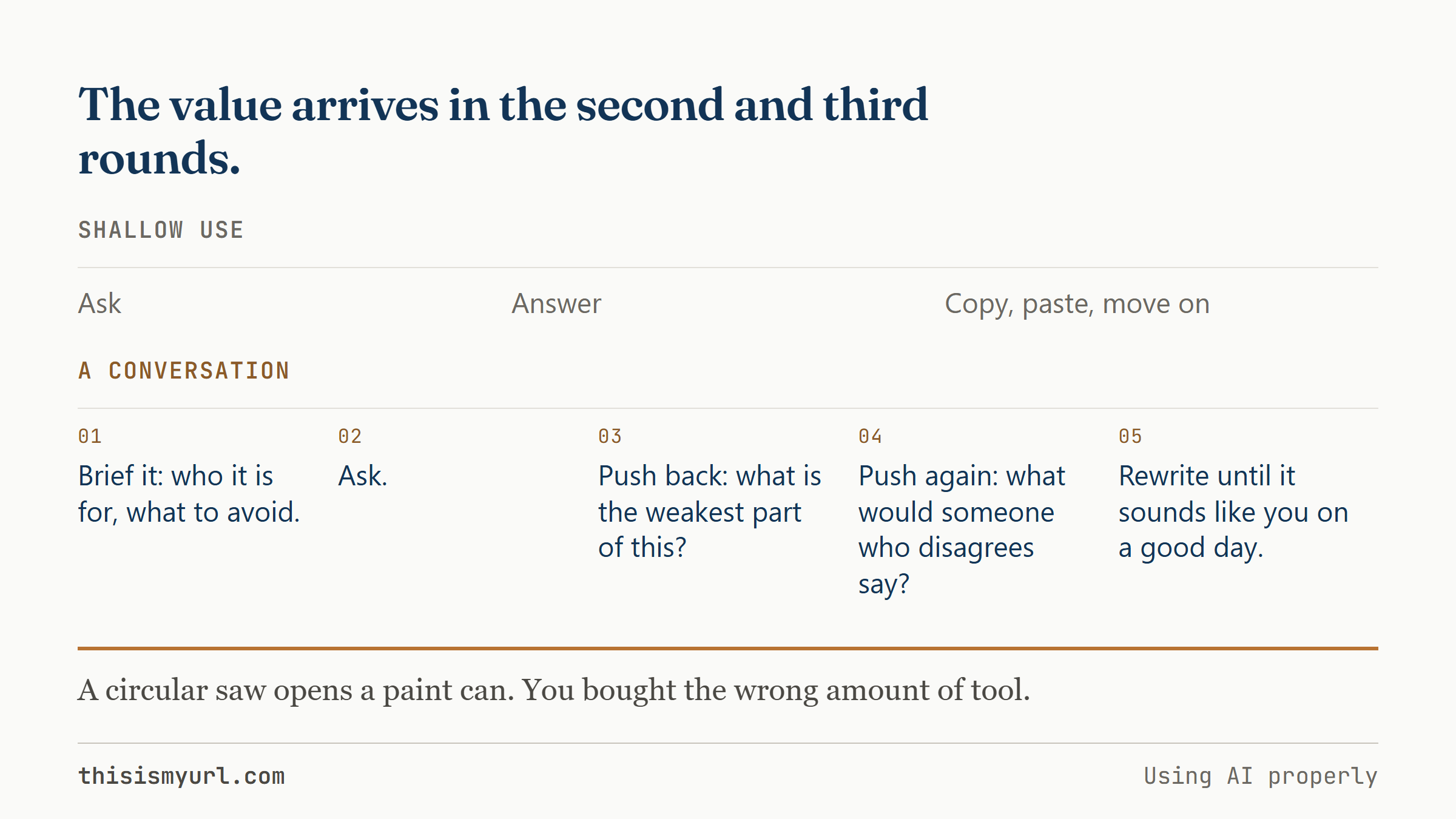
Ask a room of professionals whether they use Artificial intelligence (AI) and most hands go up. Ask what they use it for and the answers get thin fast: summarize this article, fix this sentence, what’s a good subject line. Useful, sure, the way a circular saw is useful for opening a paint can. It works, but you bought the wrong amount of tool.
The pattern I keep seeing is what I’d call shallow use: one question in, one answer out, copy, paste, move on. Shallow use treats AI like a faster search engine, and the results show it. The output sounds like nobody in particular and the thinking never gets stress-tested. The person doing it wonders, honestly, what all the fuss is about.
The real payoff comes from treating the thing as a conversation. The professionals getting outsized value treat the tool like a sharp junior colleague, and they do three things the shallow users skip.
The three habits that separate them
They give context before asking for anything. Who the work is for, what’s already been decided, what a good outcome looks like, what to avoid. A junior colleague briefed for two minutes produces something usable. One handed a bare instruction produces something generic, and that’s just as true here.
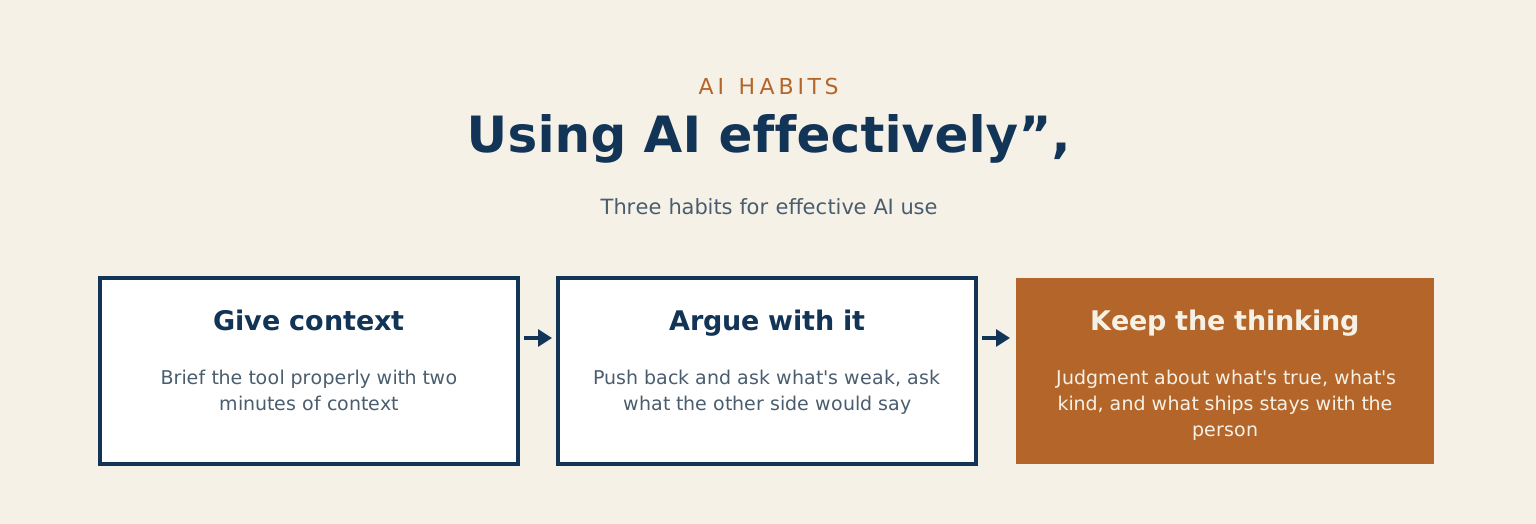
They argue with it. The first answer is a starting position, not a verdict. They push back, ask what’s weak, ask what the other side would say. The value arrives in the second and third rounds, where the idea gets pressure-tested before any human sees it.
And they keep the thinking. The tool drafts and structures and even challenges, but the judgment about what’s true and what’s kind, and the call on what ships, stays with the person. The moment you paste something you haven’t read closely enough to defend, you’ve stopped using a tool and started outsourcing your name.
A test you can run today
Take one real piece of work this week, something that matters more than a throwaway email. Brief the tool properly: two minutes of context, then the ask. When the draft comes back, ask it two follow-ups: what’s the weakest part of this, and what would someone who disagrees say. Then rewrite the result until it sounds like you on a good day, because that final pass is your job and it always will be.
If that process gives you something better than you’d have produced alone in the same time, you’ve found the real thing. If it doesn’t, you’ve lost twenty minutes and learned something about your own standards, which is not a bad trade either.
Nearly every professional uses AI now. What separates them is who has learned to have a conversation with it, and who is still opening paint cans with a circular saw.