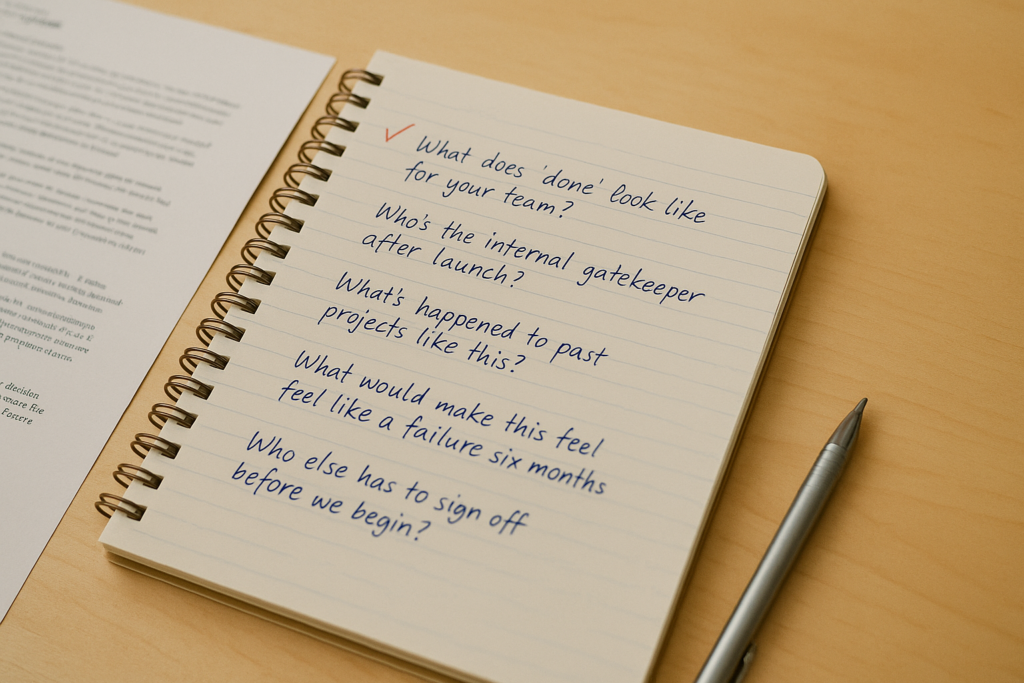
You’ve booked a discovery call. It’s tomorrow at ten. Maybe you said yes because someone on the team recommended me, or because a colleague forwarded an article, or because you’ve been quietly comparing three consultants and wanted the fastest one to commit to twenty minutes. Now you’re looking at your notes the night before and wondering what to bring. Bring less than you think. The call works best when both sides arrive ready to be specific about a small number of things.
This is for the person who already has a call on the calendar with me and wants to use the twenty minutes well. If you haven’t booked yet, there’s a link at the bottom. If you’re a procurement officer evaluating consultants inside a public-sector buy, this still works, but the eight-question version anchored in procurement evidence may be a closer fit.
Why twenty minutes works better than an hour
Sixty minutes is how I used to run these. The longer format produced longer agreements and worse work, because both sides used the extra time to be agreeable instead of honest. Twenty minutes does the opposite. There isn’t room for circling, flattering, or introducing three more stakeholders by name. The actual problem has to land in the first five minutes, or it doesn’t land at all.
The time budget breaks down deliberately. Three minutes to scope the call — who’s on it, what triggered the booking, what stage the buy is at. Fifteen minutes for the six questions below, answered without interruption. Two minutes for what happens next — a written follow-up, a proposal date, or an honest “we aren’t the right consultant for this work.” Twenty minutes is enough to know whether the project is real and whether I’ve handled work that looks like it. Sixty was enough to convince either of us that posturing was the work.
The buyers who get the most out of this format show up having already thought about the answer to “what does success look like in nine months?” The ones who get the least show up expecting a sales call. The format itself filters for the first kind, which is part of why I run it this way.
Six questions to prepare for before the call
- What problem brought you to this conversation? The first thirty seconds of your answer tells me whether you’ve been asked to find a consultant or you’ve decided to engage one. Both are valid. They shape the work differently — one is a procurement exercise looking for a defensible outcome, the other is an operator looking for a partner.
- What does the current setup actually cost? Licensing, hosting, your team’s hours, the recovery time when things break, the vendor-management overhead. If the answer isn’t on hand within fifty dollars, your current vendor knows more about your costs than you do — that’s worth knowing before we go further. The site audit checklist covers the categories that usually get missed.
- Who else has answered this question for you? Past consultants, current ones, requests for proposal that stalled out. “No one” is a real answer, but it usually means either the buy is genuinely fresh or the same proposal is in the inbox of three vendors at once. Either is fine. The honest answer changes what I recommend next.
- What does success look like in nine months? Nine, not six and not twelve. Six is too short for any real WordPress work to show its outcome. Twelve invites strategic blue-sky. Nine is long enough for the answer to be specific without being theoretical, and short enough to keep the team accountable.
- What aren’t you willing to spend? This is an awkward question to put in front of a buyer, and a lot of consultants skip it for that reason. I’d rather hear the answer. Designing an engagement to fit a real budget produces better work than pitching a number and discovering the budget at month four.
- What would make this engagement fail? The buyers who can answer this have run a project before. The ones who can’t are about to learn the answer the expensive way. Both are fine — my job is to know which buyer is on the call so I can shape the work appropriately.
| Question | Why I ask | What a good answer sounds like |
|---|---|---|
| Question 1What problem brought you to this conversation? | The first thirty seconds tells me whether you’ve been asked to find a consultant or decided to engage one. Both are valid — they shape the work differently. | Names the trigger plainly. A stalled project. A procurement requirement. A co-founder’s decision. Either “I was asked to find someone” or “I’ve decided we need a partner” works. |
| Question 2What does the current setup actually cost? | If the answer isn’t on hand within fifty dollars, your current vendor knows more about your costs than you do — worth knowing before we go further. | Names licensing, hosting, the team’s hours, recovery time when things break, and vendor-management overhead — within $50 of accurate. |
| Question 3Who else has answered this question for you? | “No one” is a real answer, but it usually means either the buy is fresh or the same proposal is in three vendors’ inboxes at once. The honest answer changes what I recommend next. | Names past consultants, current ones, RFPs that stalled out. Or an honest “no one yet — you’re the first conversation.” |
| Question 4What does success look like in nine months? | Nine, not six and not twelve. Six is too short for real WordPress work to show its outcome. Twelve invites blue-sky. Nine is long enough to be specific, short enough to keep the team accountable. | A specific deadline, a specific stakeholder signoff, a named operational change. “Bilingual portal launched by the September Treasury Board deadline, AODA officer’s signature on the accessibility documentation, comms team publishing without filing a ticket.” |
| Question 5What aren’t you willing to spend? | An awkward question to put in front of a buyer, and a lot of consultants skip it for that reason. Designing an engagement to fit a real budget produces better work than pitching a number and discovering the budget at month four. | A real ceiling and the reason it exists. “This round of funding caps at sixty-five thousand, anything past that has to go to a second round — we can do this engagement now or wait three quarters.” |
| Question 6What would make this engagement fail? | The buyers who can answer this have run a project before. The ones who can’t are about to learn the answer the expensive way. My job is to know which buyer is on the call so I can shape the work appropriately. | Names a specific failure mode the buyer has seen before — a scope-creep pattern, a stakeholder dynamic, a vendor handoff that went wrong. Or an honest “I haven’t run one of these before.” |
What a useful answer sounds like
What I’m listening for is specificity — names of actual things, real numbers when they exist, awareness of the constraints you’re actually working inside. Honesty about consultants who came before without making them the villain of the story. And somewhere in the answer, a date or a budget or a person’s name lands — something a procurement file (or a co-founder’s notebook) could point back to.
A useful answer to question four isn’t “we want a better website.” It’s “the bilingual portal has to launch by the September Treasury Board reporting deadline, the accessibility documentation needs the AODA officer’s signature, and the comms team has to be able to publish without filing a ticket.” That answer tells me the timeline, the politics, the budget shape, and the staff dynamic in two sentences. I can design an engagement against it.
The reverse direction works the same way. A useful answer to question five isn’t “we have flexibility.” It’s “this round of funding caps at sixty-five thousand, anything past that has to go to a second round, which means we can do this engagement now or wait three quarters.” I can work with that too.
Think of it as a clinic intake, not a sales pitch
Twenty minutes is roughly how long a doctor spends with you on an intake visit. The shape of the conversation is similar. They ask pointed questions, they listen for the specific words you use, they don’t write a prescription on the first visit. They might tell you that what brought you in isn’t actually the problem worth solving first. They might also tell you that it is exactly the problem, and here’s the next step.
A discovery call works the same way. I’m not selling anything in the twenty minutes — I’m trying to figure out whether the engagement you’re describing is the right shape, whether I’m the right consultant for it, and what the smallest useful next step looks like. Sometimes that next step is a proposal. Sometimes it’s a five-hundred-dollar pre-check audit before either of us commits to the larger conversation. Sometimes it’s a referral to someone better suited to the work. All three outcomes count as the call doing its job.
What I won’t do on the call
Quote a price. Recommend a plugin stack. Speak poorly about another consultant. Commit to a scope I haven’t validated.
A price quoted on the call is a guess, and guesses lock both of us into a number that might not survive contact with the actual project. If I recommended a plugin stack before seeing your editorial workflow, the recommendation wouldn’t be advice — it would be a sales script that arrived before you’d asked the question. Speaking poorly about another consultant in front of you tells you exactly how I’ll speak about you in front of the next buyer. And a scope I haven’t validated isn’t really a commitment; it’s the front end of every consulting engagement that ends badly.
The refusals are for your protection more than mine. You’d rather hire someone whose first answer to “how much?” was “I need more information” than someone whose first answer was a number.
What skipping the call usually costs
The call costs you twenty minutes. Skipping it costs whatever the wrong scope turns into when it meets the actual project. The bands current clients tell me about — what they spent on rebuild work, scope creep, or wrong tooling before they found someone willing to ask the questions first — usually land between thirty thousand and a hundred and twenty thousand dollars. Those numbers aren’t theoretical. They’re what shows up on the file when the engagement comes back for review.
If you want the longer financial picture of what a senior-consultant engagement actually costs against the in-house alternative, the cost comparison piece walks the math. Read it before the call. Bring whatever the math raises with you.
If you’re buying inside public-sector procurement
If you’re buying inside a public-sector procurement regime, the call is also where I learn which regime applies. In Canada — where most of my engagements run — that means the Canadian Free Trade Agreement Chapter 504 thresholds, sole-source justification rules, the Treasury Board Directive on Service and Digital, and provincial broader-public-sector procurement directives. Each one decides what shape of engagement is even available before either of us writes a proposal.
The principles travel beyond Canada. The thresholds change, the documents have different names, the offices have different titles, but the questions are the same. When does this need to go to tender? When can a sole-source justification carry the file? What evidence does procurement need to keep? If you’re inside Canadian public-sector procurement specifically, the eight-question version of this framework goes deeper on each.
Product names referenced on this page — including WordPress — are trademarks or registered trademarks of their respective owners. Training offered here is independent and is not affiliated with, endorsed by, or sponsored by any of these companies.