
Edmonton’s news cycle has its own gravity. The Alberta Legislature is here, so provincial politics lands harder on the homepage than it does in Calgary, and the reader expects the paper to carry the story. The Edmonton Journal has done that since 1903, and was awarded a Pulitzer Special Citation in 1938 for editorial coverage of press freedom under the Aberhart government, the kind of institutional credential that shapes a paper’s editorial posture for generations. Two Alberta papers, adjacent markets, distinct editorial centres, and the WordPress® platform architecture had to honour both without forcing one to read like the other.
Sharing a parent, holding the front page
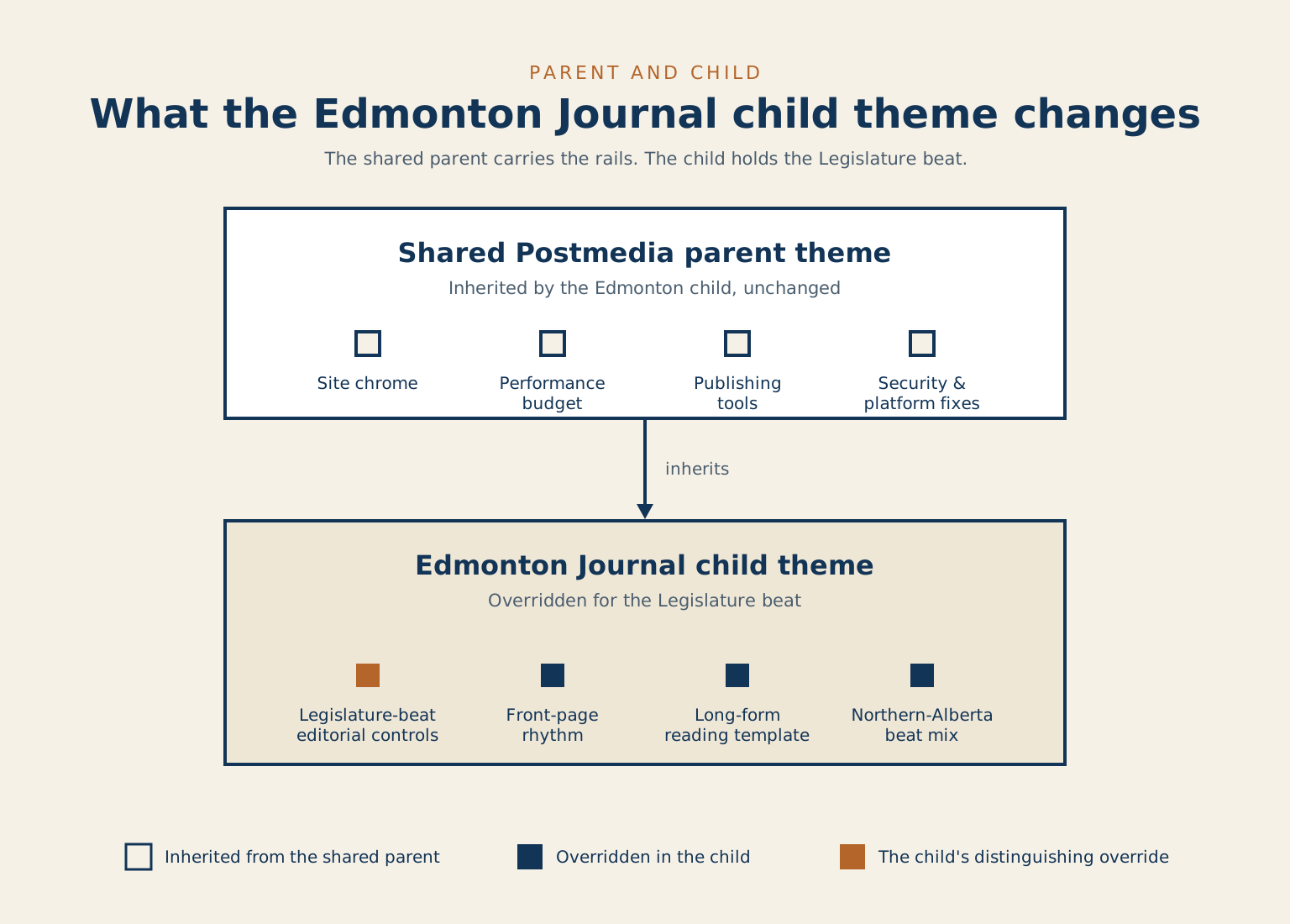
The Edmonton Journal ran as its own child theme on the shared Postmedia parent that carried the eleven properties of the network, alongside the Calgary Herald‘s child. Same upstream code, different homepage discipline. The temptation when two papers in the same publisher serve adjacent markets is to over-share the homepage logic: let one front-page configuration drive both, save some maintenance, ship faster. The better answer turned out to be sharing the chrome, the performance budget, and the publishing tools, but letting each paper’s editor configure the front page on their own rhythm.
The reader can tell the difference. Provincial politics, civic affairs, arts and culture, and the Journal’s distinctive northern-Alberta beat read recognisably as the Journal’s mix when the homepage does not impose Calgary’s editorial pacing on it. That is not a styling decision: it is an editorial-tools decision built into the child theme. The CMS controls the Journal’s homepage editor uses are tuned to a paper whose primary readers care about what happened at the Legislature today, and that is a different shape of homepage than the Herald’s.
The shared-parent architecture, made concrete
The child theme build for the Journal is the cleanest illustration in the network of the architectural principle the migration was built around: share infrastructure, hold editorial identity in the child. Both Alberta papers benefited from every performance, security, and platform fix that landed in the shared parent. Neither paper was constrained by the other paper’s editorial choices. When a long-form feature landed in the Journal that needed a different reading rhythm than the Herald’s daily business template, the Journal’s child theme could carry that without forcing a network-wide template change.
The 2011-2012 Postmedia move onto WordPress VIP put the eleven papers on a platform that had not yet become the default answer for major Canadian news publishing. The VIP onboarding review process at that time meant the parent theme cleared a senior-engineer review before any child went live, which is part of why the Journal’s homepage held up under traffic from launch rather than needing a stabilisation sprint afterward.
- The work: Edmonton Journal child theme on the shared Postmedia parent; Legislature-beat-aware editorial controls and front-page rhythm
- Architecture: Shared parent with the Calgary Herald and the rest of the Postmedia network
- Client: Postmedia Network Inc. (Edmonton Journal)
- Period: 2011-2012
The Alberta pairing is the cleanest illustration in my portfolio of the share-the-rails / hold-the-voice pattern. Any publisher running adjacent-market properties is solving a version of this problem.
This work was part of the broader Postmedia WordPress VIP migration: one parent theme, eleven distinct child themes across Canada’s major daily newspapers. The full architectural story, including the parent-child seam and the platform decisions that made the network work, is in the Postmedia WordPress VIP migration case study.