Wix to WordPress: how to know when you've outgrown it
What actually leaves Wix, what Wix's own help pages say you cannot export, and how to tell whether you have outgrown it, with every limit sourced.

If you built your business on Wix, you made a good decision. I mean that. Wix got you online without a developer, or a hosting bill you had to understand, or ever learning what a plugin (a small add-on that gives a website a new feature) is. For a brand-new business that's exactly the right trade, and anyone who sneers at it has forgotten how hard a blank page can be.
Then one afternoon, usually a year or two in, you go looking for the exit and find this line in Wix's own help centre, on a page where Wix collects votes for the feature: "Currently, it is not possible to export blog posts to other platforms."1 If that's where you are, here's how to tell whether it's time to move or just a rough week with your website.
In short: write down what WordPress would let you do that Wix won't. If the list is short, or every item is something you might want someday, stay. If it's long, and it's the stuff between you and the next size of your business, move. Either way, you never go dark: the new site gets built while the old one keeps running. Your words mostly come with you, but your design doesn't, and every old page address needs a forwarding address on the new site. Google says to expect some ranking movement and to keep those forwards for generally at least a year.
Why Wix was the right call
Think about what you got. A site that looked professional in an afternoon. One monthly bill that covered the hosting, the security, the software updates and the little padlock in the address bar, none of which you had to think about for a second. When something broke, it was Wix's problem to fix. That's a genuine service, and for plenty of businesses it stays the right one for years. You're in good company either way: about 4% of all websites run on Wix and about 40% on WordPress,2 so neither choice is exotic.
The day it starts to feel small
The trouble with a place that does everything for you is that it also decides everything for you. Maybe you want to move a section somewhere the template refuses to put it. Maybe the built-in booking tool almost works the way your business runs, and "almost" has started to cost you customers. Or you've begun to care about how you show up in Google, and every guide you read points at a control you can't find.
I'd be unfair to Wix if I left it there, because it lets you do more than people assume. You can edit the note that tells search engines which pages to skip (a file called robots.txt),3 add the hidden labels that tell Google "this is a bakery, these are its hours" (structured data),4 and set up forwarding addresses.5 The limits are specific. Those labels only go on regular pages, up to five per page. Your page addresses have to keep a fixed prefix such as /post/ or /product-page/.6 Forwarding addresses are capped at 5,000 a site, and for blog pages they aren't created automatically when you change a page's address.5 For most small sites none of that will ever matter, in my experience, so don't move over it. It matters when you're the business that wants control over every page address.
Write down what WordPress would let you do that Wix won't.
After enough papercuts, the businesses I see genuinely outgrowing Wix need the same handful of things. They want real say over their page addresses and structure, and a store with the checkout they chose and fees that don't climb as they grow. They want booking, memberships or client logins that fit how they work, and a site that talks to the email list, customer database and accounting software they've picked up since launch. WordPress is also simply common, which gives you more people to ask for help, though I found no data on hiring supply and I'm offering that as experience.
What WordPress gives you room for
WordPress is the opposite kind of deal. Where Wix rents you a furnished apartment, WordPress hands you the keys to the building itself. You can change almost anything and add nearly any feature anyone has ever wanted on a website, and you're never waiting for a company to decide your idea is worth building.
One thing is worth slowing down on, because it's what Wix doesn't give you: the right to take your site with you. Wix says so itself. You can't use another host for a Wix site, because its architecture doesn't support external hosting.7 WordPress is open-source software released under a licence called the GPL,8 and the project lists among its freedoms the freedom to study how it works and change it.9 Its export tool packs your posts, pages, comments and categories into one file.10 So I'd call it your content and your code that travel, and not "the whole thing." You can move both to any host you like. Most people never need to. The ones who do are glad they can.
Here's the catch, and it's the same one every time. WordPress doesn't come with a landlord. The updates, the backups and the occasional plugin that misbehaves become yours to handle, or yours to pay someone to handle. Security researchers Patchstack counted 11,334 new security holes in WordPress add-ons and themes in 2025, 91% of them in plugins, only six in WordPress itself, and the year before it counted 7,966.11 My reading of that is that the risk lives in the plugins you pick, so a lean site with a few well-kept plugins is a very different animal from a pile of thirty.
What the move involves
Build the new site completely while the old one keeps working. Nothing is switched off or announced, and no customer sees anything until the replacement is genuinely finished. In my experience that one decision removes most of the risk people associate with changing platforms.
Along the way: choose hosting, rebuild the design, move the content, rebuild whatever the Wix apps were doing, and write the forwarding-address list while the content is still fresh in mind rather than at the end when everyone is tired. Then walk the new site as a customer before anyone else does. Buy something. Book a slot if you take bookings, and send yourself a message through the contact form. The problems that matter are almost never on the pages you've been staring at for weeks, and the only way to find them is to go through the whole thing the way a stranger would.
What moves across, and how
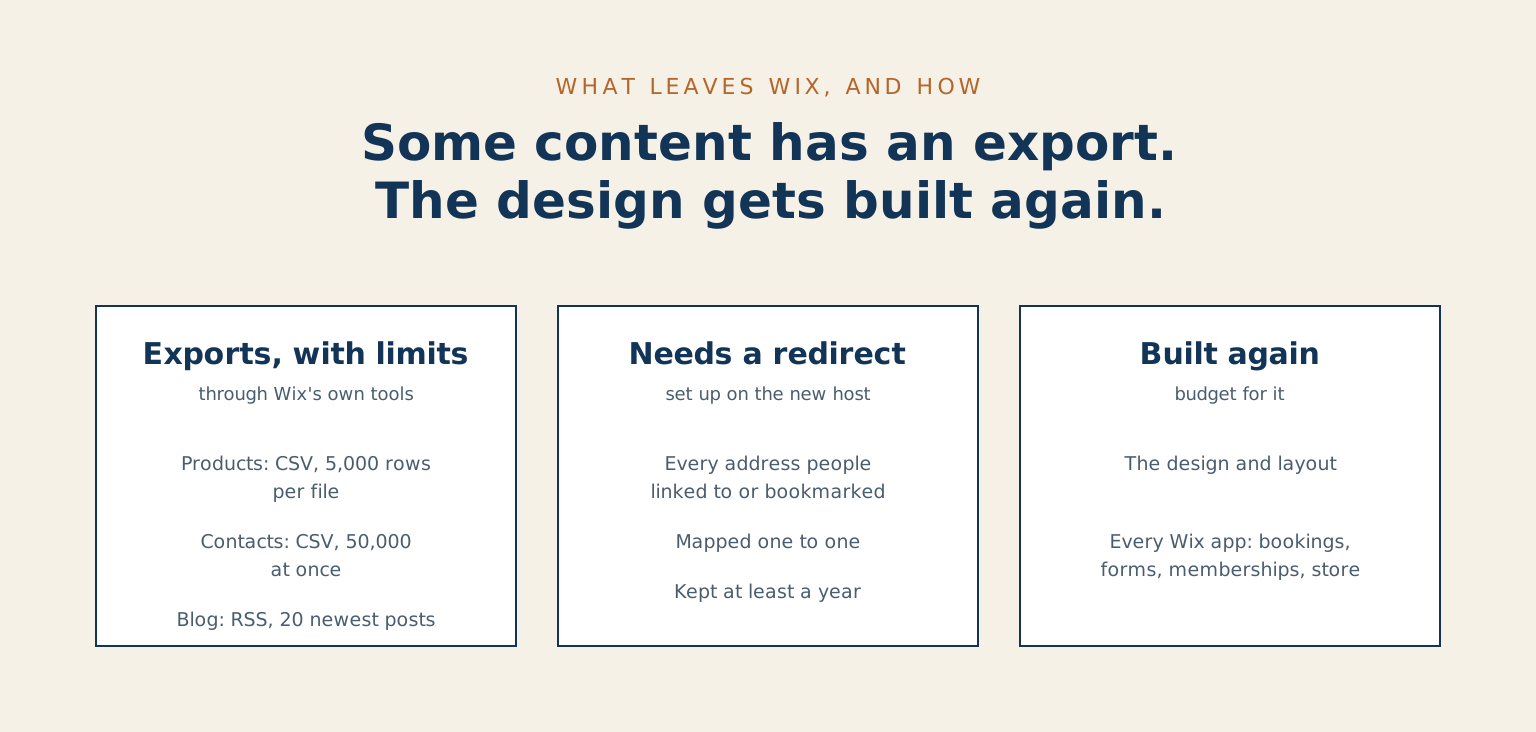
People tell me their words and pictures come with them, and mostly they do, but the route differs by content type and Wix sets specific limits on each. A CSV file, in case the word is new, is a plain spreadsheet file.
| What | What it means for the move | What Wix's help pages say |
|---|---|---|
| Blog posts | A blog with more than 20 posts needs another route, and I'd plan on copying it. | No export to other platforms.1 The RSS feed (the automatic list other tools read) shows up to the 20 most recent posts.12 |
| Products | A big catalogue arrives as several files, and digital products are uploaded again. | CSV export, up to 5,000 rows per file. Digital products aren't supported.13 |
| Contacts | Fine for most small businesses. | CSV export of up to 50,000 contacts at once.14 |
| Bookings | The history comes as reports. Expect to recreate your service setup. | Reports on bookings and staff, with fixed fields.15 I found no Wix page on exporting service setup. |
| Page copy and the media library | Plan on moving them yourself, which takes longer than you'd think but goes smoothly. | I found no Wix page documenting a bulk export. |
| The design itself | Rebuilt on the WordPress side. | The site must run on Wix's servers.7 |
Wix's own help pages don't quite agree with each other here: one says blog export isn't possible, another documents a feed that stops at 20 posts. Both are undated, so check what Wix currently offers when you start. Treat the table as what the help centre said when I read it on 11 October 2026.
The design doesn't come with you, and this is the part that surprises people. There's no version of it WordPress can open, so whatever you had built gets rebuilt. Plenty of people treat that as the moment they finally fix the things that had been bothering them, and it belongs in the budget rather than in the pleasant-surprises column. Anything built on a Wix app gets rebuilt with a WordPress equivalent too. Bookings, forms, memberships and the store all have good counterparts, and none of them transfer. Make a list of every Wix app you use before anyone quotes the work, because in my experience that list is most of the difference between a small project and a big one.
Your page addresses, and the year after
Every page on your site has an address, and people have linked to or bookmarked many of them. A redirect is a forwarding address: someone who clicks the old link lands on the new page. Without them, the old links go nowhere, and you throw away search visibility the site has earned. Google says permanent redirects don't cause a loss in ranking credit,16 and treats one as a sign that the new address is the real one.17 In my experience the search visibility is usually the most valuable thing a site that's been online a few years owns. Google doesn't put a number on what skipping them costs, and I won't invent one.
Two details trip people up. Google advises keeping redirects in place "generally at least 1 year," and says to expect temporary fluctuation in your ranking during the move, with new addresses taking a few weeks or more to show for a medium-sized site.16 And the forwarding has to be set up on the new host, because that's where visitors arrive once your domain points there. Keeping the Wix subscription for a while is still sensible, as a safety net and a place to check things against, but the old plan isn't what keeps your forwards alive.
Your domain, and the email that rides on it
Your domain comes with you and keeps working. Email is where people get caught, so start with one question: where does your domain currently point? Ask whoever you pay for the domain where its name servers are set (the name servers are whoever keeps your domain's address book), and write down what they say.
If you bought the domain through Wix and move it away, Wix says you can't transfer it within 60 days of purchase, a transfer usually takes up to seven days, and your Wix site is disconnected when it completes.18 It also says business email on that domain won't work after the transfer until you add the MX records again, which are the settings that tell the internet where to deliver your email.18 If you only pointed a domain you bought elsewhere at Wix, your DNS records (the domain's settings) and the email attached to them were never changed.19 If you connected by name servers, Wix hosts those settings and says it imports your existing email settings when you connect,19 so check that what's there still matches your email provider before you move anything.
What it costs to run WordPress instead
Most of what you pay on Wix lands on one monthly bill, though card fees and some apps sit on top. WordPress is several smaller bills, and the comparison only works if you count all of them. I can't give you a sourced total, because I found no public dataset that compares the two over time, and Wix's plan prices change by region and date, so I won't reproduce them here. What I can show you are the lines.
| What you are paying for | On Wix | On WordPress |
|---|---|---|
| Hosting and the padlock | Inside your plan | A separate bill |
| The design | The template, included | A theme, sometimes paid |
| Bookings, forms, the store | Wix's own apps, priced by Wix | A handful of plugins, some free and some annual |
| Taking card payments | Wix Payments lists 2.9% plus 0.30 CAD for Canadian cards other than American Express20 | Your processor's own schedule, which you choose |
| Updates, backups and security | Handled quietly by Wix | Your own time counted honestly, or somebody's monthly invoice |
That last row is where the comparison usually goes wrong. Wix was handling updates, backups and security in the background, and the day you leave, that job becomes yours. Whether WordPress comes out ahead for you depends on how many plugins you run and who looks after them, and you can count that yourself. When I quote a move, I quote a fixed price, so you'd know the number before we start.
Common questions about moving from Wix
Will I lose my Google rankings? Expect movement and plan for it to be temporary: Google says to expect temporary fluctuation in your ranking during a move.16 The part you control is the forwarding addresses. In my experience the traffic cliffs people warn about come from broken links and missing forwards rather than from WordPress itself, so map every existing address to its new one and keep the content.
Can I just export my Wix site? You can get some of your content out, with the limits in the table above. You can't get the site out. Plan on rebuilding the look, and check what Wix offers for content export when you start, since those pages change.
How long does it take? For a straightforward small-business site, weeks rather than months in my experience, and most of that is rebuilding the design and whatever the Wix apps were doing. The content move is the quick part. That's my own record, not a published benchmark. If you want a realistic answer for your own site, tell me what you have and I'll give you one.
What about my domain and email? The domain comes with you. Check where its name servers point before you start, because that tells you whether your email settings sit with Wix or with someone else. A domain transferred away from Wix needs its MX records added again at its new home.18
When staying is the smart answer
There's an honest case for staying, and for a lot of Wix sites I'd make it without blinking. A handful of pages that rarely change and quietly do their job? You don't have a problem to solve, and moving would be a solution looking for one. Nervous about being on the hook for your own updates? That monthly fee is buying you real peace of mind, which is a perfectly sound thing to buy.
The test is the one at the top, and it's mine: write down what WordPress would let you do that Wix won't, using the specific limits above rather than a general feeling. If that list comes out short, or every item on it is something you "might" want "someday," you've talked yourself into a project you don't need. Moving platforms costs real time and real money, and "I hear WordPress is better" doesn't cover the bill.
But if that list is long, and the things on it are the things standing between you and the next size of your business, then you already have your answer. You've outgrown the easy option, which is a good problem to have. It means the thing you built worked.
How much of this you can check
The Wix limits, Google's redirect advice, the W3Techs share figures and the Patchstack counts all come from their publishers, linked below, and I read the Wix pages on 11 October 2026 because most of them carry no date. Anything I've marked "in my experience" is mine, not a study's, and I couldn't find solid research on small businesses switching platforms, so I haven't pretended to. If something here has gone out of date, tell me and I'll add a dated correction at the bottom rather than quietly changing it.
If your Wix site is straining against what you need it to do, moving to WordPress is a real project, bigger than a weekend export, and it's one I help businesses through. See what I do on the services page, how I take on rescue work and small projects, or tell me where your current site is holding you back.
References
- Wix.com Help Center, Wix Blog request: exporting blog posts to other platforms. Undated; read 11 October 2026.
- W3Techs, Usage statistics and market share of content management systems, snapshot 11 October 2026.
- Wix.com Help Center, Editing your site's robots.txt file. Read 11 October 2026.
- Wix.com Help Center, Add structured data markup to your site's pages. Undated; read 11 October 2026.
- Wix.com Help Center, Setting up a 301 redirect for a page on your site. Undated; read 11 October 2026.
- Wix.com Help Center, Customizing your page's URL structure in SEO settings. Read 11 October 2026.
- Wix.com Help Center, Exporting or embedding your Wix site elsewhere. Undated; read 11 October 2026.
- WordPress.org, License, last modified 11 July 2023.
- WordPress.org, About, last modified 29 June 2026.
- WordPress.org Documentation, Tools export screen, last updated 8 June 2024.
- Patchstack, State of WordPress security in 2026, 25 February 2026, and State of WordPress security in 2025, 14 March 2025.
- Wix.com Help Center, Wix Blog: adding an RSS button to your site. Undated; read 11 October 2026.
- Wix.com Help Center, Wix Stores: exporting your product list. Undated; read 11 October 2026.
- Wix.com Help Center, Wix Contacts: exporting your contacts. Read 11 October 2026.
- Wix.com Help Center, Wix Bookings: exporting reports on bookings and staff, 13 May 2025.
- Google Search Central, How to move a site, last updated 20 August 2026. Read 11 October 2026.
- Google Search Central, Redirects and Google Search, last updated 14 April 2026.
- Wix.com Help Center, Transferring your Wix domain away from Wix. Undated; read 11 October 2026.
- Wix.com Help Center, Pointing vs. name servers domain connection methods. Undated; read 11 October 2026.
- Wix.com Help Center, Wix Payments: service fees. Undated; read 11 October 2026.