You’ve opened a WordPress build proposal. There’s a number on page one — fifty-two thousand dollars, or a hundred and twenty, or two hundred and eighty. Underneath it, a payment schedule. Maybe a Gantt chart. Nothing about what year two costs, or year three, or what happens if the developer leaves. That number is the first of five you should be looking at, and it’s the one with the least bearing on whether your site is still working three years from now.
This is for the person who has to defend a website budget to someone above them — a procurement officer, an operations lead, a founder doing the engineering math for the board. The numbers below are in Canadian dollars and reflect 2026 conditions, because most of my engagements run in Canada and those are the numbers I can stand behind. The principles travel anywhere a website needs to be paid for over more than one fiscal year.
The number every proposal shows you, and the four it doesn’t
Most WordPress build proposals lead with implementation cost and stop there. It isn’t a conspiracy. It’s how agency-world quoting works, and it produces a clean number that fits on a procurement form. The trouble is that the implementation number is one of five line items that decide what your site actually costs over its working life. The other four don’t appear in the proposal because they’re somebody else’s problem until they aren’t.
Here are all five, named plainly:
- Implementation. The build cost. The number on page one.
- Maintenance. Keeping the site running — security updates, plugin compatibility, the small repairs nobody warned you about.
- Plugin licensing. The premium plugins that earn their keep, renewed every year.
- Training. Hours your team spends learning to use what was delivered, plus the hours they need again when someone new joins.
- Work the build didn’t include but you needed. A new section, a form that has to behave differently, an integration that wasn’t on the original list. Year two always has some of these.
An honest WordPress cost conversation includes all five. Most proposals show the first one and leave the rest to discovery.
Route A — a senior consultant at $275 an hour
The consultant route uses a small number of senior hours where they matter most — the architecture, the integrations, the accessibility decisions, and the editorial workflow that runs the site after launch. The rate is high. The hours are few. Here’s what three years actually costs.
Year 1 — implementation and stabilisation
- Implementation: 120–200 senior hours at $275 = $33,000–$55,000
- Maintenance retainer (Essential tier, 12 months at $750/mo): $9,000
- Plugin licensing: $2,400–$4,800
- Training (two days for the team): $4,500
- Year 1 total: $48,900–$73,300
Year 2 — operate, refine, extend
- Senior hours for refinements and new features: 60–100 hours at $275 = $16,500–$27,500
- Maintenance retainer (typically scales to Active at $1,500/mo): $18,000
- Plugin licensing: $2,400–$4,800
- Training top-up (half day for new hires): $1,500
- Year 2 total: $38,400–$51,800
Year 3 — replatform decisions and renewal
- Senior hours for strategy review and selective rebuilds: 40–80 hours at $275 = $11,000–$22,000
- Maintenance retainer (Active tier): $18,000
- Plugin licensing: $2,400–$4,800
- Year 3 total: $31,400–$44,800
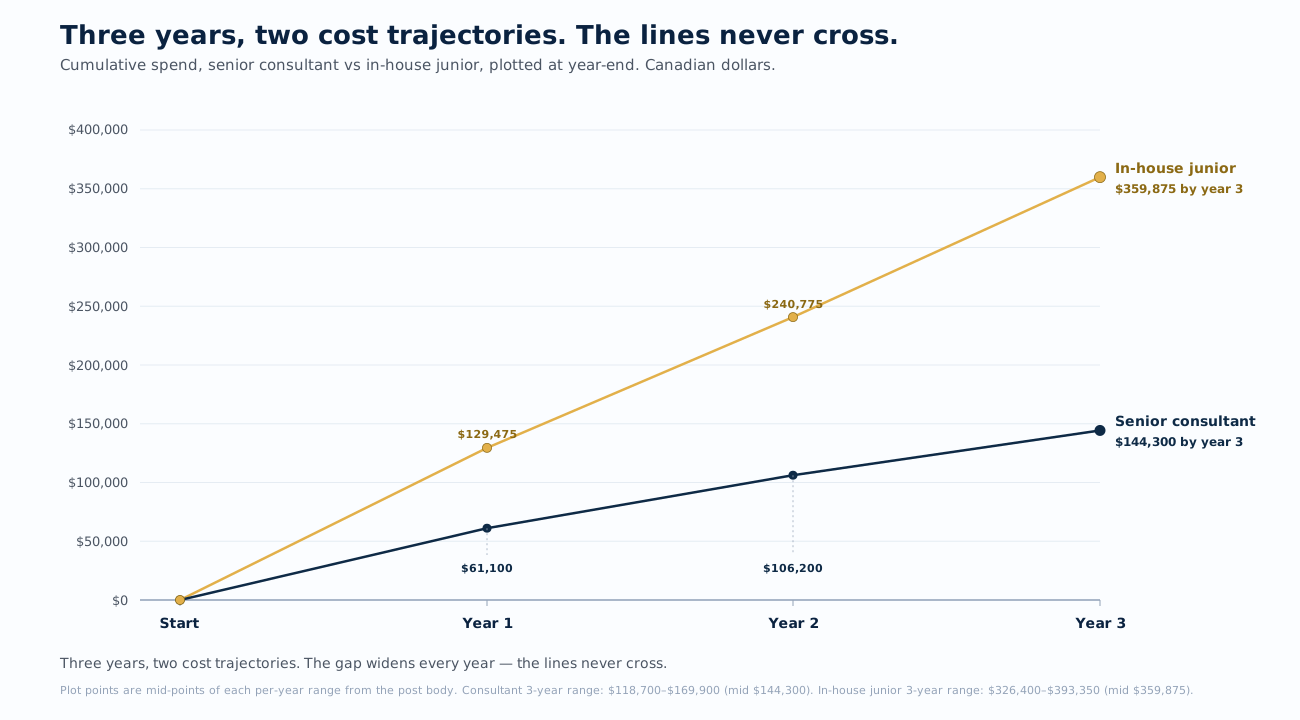
Three-year total, senior-consultant route: $118,700 — $169,900. Roughly $3,300 to $4,700 a month for a senior WordPress practice attached to your site for thirty-six months. The variance comes from complexity at year one and how aggressively you decide to extend the site in years two and three.
Route B — a full-time junior developer at $75,000 base
The in-house route is the one finance directors instinctively prefer because the headcount sits on a line they already understand. A WordPress-capable junior developer in a Canadian market costs roughly $75,000 base. That’s not the three-year number. Here’s the full one.
Year 1 — hire, onboard, ship something
- Base salary: $75,000
- Benefits and employer-side contributions (CPP, EI, vacation, health): typically 25–30 percent of base = $18,750–$22,500
- Recruitment cost (third-party agency or HR overhead): $8,000–$15,000
- Onboarding and tooling (laptop, software, training budget): $5,000
- Senior oversight you still need to buy externally (40–60 hours of senior review at $275): $11,000–$16,500
- Plugin licensing: $2,400–$4,800
- Year 1 total: $120,150–$138,800
Year 2 — productive ramp, first review
- Salary with 3–5 percent merit increase: $77,250–$78,750
- Benefits load: $19,300–$23,600
- Senior oversight (still needed, dropping to 20–40 hours): $5,500–$11,000
- Plugin licensing: $2,400–$4,800
- Year 2 total: $104,450–$118,150
Year 3 — retention risk or replacement
- Salary with year-over-year increase: $79,500–$82,000
- Benefits load: $19,900–$24,600
- Either zero senior oversight (now embedded) or full replacement cost if your junior leaves at month 26 — 10–15 percent annual turnover is normal. Replacement budget: $0–$25,000
- Plugin licensing: $2,400–$4,800
- Year 3 total: $101,800–$136,400
Three-year total, in-house junior route: $326,400 — $393,350. Roughly $9,100 to $10,900 a month for a junior developer attached to one site, with senior oversight on the side for the first two years and turnover risk in the third.
The honest comparison
Senior consultant: $118,700 — $169,900 over three years. In-house junior: $326,400 — $393,350 over the same period. The consultant route is roughly 36 to 43 percent of the in-house cost.
That gap doesn’t make the consultant the right answer for every team. What it does is reframe the conversation away from rate-versus-salary. $275 an hour versus $75,000 a year sounds like a contest. Hours deployed against the actual need versus a full-time salary plus benefits plus turnover risk isn’t a contest — it’s two different ways of buying the same outcome.
Think of it like renovating a house. Hiring a senior consultant is closer to calling a kitchen contractor — they show up for the demo and the layout, leave you with a finished space and a written list of how everything works, and come back when you ring them. Hiring an in-house junior is closer to hiring a live-in handyman — they’re there every day, paid every Friday, doing everything from new countertops to the wonky bathroom tap. Both are real ways to renovate a house. Both have a real price. The price isn’t the hourly rate; it’s the shape of the help you’re committing to.
When the in-house junior is the better buy
The math above doesn’t say “always hire the consultant.” It says the three-year total favours the consultant on the typical case. Three specific situations flip that math, and they’re worth naming honestly because they’re more common than the average proposal lets on.
- You’ll use the developer on more than one site. A junior responsible for three sites is amortised across three budgets, and the per-site cost halves. A consultant stays a per-engagement line. If you’ve got a portfolio of two or three properties, the numbers stop favouring the consultant somewhere around site three.
- You need same-day editorial support that lives inside the org chart. Consultants respond on contracted service-level agreements. An in-house developer reachable on Slack inside business hours is a different operational shape, and for some newsrooms and education-services teams, that shape matters more than the cost saving. The right answer there is the answer that lets your editors ship without waiting.
- You have a three-to-five-year roadmap that will fill a full-time developer’s capacity. If the work pipeline is real and ongoing, a junior who grows into a mid and then a senior is a better three-year investment than a consultant relationship that doesn’t produce career growth for anyone on staff. The investment is in the person, not the deliverable.
If none of those describe your situation, the consultant route is almost always the better commercial decision. If one or two do, the answer is usually a hybrid: hire the junior, and buy a small senior-oversight retainer to fill the architecture, accessibility, and procurement-defensible-build gaps the junior doesn’t yet cover. That’s exactly the model the in-house columns above already assume — I’ve just made it explicit.
I’ve worked alongside in-house developers in both shapes. The good shapes are the ones above — clear roadmap, multiple sites, real operational need for embeddedness. The painful shapes are when the junior was hired to save money on a project that should have been consultant-led, and year three is when that decision presents itself for review. Either path is defensible. Picking the right one for the actual situation is the work.
The procurement context
If you’re buying inside a public-sector procurement regime, the consultant-versus-employee decision is also a procurement decision. In Canada — where most of my engagements live — that means the Canadian Free Trade Agreement Chapter 504 thresholds, sole-source justification rules, the Treasury Board Directive on Service and Digital at the federal level, and provincial broader-public-sector procurement directives (Ontario’s BPS, British Columbia’s CSA, equivalents in the other provinces). Those rules decide which route is even available at a given engagement size, not just which one is cheaper.
The principles travel beyond Canada. Every public-sector procurement regime I’ve worked alongside has its own version of the same questions: when does this need to go to tender? When can a sole-source justification carry the file? What documentation does the consultant need to produce for the procurement officer to keep on file? The answers vary by jurisdiction. The shape of the conversation doesn’t.
None of that changes the underlying math. It changes who signs the paperwork and what evidence procurement keeps in the file. Both routes can be defended. Either route can be done badly.
Pick the shape, not the rate
I’d rather see a buyer make this decision once, well, than twice — once cheaply and then again expensively, when the first answer doesn’t hold up at year two. The three-year math is what makes the once-well version possible. It’s also what makes a procurement file readable to whoever inherits it.
The question isn’t “consultant or employee?” It’s “what shape of help does this site need over the next three years, and what does that shape honestly cost?” Two different shapes, two different commitments, two different prices. Pick the one that fits the work, and price the work for what it actually is.
Product names referenced on this page — including WordPress — are trademarks or registered trademarks of their respective owners. Training offered here is independent and is not affiliated with, endorsed by, or sponsored by any of these companies.